Beginning
Working with a Partner
Being a partner and having a partner is helpful as you go through the writing process.
Partners can talk about topics and details. Talking can help you prewrite and write.
Partners can listen while a first draft is shared out loud. Partners ask questions to help revise the writing.
Partners can help check writing for conventions. Working together can help edit the writing.
Partners can read and enjoy a final copy. Reading is one way to publish.
When you are the writer: Tell why you chose your topic, read your writing to your partner, and pay attention to your partner’s comments.
When you are the listener: Look at your partner, listen caerfully to the writing, and respond to the writing (Tell your partner what you like and ask any questions you may have).
Six Writing Traits: Ideas, organization, voice, word choice, sentence fluency and conventions.
Start with good ideas.
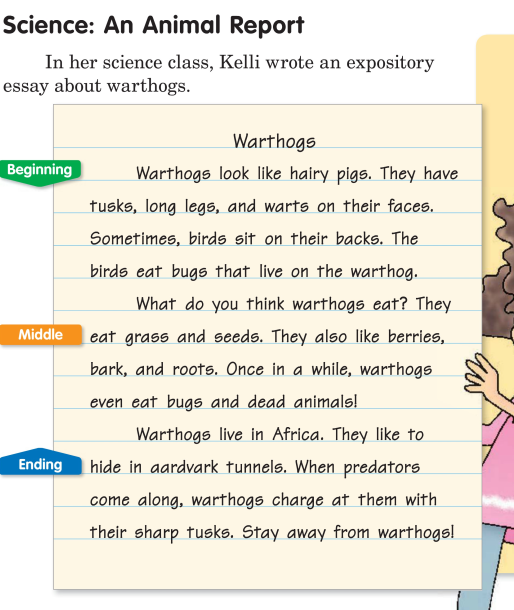
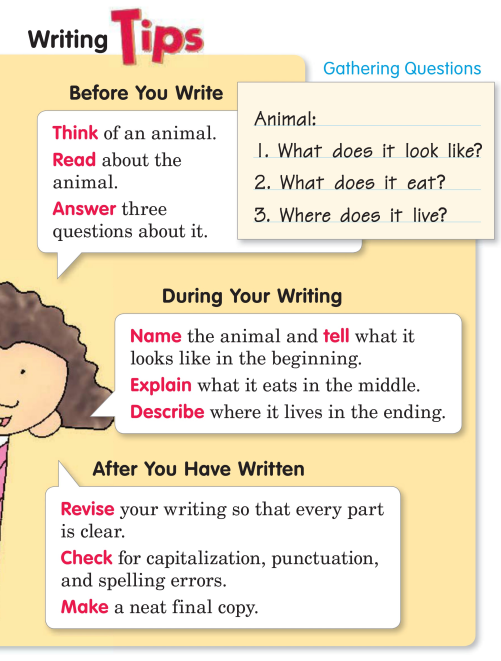
Make your writing easy to follow. Your writing has a beginning, a middle and an ending.
Sound like you are really interested in your topic.
Choose your words carefully. Use specific words that make your writing clear and fun to read.
Use different lengths of sentences.
Follow the rules for writing. Capitalization, punctuation, and spelling.
Connecting the Process and the Traits:
Prewrite: Ideas (Choose a topic and details), organization (Put your details in order) and voice (Plan how to show interest in the topic).
Write: Ideas (Put your ideas on paper), organization (Make your ideas easy to follow) and voice (Sound interested in your topic).
Revise: Ideas (Change any ideas that could be clearer), organization (Change or move parts that seem out of order), voice (Change parts that don’t show interest), word choice (Change words to be clear and specific), and sentence fluency (change setences to short and long).
Edit: Conventions (Check capitalization, punctuation, and spelling).
A Rubric.

Portfolio: Collect ideas for new stories and poems, keep pictures and drawings you like, store unfinished writing to work on later (This blog is my portfolio and notebook, lol), and save final copies to read later.
Show case portfolio: You show your best writing, your teacher will help you decide which writing to include.
Growth portfolio: You save writing frim different times of the year. You will be surprised how your writing improves.
Descriptive Writing
Describe a person:
The topic sentence tells who the paragraph is about.
The body sentences describe what the person looks like (and sounds like) and what she or he does (or what she or he likes to do).
The closing sentence tells how the writer feels about the person.
A sensory word list is very useful to gather details.
Narrative Writing
A time line shows events in time order.
A narrative is a story.
An experience is something that you do.
Describe an experience at the zoo:
The topic sentence tells the main idea of the paragraph.
The body sentences tell what happened.
The closing sentence gives the reader something.
When review your first draft, make sure you included a beginning, a middle, and an ending. Besides, make sure that your sentences were in the best order.
Expository Writing
Directions tell how to do something.
Reports, recipes, and invitations are examples of expository writing.
Explain a how-to topic:
The topic sentence introduces the topic. The first paragraph names the topic and tells the readers what supplies are needed. There are two ways to introduce your topic:
Ask a question: Would you like to grow a flower?
Make a statement: I can teach you how to grow a flower.
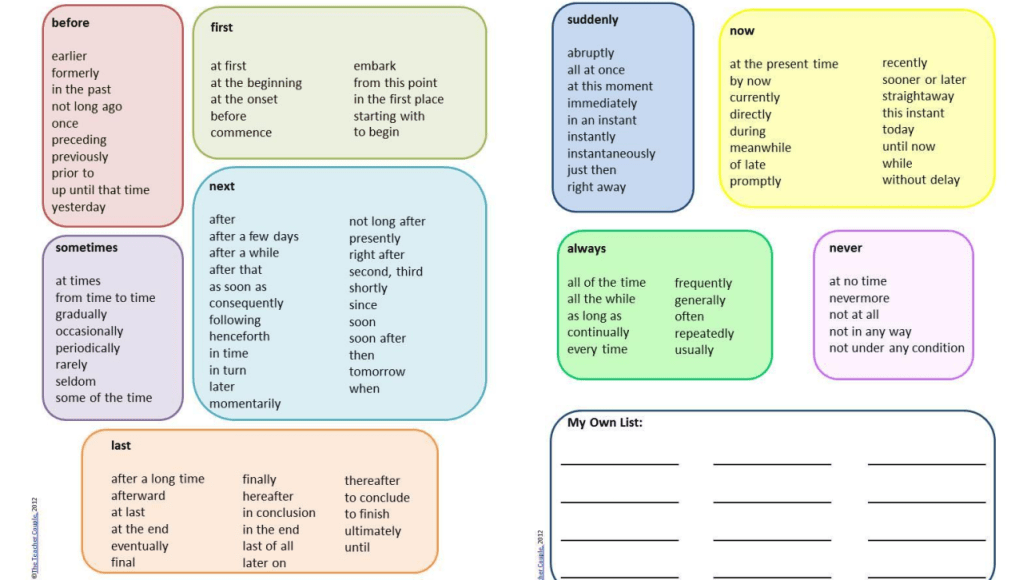
The body sentences give step-by-step directions. Be sure to use time-order words to make the steps easy to follow.
The closing sentence restates the main idea. There are also two ways to start this paragraph:
Tell why you like the activity: I like growing flowers because they are pretty.
Tell why others might like this activity: Growing flowers is a colorful hobby.
Improve your voice when revise: reread your first draft to be sure that you sound confident and excited about your topic.
Persuasive Writing
If a fact supports a statement, it helps show that the statement is true.
A persuasive paragraph:
Your persuasive paragraph must contain a topic sentence, body sentences and a closing sentence.
The topic sentence states your opinion. You must select a strong topic first. You should then state your opinion or main feeling about your topic This statement will be your topic sentence.
Beginning with the words you should is a good way to start.
The body sentences give two or three reasons for your opinion. List the reasons for your opinion and choose the most important reason and circled it. State your most important reason last. Be sure that you sound convincing in your paragraph.
The closing snetences tells the reader what action to take.
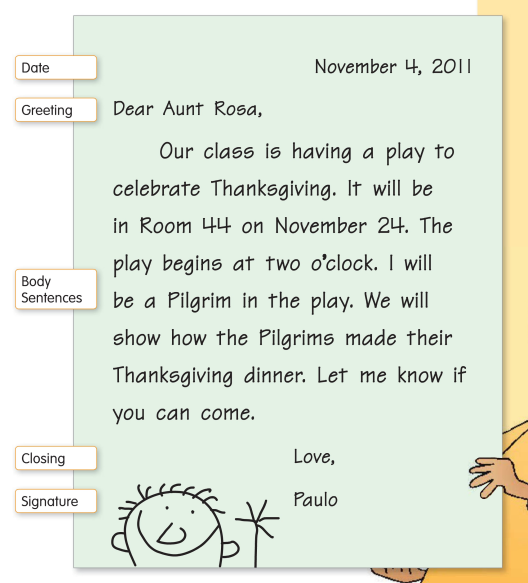
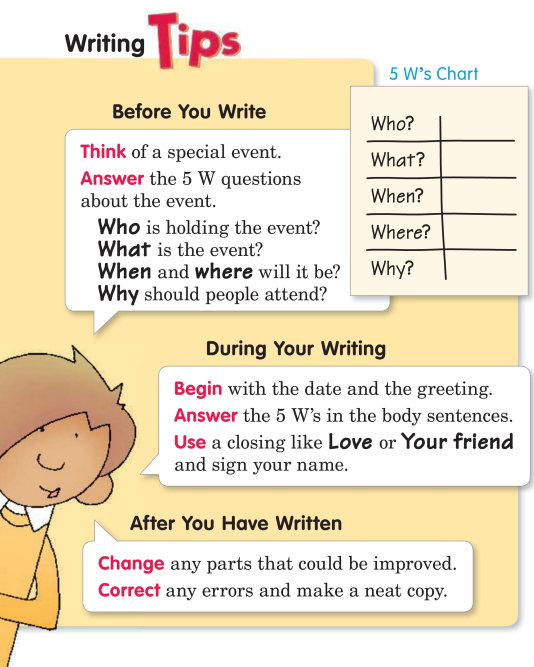
Persuasive letter : Date, greeting, body, closing, signature.
Start the beginning paragraph with your opinion. Then add one or two details about the topic.
Explain your reasons in the middle paragraph. Put your most important reason last. Make sure all the ideas that sound polite and serious enough.
In the ending paragraph, add an interesting detail and ask the reader to dosomething.
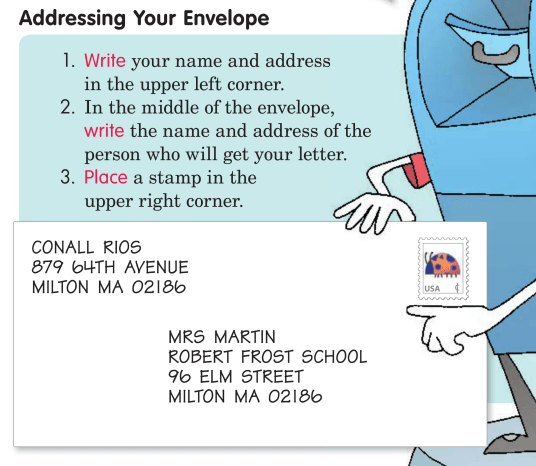
To send your letter, fold it neatly into three parts. Then put it into an envelope. Remember: The U.S. Postal Service asks that you use all capital letters and no punctuation when addressing your envelope.
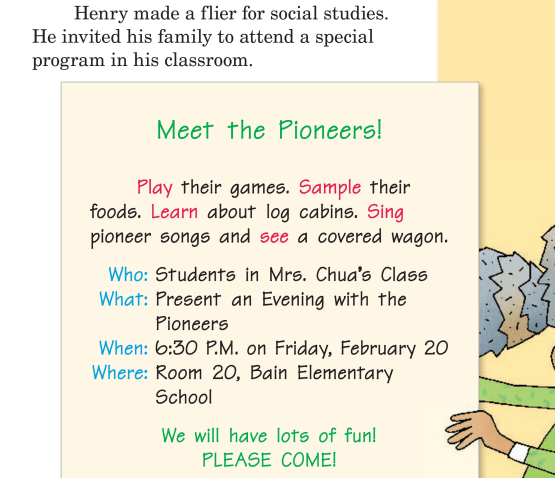
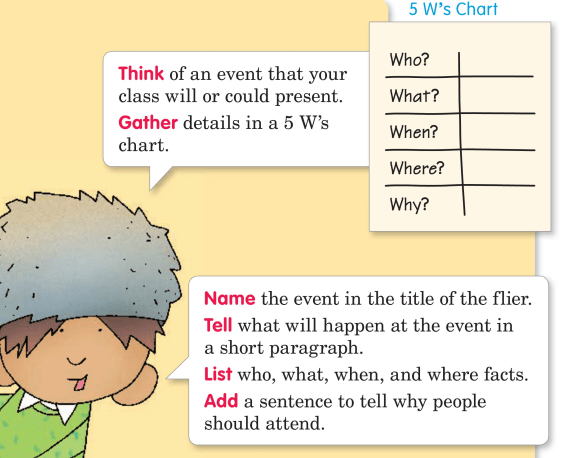
Make a flier
Responding to Literature
Reviewing a fiction Book
The topic sentence names the character, the book and the author. Like “I am like ___ in the book ___ by___.” You need to gather details and fill in 5W’s chart. Tell how you are like one of the characters and use an example from the story to show this.
5W’s chart: Who? What? When? Where? Why?
The body sentences tell how the write is like the character. Share the details in time order.
The closing sentence shares one last idea. Thought about why you like the book and decide the readers would like it for the same reason.
Underline the book’s title.
Reviewing a Nonfiction Book
In the beginning paragraph, answer the question: What is the book about?
In the middle paragraph, answer the question: What facts do I think are most interesting?
In the ending paragraph, answer the question: Which is my favorite part? Why?
Underline the book’s title.
Compare Fiction
Reviewing two books by one of your favorite authors to compare.
Use a Venn diagram to gather details to show how your books are alike and different.
Tell the book you prefer and reasons.
Responding to a poem
Chose a poem and gather details.
The poem “____” is about ____.
My favorite simile is”_______.”
I think the poet wrote the poem because ______.
Creative Writing
A character is a person in a story or play. Stage direction tell actors what to do. A storyboard is a set of pictures that show the parts of a story in order. Every story has four special parts: characters, setting, problem, and plot.
More elements:
Action: The action is what happens in a story.
Character: A character is a person or an animal in a story.
Dialogue: Dialogue is what characters say to each other.
Fiction: Fiction is a mide-up story.
Moral: A moral is the lesson that a story teaches.
Plot: The plot is what happens.
Problem: The problem is the trouble in a story.
Setting: The setting is the time and place of a story.
Theme: The theme is the main idea or message in a story.
Writing Add-On Stories
Think of a main character (who) , a problem (what) , and a setting (where and when) for your add-on story. First, think about characters would try to help the main character. Then choose three characters to help the main character. Next, make a story grid and list your characters and what they did.
Review the story question chart and story grid. In the beginning paragraph, set up your story by naming the main character, the problem and the setting. This paragraph should sound interesting or exciting so that readers want to read on.
In the middle part, you develop the plot or action of your add-on story. To do this, show how each new character tries to help the main character. Use specific action verbs like strentched and hissed and dialogue to make this part fun to read. You could write about each new character in a different paragraph to make your story easy to follow.
In the ending part, you should tell how your main character feels when the problem is finally solved.
Creating a Play
Dialogue is what the characters say. Stage Directions in parentheses “()” tell what the characters do and feel.
To get started, select a topic that you would like to turn into a play. Think about the characters you will include. Also think about setting of your play. Then, think of the important events that happen in the play. Making a storyboard to help you plan the different actions and dialogue in your play with the time-order words first, next, then, and last.
In the beginning part, name the characters and the setting of your play. Also tell what is happening as the play starts.
In the middle part, you tell your story by having the characters talk to each other. You also include stage directions when they are needed. The characters tell the story, so their words are the most important part of my play.
In the ending of your play, have the main character say one last important thing.
Using the questions below as a revising guide:
Does your beginning tell what is happening as the play starts?
In the middle, did you write each character’s name before her or his words?
Did you have the main character say something important in the ending?
Performing a play:
Select a classmate for each character and for a narrator.
Give each team member a copy of the play and decide who gets each part.
Practice reading the play and following the stage directions.
Perform the play by reading it to your audience. Follow the stage directions as you go.
Writing Rhyming Poems
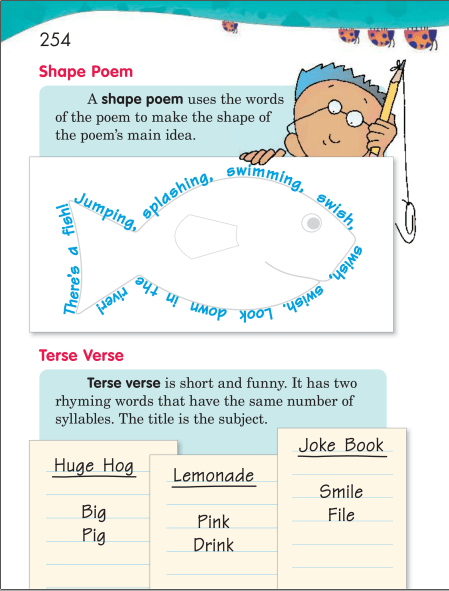
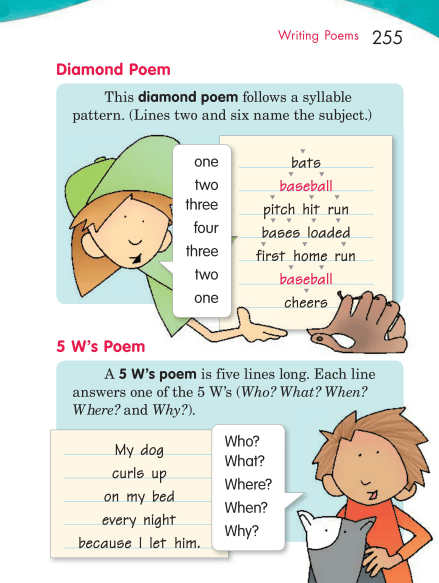
Poems come in all shapes and sizes. Some poems rhyme. Some poems follow a certain shape. Other poems even follow the alphabet!
Writing a rhyming poem can be fun. First, Draw pictures of activities you enjoy as a topic. State the topic for you poem in a sentence. Gather details aboutthe sights and sounds related to the activity. Then write sentences about the topic for different sensory words.
Before you write your first draft, you should think of rhyming words that you can use in your poem. Choose special words from your sensory chart. Write them across the top of your paper. Then list words that rhyme with each special words.
Use rhyming words at the end of each pair of lines. Make sure that your poem is fun to read. Each pair of lines should sound good together.
Revising your poem and answer these questions:
Did you write about one activity?
Did you make each pair of lines rhyme?
Did you include close to the same number of words for each set of rhyming lines?
Then check for conventions.
Creating a Name Poem
A name poem uses the letters in a name to make a list poem. Write your name across the top of a piece of paper. List three or more describing words for each letter.
To write your name poem, use describing words from your list. Try to use close to the same number of words in each line.
Sean’s Name Poem:
Speaks Spanish
Explores the beach
Amigo to everyone
Nickname is Champ
ABC Poem
Amazing
Bubbles
Can
Dance
Everywhere
Tongue Twister
Wet weather brings wonderful worms who wiggle wildly.Wow.
Report Writing
A reference is a book or other source that is used to find information.
A presentation is a showing that often uses slides or video.
Periodicals: This is where you will find magazines and newspapers.
Computer or Card Catalog: This section tells you the titles of every book in the bilrary!
Media Section: This area has CD’s. DVD’s and computers.
To find a nonfiction book, carefully write down the call number from the catalog. Every book has a title, an author and a subject card.
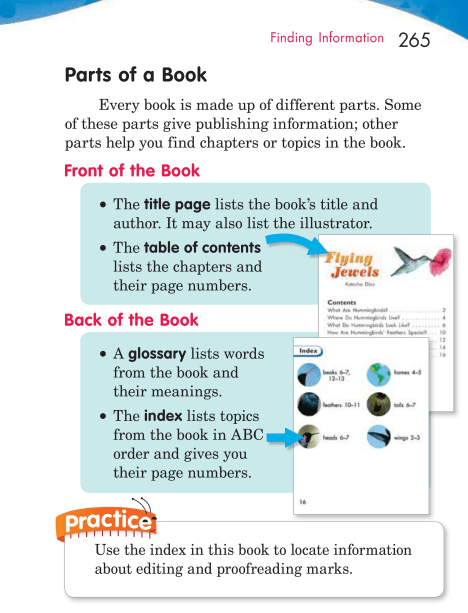
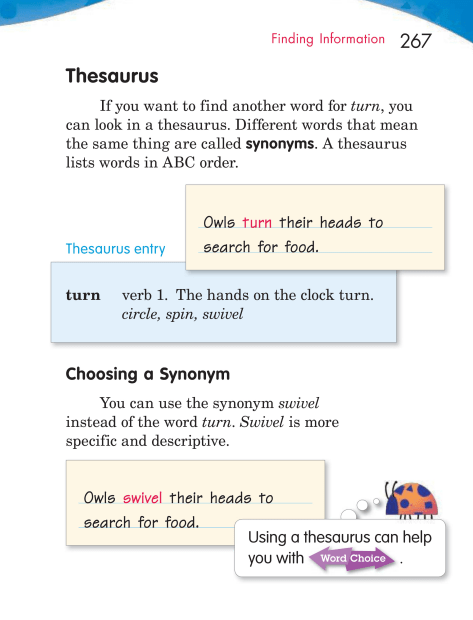
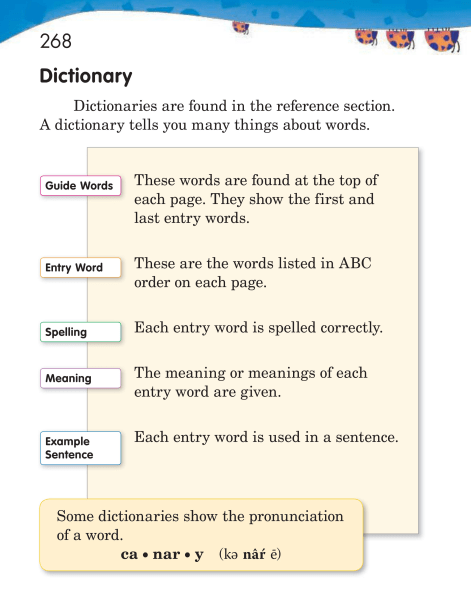
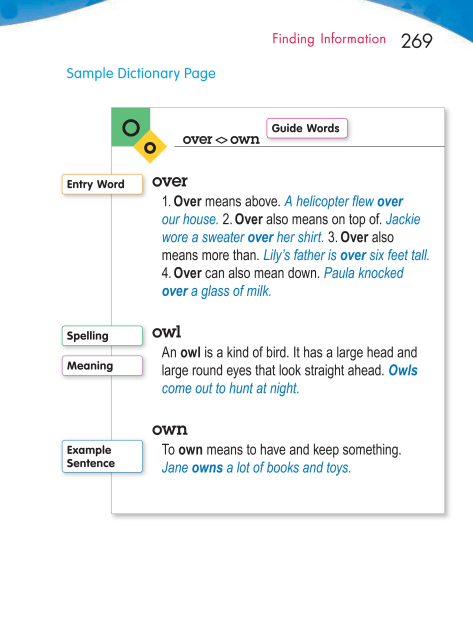
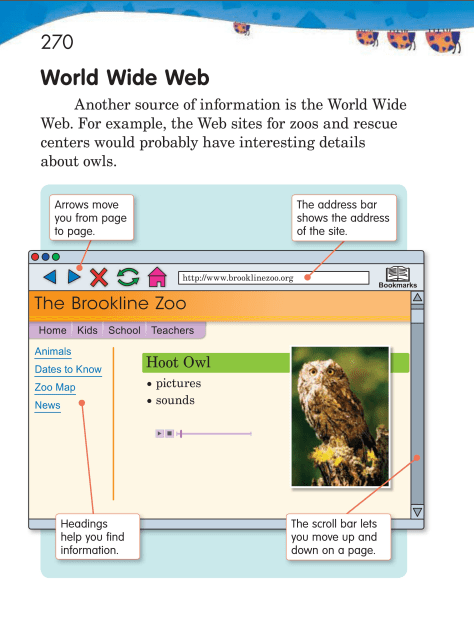
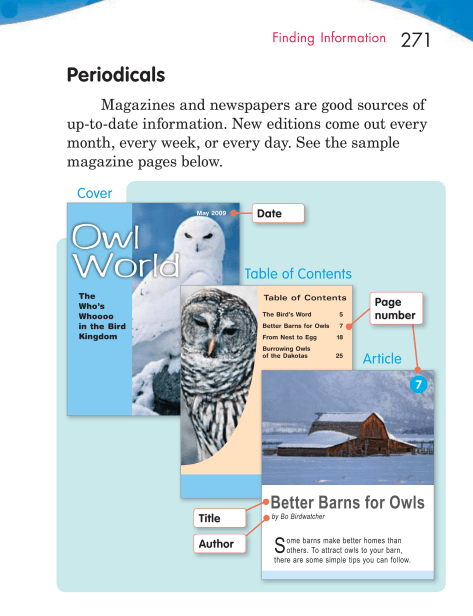
To write a report, you need to choose a topic first. You might brainstormed about different birds in class, and you decided to write about hummingbirds. The next step is finding sources from books, magazine or the Internet. Make a list of sources, like the list.
To gather details, you need to make a gathering grid. Fold a large sheet of paper into several squares and write a heading in each. Then list facts under each heading:
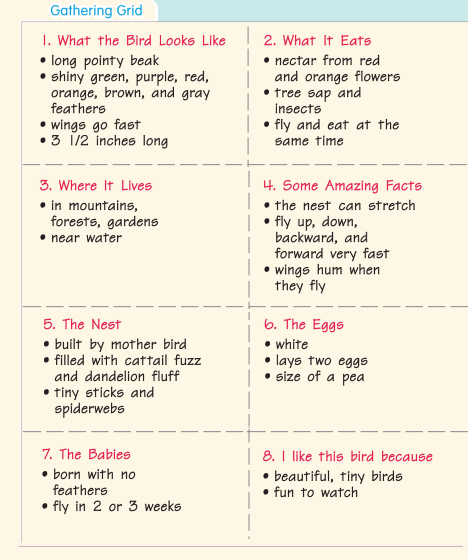
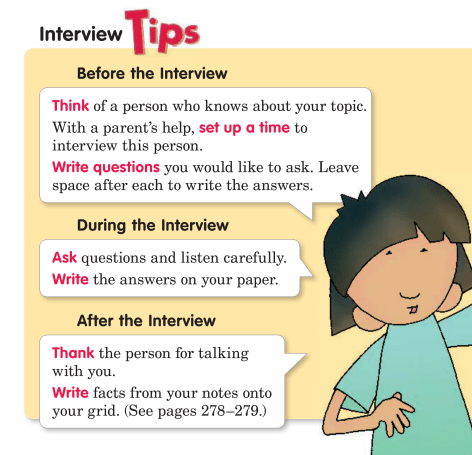
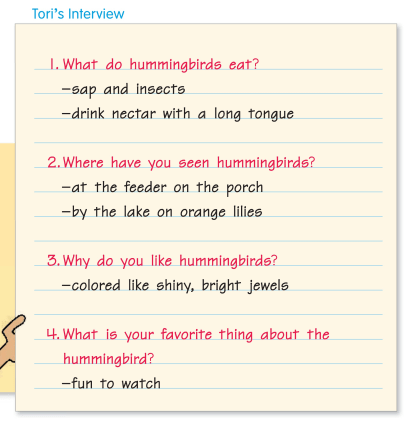
The beginning part of a report should get the reader’s interest and introduce your topic. You can start your first paragraph with an interesting idea. Then use two amazingfacts from your grid to support the first sentence. Your goal was to make your topic sound really interesting.
State an interesting idea: A(n)________ is an amazing bird.
Share a personal feeling: I like the ______ because ______.
Ask a question: Do you know about the _______________?
The middle paragraphs should explain and describe your topic. First, make groups of main ideas from your grid and put them in order. Then write your paragraphs. Write about a different main idea in each paragraph from your grid.
The ending paragrah should bring your report to a close. Review your ideas from the grid for any amazing details that haven’t used. Started the final paragraph with one of these ideas and finish your paragraph by telling why you like humming birds.
Make sure your report include one main idea in each paragraph, and use short and long sentences.
Creating a title by naming your topic, describing your topic or using creative descripitive words.
Preparing a Slide Show
Plan your slide show carefully and gather a lot of ideas. Make a slide grid. Write the main ideas for each slide. Add ideas for pictures, sounds and actions. Next, make a story board for your presentation. Using your grid for ideas.
Make an index card for each slide. Write what you will say while showing each slide. Use a computer program to make your slides. Include pictures and sounds.
Improve your presentation: Did you include all the important ideas? Did you put the slides in the right order?
Check for conventions and publish (give your presentation).
Giving speeches
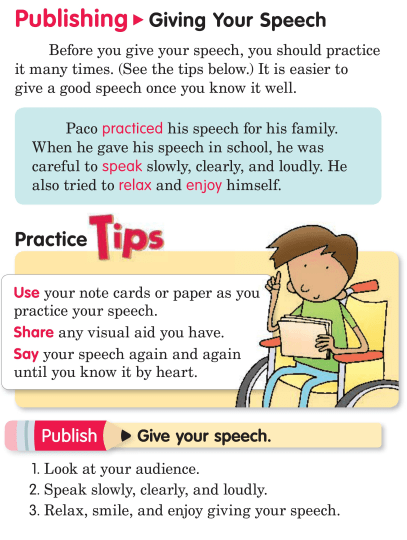
Choose a topic in different ways. You need to know why you are giving a speech. This is called “Knowing your purpose.”
Tell about something you like to do.
Tell about something you learned.
Change a report you wrote into a speech.
Gather details. You can turn a report into a speech, or make a speech about a new topic.
Organize your detais. At the beginning, name your topic and get the listener’s attention. Then, share the main facts about the topic. In the end, tell why the topic is important.



Leave a comment