The Writing Process.
A trait is a quality that someone or something has.
The writing process: Prewrite, write, revise, edit, publish.
Prewriting: Select a topic that tryly interests you. Gather details about the topic. Plan what you want to say.
Writing a first draft: Introduce your topic. Get all your ideas on paper.
Revising: Read over your first draft. Share your draft with another person. Make changes to improve your writing.
Editing and Proofreading: Check your spelling, capitalization, and punctuation. Write a neat final copy of your work. Check one last time for errors.
Publishing: Share your writing. Display it in class.
Do you know what can happen if you write too fast? You might leave out some important ideas or you might put ideas in the wrong order. Then again, you might use boring words. You might even forget to put periods at the end of your sentences!
The writing process gives you time to fix them, It gives you time to make each writing trait – and each part of your writing – the best it can be.
Six writing traits of good writing: Ideas, organization, voice, word choice, sentence fluency, conventions. Writing can be judged with a rubric. A rubric is a chart of the traits of good writing.Each trait of your writing can be scored.
A 6 is the highest score, and a 1 is the lowest score. For example, if the ideas in your essay are strong, you would get a 5 for ideas. The traits of writing are very important in the writing process. For example, in prewriting, you are focusing on your ideas.
Publishing your writing: Print it! Send it! Submit it! Post it! Act it out!
A personal portfolio is helpful! You can use three folders for: Collecting ideas for new stories and poems, storing writing that you are still changing and saving the final copies of your writing.
Your teacher may ask you to make a classroom portfolio. There are two main types of classroom portfolios: a showcase portfolio and a growth porfolio. In a showcase portfolio, you show your best writing. You choose writing you really like. You pick a piece you worked hard on. You select something that shares your feelings and include writing that you’re proud of. In a growth portfolio, you save writing that helps you and your teacher see how you are growing as a writer. Here are some of the skills you’ll want to keep track of: Using specific details, organizing your ideas and writing clear sentences. Your teacher may ask you to introduce each piece of writing in your potfolio. You can say why you like the piece or where you got the idea for it.
Descriptive Writing.
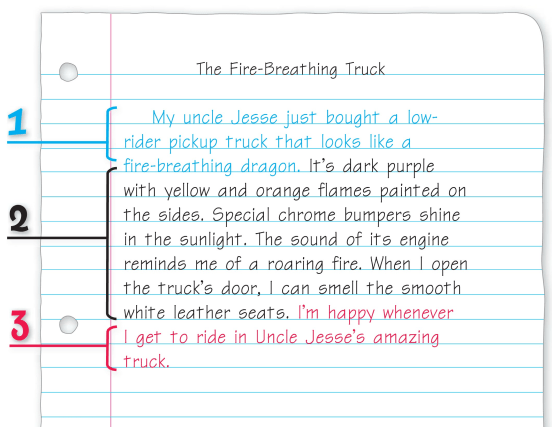
Your topic sentence tells the reader what you will describe. The body sentences use sensory details to help the reader see that you are describing. The closing sentence lets the reader know how you feel about your topic.
Cut any detail that doesn’t belong.
Your goal is to…
Idea: Describe an object so that your reader can imagine it.
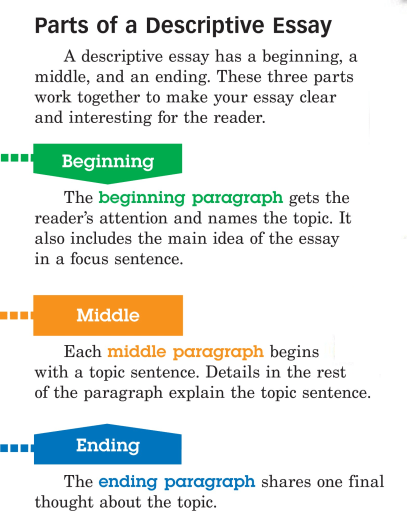
Organization: Creat a strong beginning, middle, and ending.
Voice: Use a voice that shows you are excited about the object.
Word Choice: Choose nouns and adjectives that let the reader picture your object.
Sentence Fluency: Write complete sentences that flow smoothly.
Conventions: Use correct capitalization, punctuation, spelling, and grammar.
Prewriting: Selecting a Topic
Write “Special Objects” on the top of a piece of paper.
List things that are special to you.
Mark (*) the one that you would like to write about.
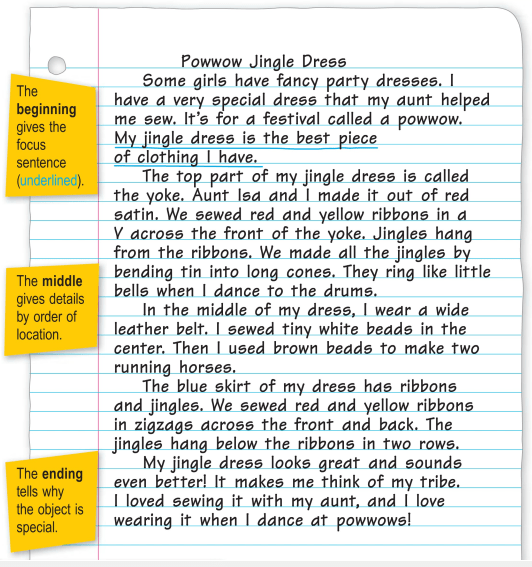
Write a focus sentence that name your special object and tells how you feel about it.
e.g. : My Baby Shark cup is very special to me.
Gathering Details: One way to gather details about your object is to draw a picture diagram. Label the parts of the picture and use words that tell about the color, shape, size, special details and maybe even sounds of your object.
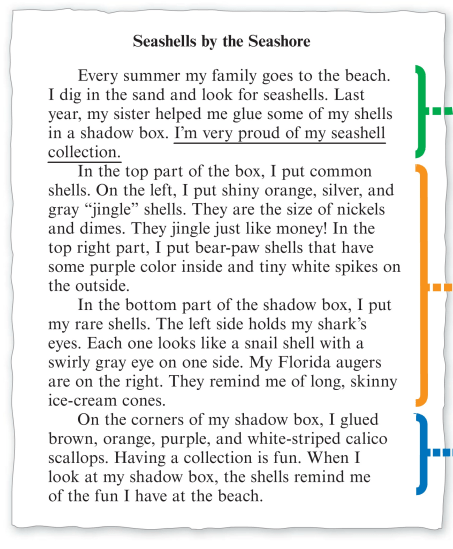
Beginning your essay: The beginning paragraph in your essay should get your reader’s attention. Then it should tell how you got the object. Finally you focos sentence should tell how you feel about your object.
You could try one of the “ABC’s og beginnings” shown below to get your reader’s attention.
Ask a question: Do you know what a _____is ?
Be creative with a riddle: I have something special that is _____. What is it?
Connect with the reader: Everyone has at least one special treasure. I have something that belonged to my grandma.
Developing the Middle: Each of your middle paragraphs should begin with a topic sentence and tell about a certain part of your topic. Use order of location by describing your topic in one of three ways shown below.
Choose one way to describe your object. (left to right, top to bottom, outside to inside.)
Look at your picture diagram again. Now write two topic sentences that describe the main parts of your object – the left and right parts, for example.
Write two body paragraphs by adding more sentences after each topic sentence. In clude details from your picture diagram to support each topic sentence.
Ending Your Essay: Your ending paragraph should give your reader one final thought about the topic. Here are some ways to create a strong ending.
Remind your reader about your beginning.
Show your feelings about your topic.
The special object to your life.
Revising: Add details, cut a detail, move details.
Editing: Checking for conventions.
Publishing: Carefully write a clean final copy and proofread it.
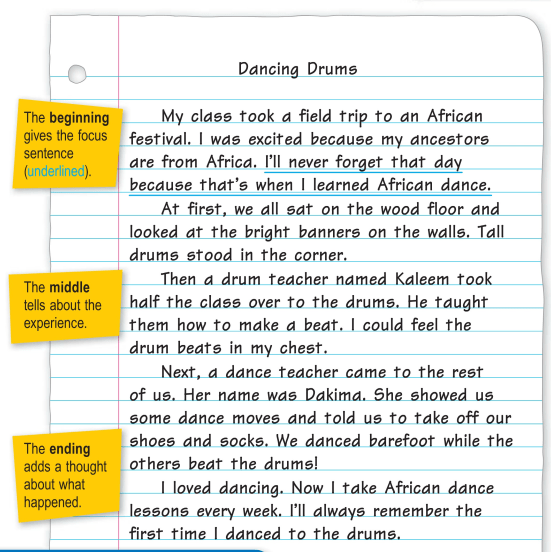
Narrative Writing.
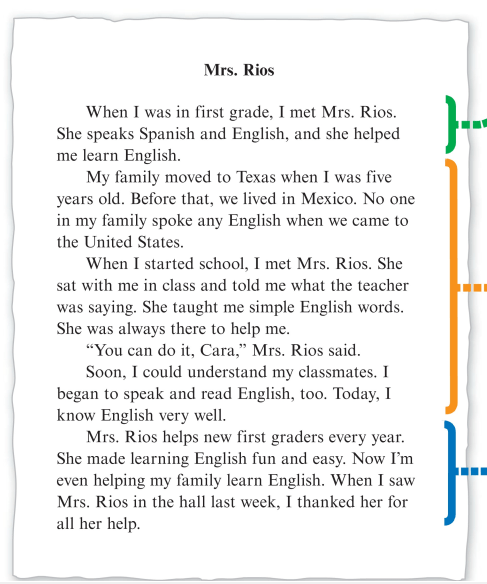
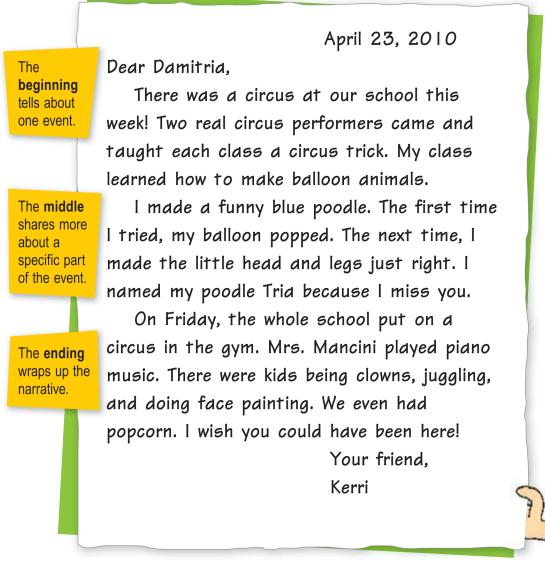
The top sentence tells the main idea of the paragraph. The body sentences tell more about the main event or topic of your paragraph. The closing sentence gives the reader something to think about.
Narratives come in all shapes and sizes. You can write a narrative in one sentence: “We went to the milwaukee Art Museum and saw the ballerina sculptures.” You can write a narrativee in a paragraph, or a narrative that includes many paragraphs.
Transition words (words that show time): first, second, next, then, soon, later, as soon as, finally, after, before, tomorrow, suddenly….
Your goal is to…
Ideas: Use intersting details to write about a helpful person.
Organization: Put the parts of your essay in an order that makes sense.
Voice: Write as if you are talking to a classmate.
Word Choice: Use action verbs to keep your story moving.
Sentence Fluency: Use a variety of sentence lengths.
Conventions: Check your capitalizaiton, punctuation, spelling, and grammar.
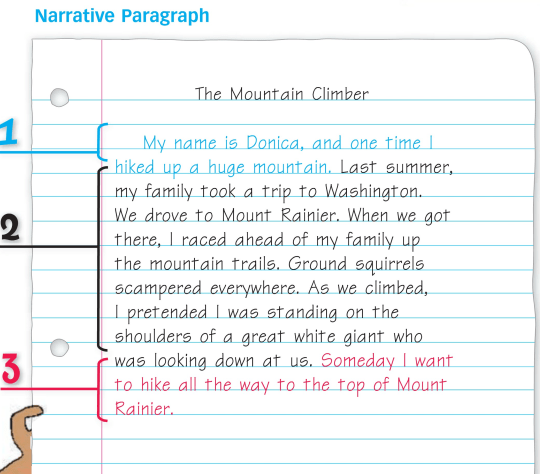
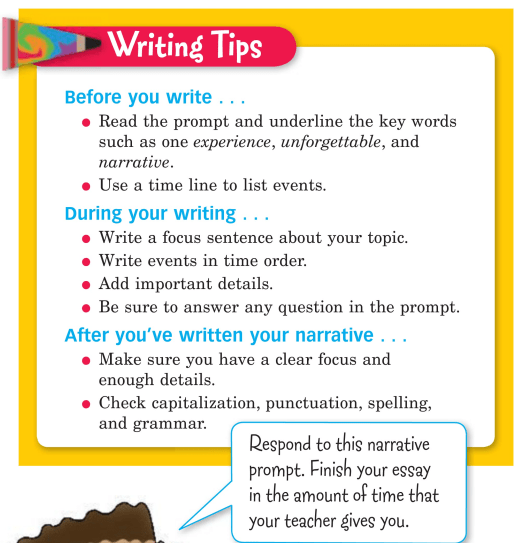
Prewriting: Finding an Idea. Use a gathering wheel to list the names of the persons.
On your own paper, make a wheel shape. Write the topic words in the center of the wheel. In the space around the center, write the names of people you will write about. Put a star (*) next to the person you want to write about.
Put your details in order. Narratives are organized by time. Use a time line can help you put your events in order. Draw an arrow going down the left side of your paper. Next to the arrow, write a few words about the details. Make sure to write down the events in the right order.
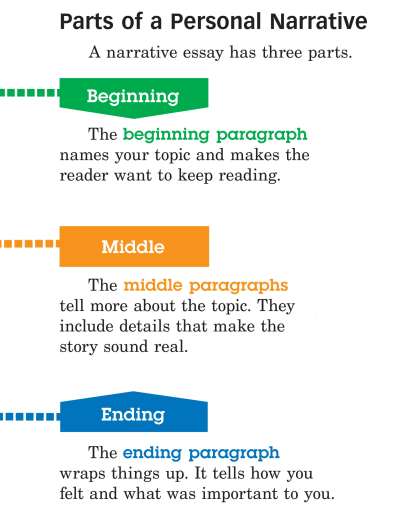
Beginning your Essay
Ask a question: Have you ever had a terrible day? On my terrible day. I ____.
Begin with someone talking: “Don’t worry.___” That’s what my friend ___ told me when I came home with my arm in a cast.
Connect with the reader by telling a little story: One day, I _______. My friend ___ was there to help me.
Developing the middle: Start in the middle of the action. Share your thoughts and feelings. Add dialogue.
Ending Your Essay:
Restate why the person’s help was important: Without ____, I don’t know what I would’ve done.
Share your feelings about the person: I’ll never forget what ___ did for me.
Talk with your reader: Have you ever needed help? That’s when you know how great it is to have a friend to help you.
Revising
Make sure your body sentence include an interesting detail about the topic: What you see and how you feel.
If you find a sentence that doesn’t fit the topic, cross it out.
If your sentences aren’t always in the order that the event happened, move your sentences around.
Use action verbs to keep your story going. Use a variety of sentence lengths.
Editing: Checking for conventions, especially homephones.
Expository Writing.
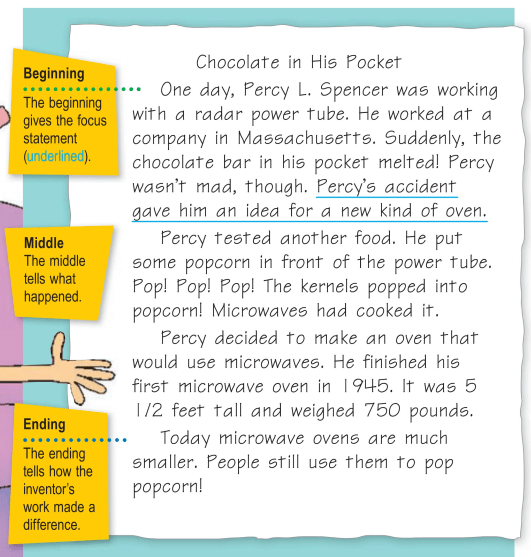
The world is full of questions. Writing that proides answers to these questions is called expository writing. Expository writing explains or informs. The topic sentence tells what the paragraph explains. The body sentences add details that help explain the topic sentence why or how. The closing sentence completes the explanation.
Your goal is to…
Ideas: Choose an interesting topic and explain it with details.
Organization: Put the parts of your essay in the right order.
Voice: Show your interest and excitement.
Word Choice: Use specific nouns to help make your ideas clear.
Sentence Fluency: Write complete sentences that are easy to read.
Conventions: Check your puntuation, capitalization,spelling, and grammar.
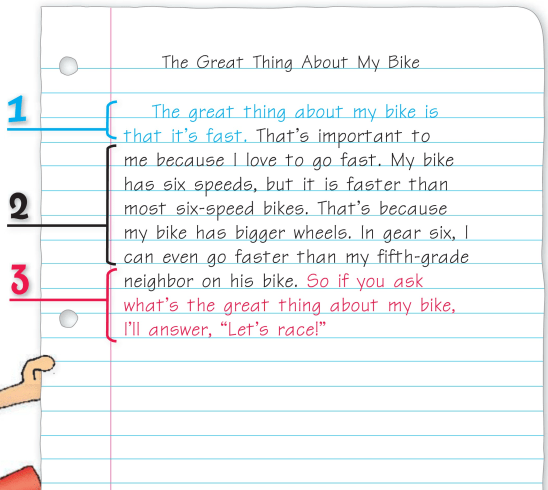
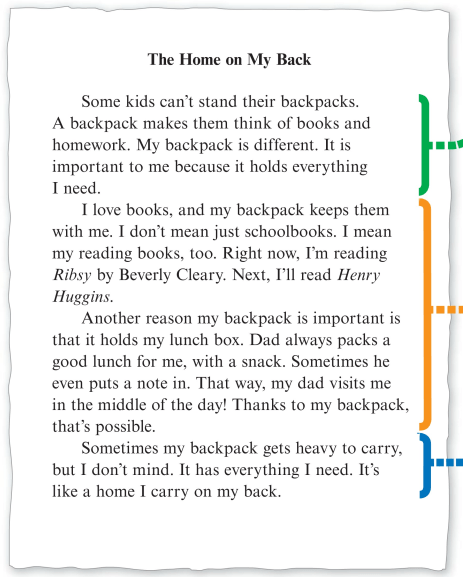
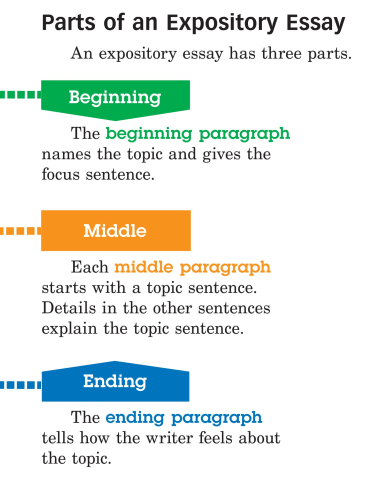
Prewriting: Select a topic by creating an ideas cluster (or a T-chart): Write “the important things” in the middle (or on the top) of your paper. Around it (below it), write the names of objects you like. Connect them. Put a star (*) next to the idea you want to write about.
Think about these questions: What is most important about your topic? Why is that important? How is that important? The first answer is your focus sentence. It tells what your essay will be about. The other two answers are the topic sentences for the body paragraphs. They will tell why and how about your topic.
Beginning Your Essay:
Ask a question: What could be better than an overnight with friends?
Be creative and tell a little story: At midnight, something tapped on the window, and I…
Connect with readers: When my sister___ had an overnight, I listened through the wall to the spooky stories she told.
Developing the Middle: Each middle paragraph starts with a topic sentence(Think about questions why and how). More sentences follow. Those sentences contain details to explain the topic sentence.
Ending Your Essay:
Return to your beginning idea: Now __ will have to listen to my spooky stories because my very first overnight will be next weekend.
Share something funny: I’m so excited about my over night. I can’t sleep.
Talk with your readers: If you’re like me, you’ve been dreaming about having an overnight.
Revising your Essay: Follow your writing goals. Especially use specific nouns to make your ideas clear. Here is ways you can show instead of tell.
Specific nouns:
tree — weeping willow
animal — manatee
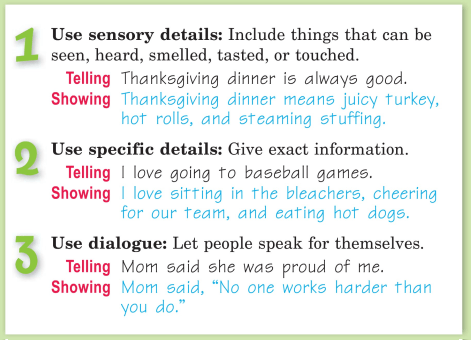
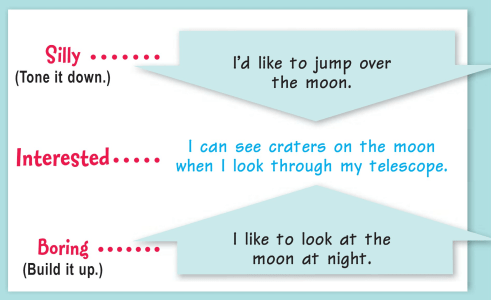
Check your ideas: Use a caret “^” to show where you want to add words or punctuation. Add dialogue if it adds information. Cut words that tell instead of show. Use a delete mark “__又” to show what you want to remove.
Check your organization: Add a paragraph mark ” ¶” beside each paragraph indent. Make a “*” next to your focus sentence in your beginning paragraph. Put a 🙂 next to the topic sentence in each middle paragraph.
Persuasive Writing (a letter).
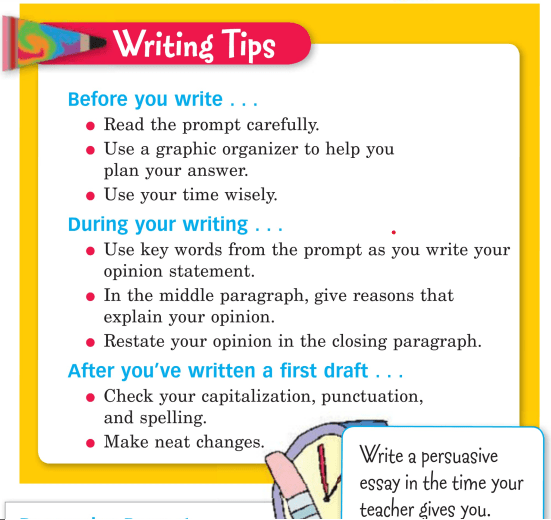
When you exagerate, you say something is greater or more extreme than it actually is.You goal is to convince your reader to agree with you, or even to take action. Writing that tries to convince is called persuasive writing. You can select a topic by create an ideas chart: Write “Supplies”, “Rules”, and “Full Stuff ” on your paper. Then list three things you need, Choose and put a star (*)next to the idea you want to write about.
The topic sentence states the topic (opinion). The body sentences give reasons to support the opinion. The closing sentence tells why the reader should agree.
An opinion is something you believe, think, or feel. A fact is something you can prove.
e.g. : We need a new seating order. (opinion) I can’t see the chalkboard. (fact)
Your goal is to…
Ideas: Convince the reader to agree with your opinion by sharing strong reasons.
Organization: Write a strong beginnning, middle, and ending.
Voice: Use a polite, convincing voice.
Word Choice: Use words like would and should to express your opinion.
Sentence Fluency: Write sentences that flow smoothly.
Conventions: Use correct capitalization, punctuation, spelling, and grammar.
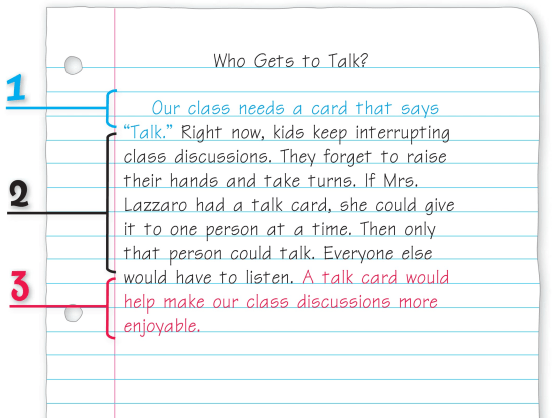
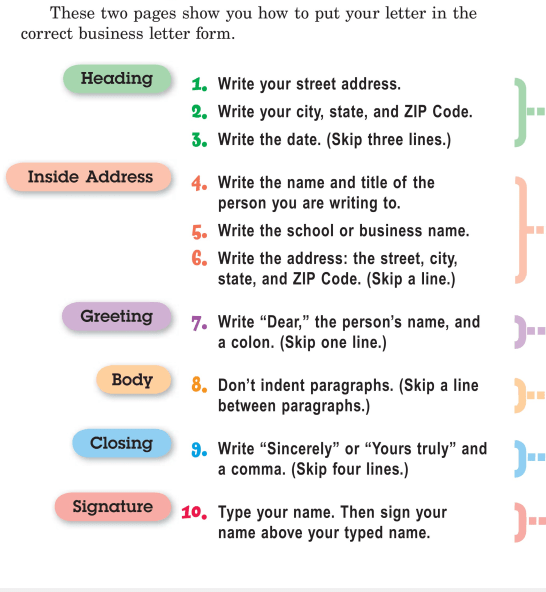
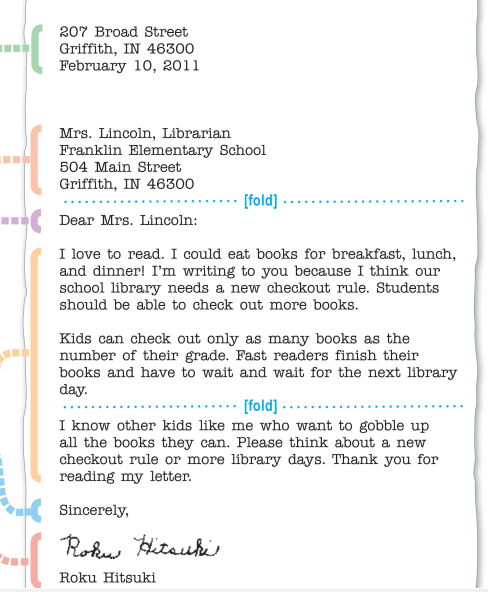
Prewriting: Selecting a Topic. Make a T-chart, fill the headings, list three or four ideas under each heading. Put a star (*) next to the idea you want to write about. Decide who should get your letter.
Write your opinion sentence: “I think _________needs (or should) ___________.”
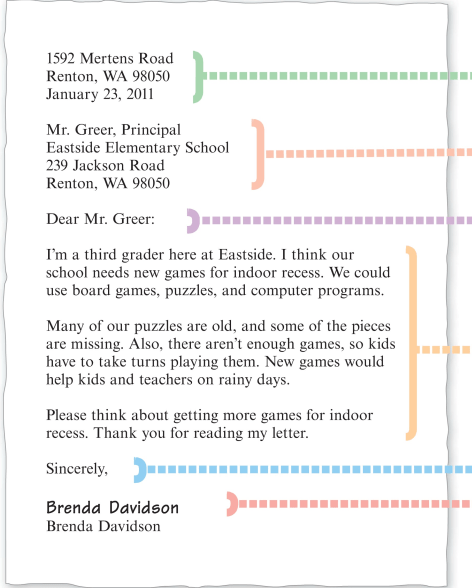
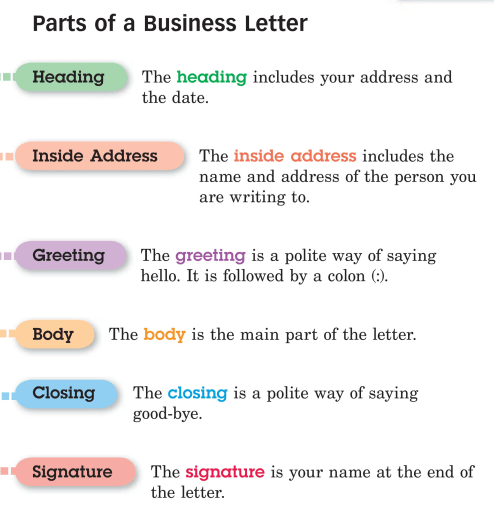
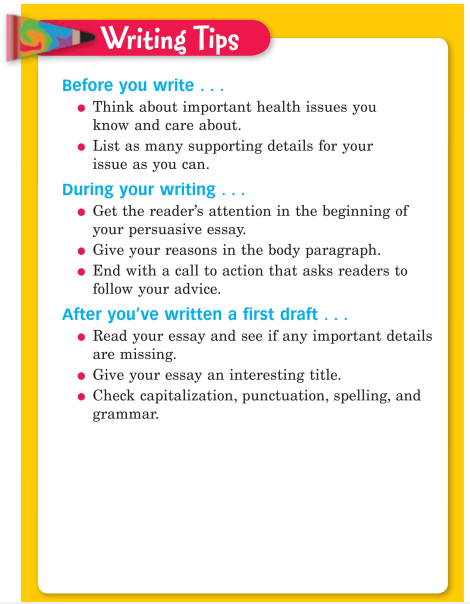
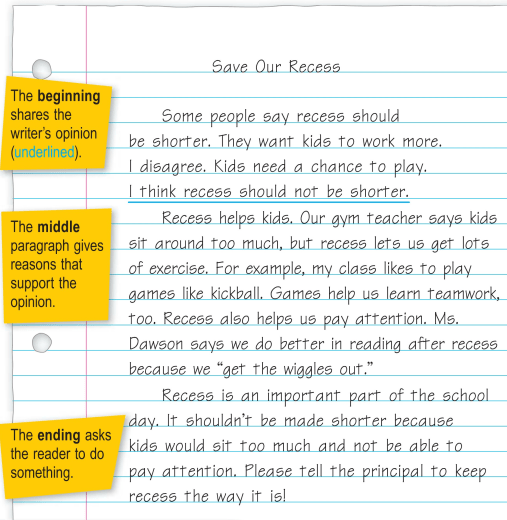
Writing: The beginning Paragraph should tell the reader who you are and what your opinion is. Remember to include your opinion sentence and write a sentence that tells a little more about you or your idea, The middle paragraph should give two or three reasons from your list you wrote that explain your opinion. The ending paragraph of persuasive letter has two jobs to do: It should politely ask the reader to do something. It should thank the reader for reading the letter.
Revising: your reasons are good if they answer the question why. You can make your voice convincing by being accurate. If you exaggerate, your reader may not believe you .
Convincing: Kids have to line up outside even if it’s really cold.
Exaggerate: Kids have to line up outside even it’s 50 degrees below zero!
Could (an acceptable choice): Teachers could remind us to walk in the hall.
Should (an acceptable choice): Teachers should be fair to us.
Must (NOT an acceptable choice): Teachers must make us obey class rules.
Short choppy sentence: The bus is crowded. It’s crowded with kids. —– The bus is crowded with kids.
Editing for conventions: Capitalize the first letter of the first word in each sentence. Capitalize the first letter of the names of people, places, streets, cities, and months. Capitalize both letters of a postal state abbreviation, such is IL for Illinois.
Publishing: Sending your letter.
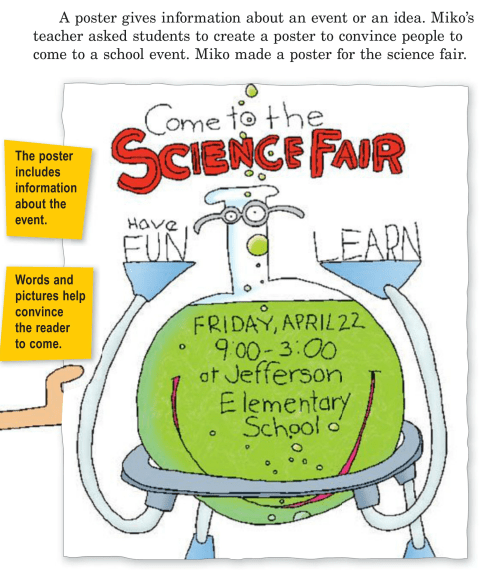
A Persuasive Poster:
A poster should give important information about the event:
What’s my event?
When does it hapen (date and time) ?
Where is it?
Who should attend?
Why should people come?
Response to Literature.
A book Review for Fiction
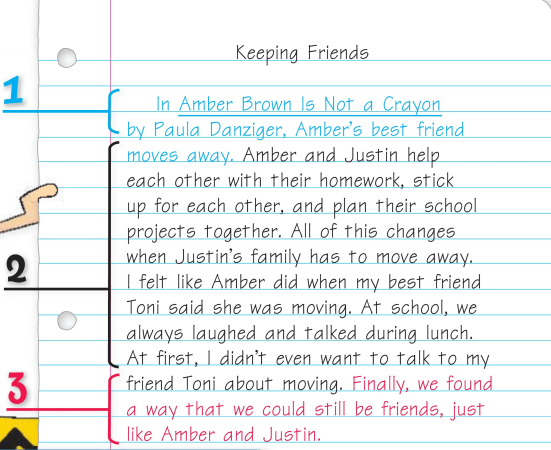
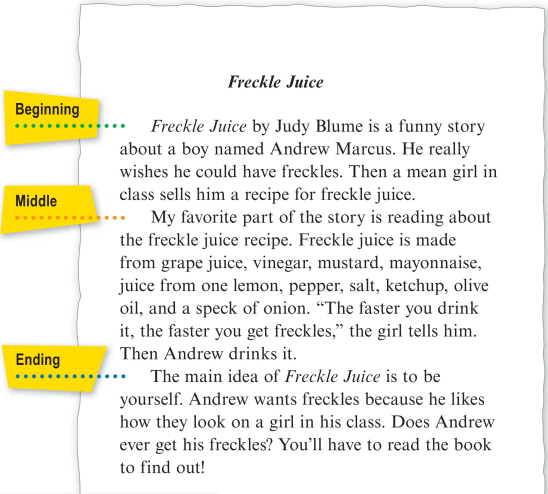
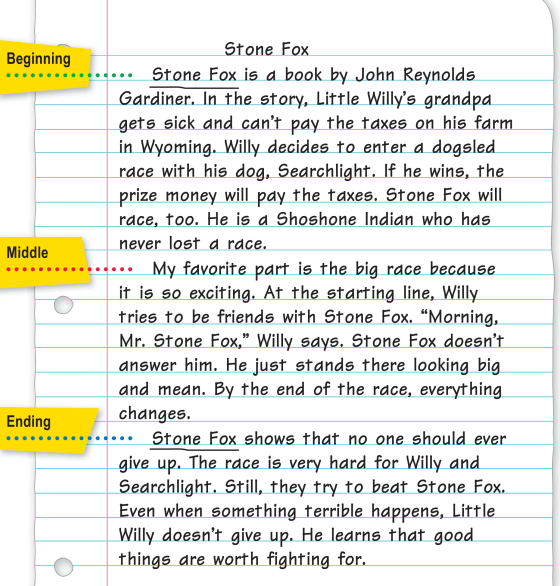
You may write a paragraph about a fiction book that you had read. You share with others how the story makes you think of your own life. You tell how a part of the story is like something that has happened to you. The topic sentence tell what the paragraph is about (title, author, main idea). The body sentences explain the topic sentence (how the story similar to your life, make a comparison). The closing sentence leaves the reader with one last idea about the topic.
Write a book review is one way to share a great book with your friends.Your goal is to make the book sound interesting or helpful. Write about events in correct time order.
Prewriting: Select a Book
Write down the titles and authors of two books you have read and complete these two sentence starters about each book. Put a star (*) next to the book you want to write about.
Sentence Starter: The story is about_______. I like this story because_______.
Make a story map and gather important details about your book.
Main Characters: ______ Setting: _____ Problem: _______ Most Important Events: ______
The first paragraph should name thebook and its author. It should also tell what the book is about. Leave out unimportant details. And don’t give away the most surprising parts of the book or the ending. Don’t spoil the story for your classmates or friends!
The middle paragraph should tell about your favorite part of the book and give your reasons why do you like it. Give more details about what important events happen in this part.
In the last paragraph, you tell about the main idea or theme of the story. One way to find a theme is to think about the big problem the main character faces. You can also ask yourself what the character in the story learns.
A Book Review for Nonfiction
A nonfiction book contains information or stories that are true.
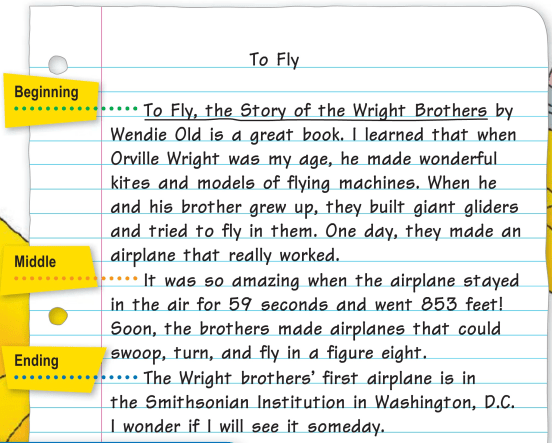
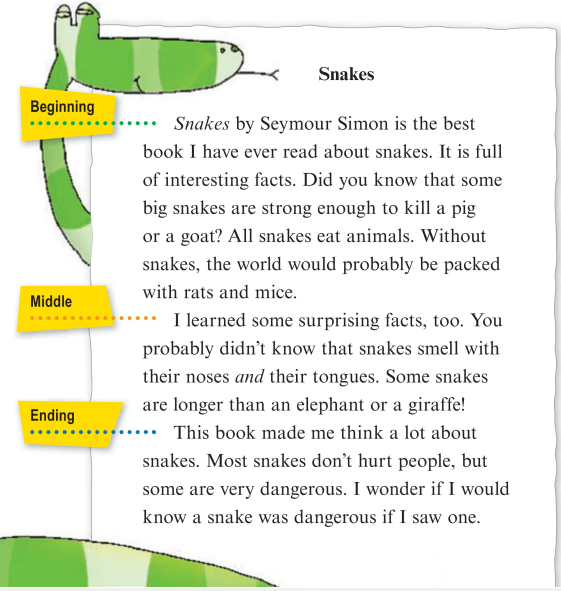
Prewriting: List three books and write down the title and author for each book. Write one sentence about the main idea of each book. Then put a star (*) next to the book you want to review. Then ask yourself these three questions about your book:
What important facts did I learn?
What surprising details did I discover?
What one thing do I still wonder about?
Write your first draft. In the beginning, answer what important facts did you learn. In the middle part, explain what surprising details did you discover? In the ending, tell what one thing do you still wonder about.
Comparing a Fiction and a Nonfiction Book
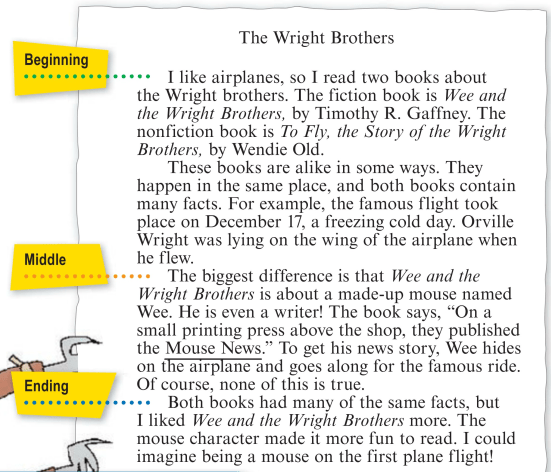
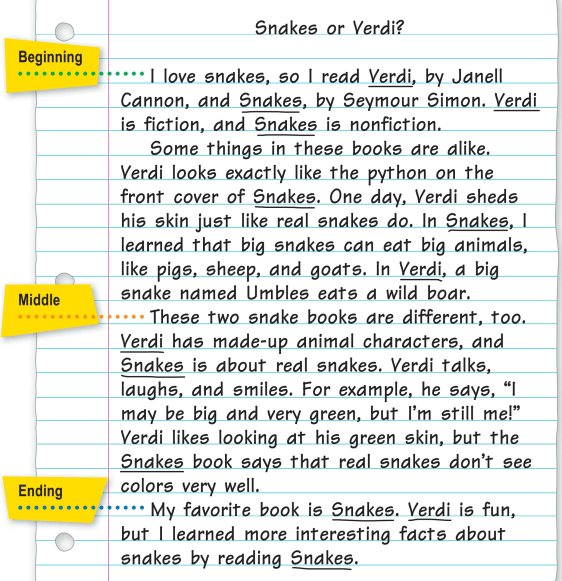
In the beginning, explains what two books are you comparing, who are the authors.
In the middle part, answer how are the books a like and how are they different. Draw a Venn diagram.
In the ending, answer which book do you like more.
Responding to a Poem
Poetry is a special kind of literature that describe an idea or a feeling.
Select a poem first. Next you need to gather information about your poem:
“TITTLE” BY AUTHOR
What kind of poem is it?
What are my favorite lines or words?
Why do I think the poet wrote this poem?
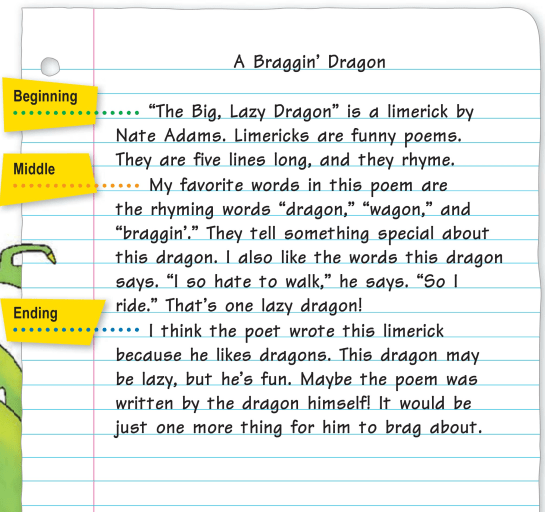
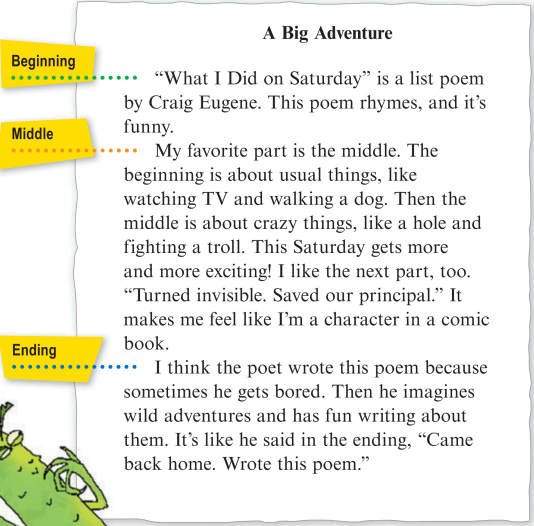
In the beginning paragraph, name the poem and its author. Explain what kind of poem it is.
In the middle paragraph, tell about your favorite words or lines in the poem.
In the ending paragraph, tell why you think the poet wrote the poem.
Creative Writing.
Creative writing is one way to dream things that never were and bring them into reality.
Writing a Story
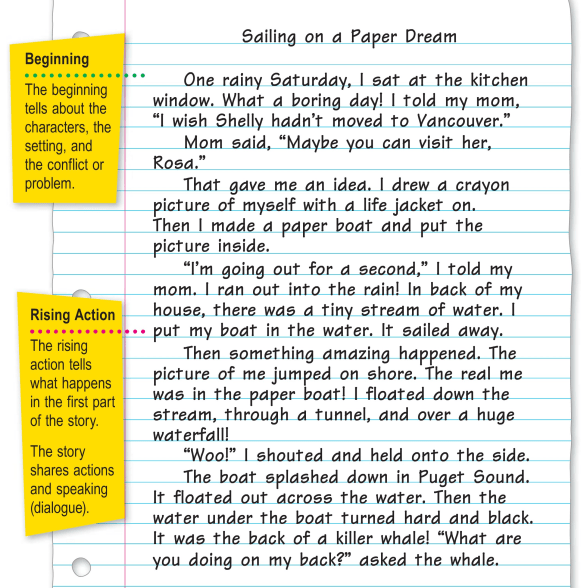
A story is born in the storyteller’s imagination. All stories have four basic ingredients: Characters, setting, conflict (a problem or challenge the characters face), and plot.
Prewriting: List places in one column and time in another column. Connect a place and a time with a line. Then think about these questions:
What big problem do I face?
What amazing thing do I do?
What else happens?
What’s goes wrong?
Write your first draft:
Start with action: Lighting flashed, and rain pounded on the roof. (GET STARTED)
Begin with someone talking: “Why did shelly have to move away?” I asked. (GET STARTED)
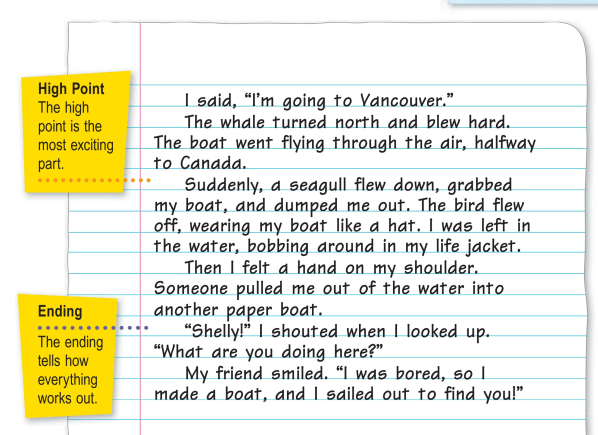
Introduce a new problem: Suddenly, a seagull flew down, grabbed my boat, and… (KEEP GOING)
Add a new twist: Someone pulled me out of the water…
Creat a Play (exemplars omited)
Elements of fiction: the action, characters, conflict (problem or challenge for the characters), dialogue, an event, fiction (an imaginative or made-up story), a moral, the narrator, the plot.
A plot line: The beginning introduces the characters, the setting, and the conflict. The rising action tells about problems that come up. It leads to the most exciting part of the story. The high point is the most exciting part of the story. The ending tells how things finally turn out.
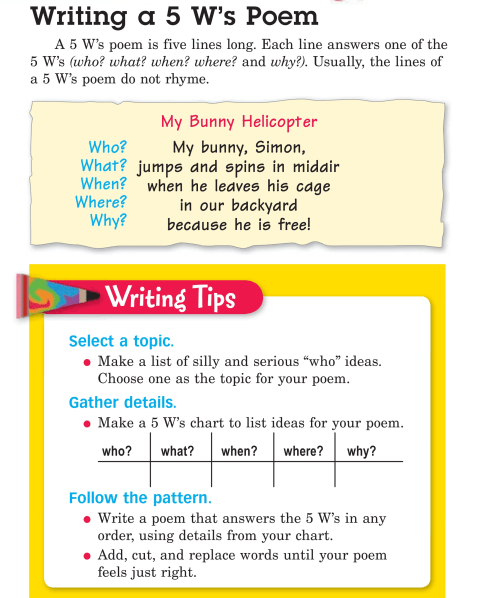
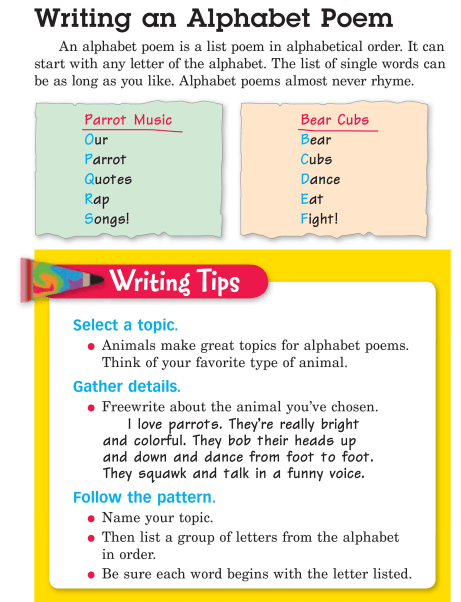
Writing Poems
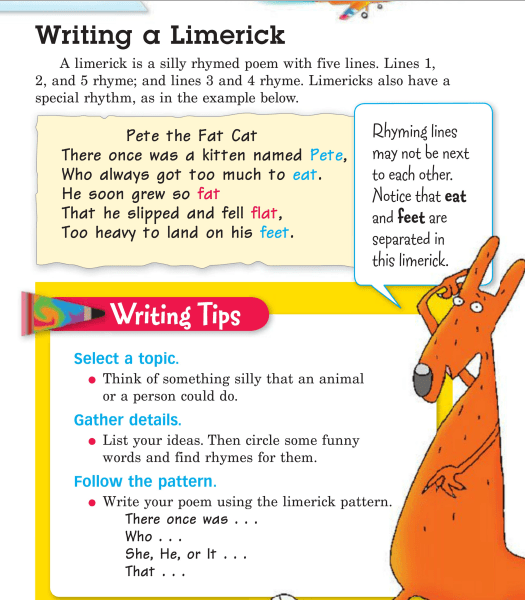
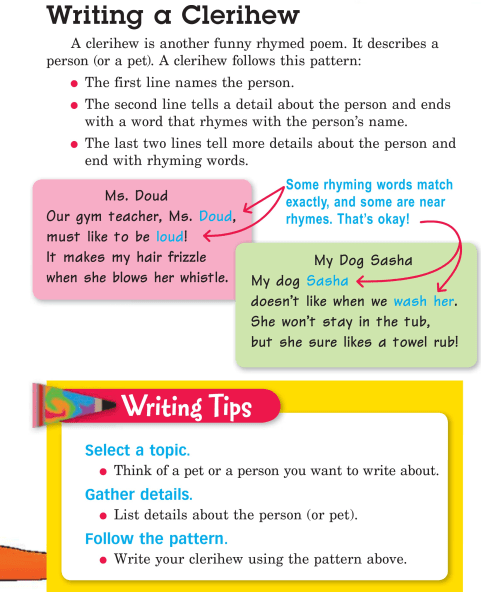
Some poems use pairs of rhyming words. Rhymes are fun to read and easy to remember.
Prewrite: Use T- chart to select a topic. Gathering details use sensory chart. Use different ways to make your writing sing!
Rhyme: use rhyming words at the end of lines: pig, wig; fun, sun.
Sound words: Sound like the noise they name. Using sound words is called onomatopoeia:
Buzz, buzz, hummed the bee.
Consonant sounds: begin or end with the same consonant sound. This is called alliteration:
Wind whispers through the willows.
Rhythm: Rhythm is the pattern of beats in a poem:
I bought my pig. A curly wig. Summer is fun. Give me the sun!
Getting started:
Close your eyes and picture whatever it is you are writing about. Jot down the words that come to mind.
Start with your favorite detail. Then write about your second favorite, and so on.
Use a starter phrase, like “When I see…” or “I like to…,” and keep going.
Revising: Add new lines or details to make your ideas clearer. Cut parts that don’t seem to fit the rest of your poem. Replace words to improve your poem’s rhythm and rhyme.
Editing: Creating a title. Use the first of last line. Use words from the poem. Describe the poem.
Reserch Writing.
An internet site is a place where you can find information on the computer.
Data is information about something.
If something is logical, it’s a reasonable or sensible thing to do.
An article is a piece of writing in a newspaper or magazine. The periodicals area has magazines and newspapers.
Writing a Sumarry Paragraph
When someone asks you about your day and what you did, you probably share only the most interesting details. That’s called summarizing.
Find a short article about an interesting subject you are studying.
Read the article carefully and write down the main idea and the most important details.
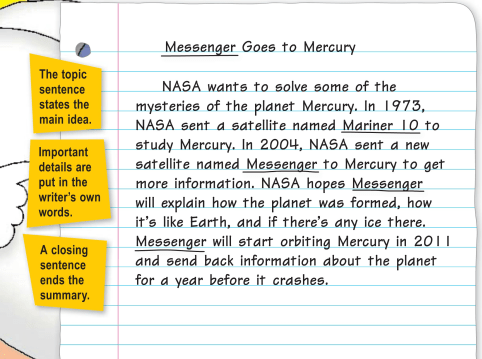
Tell the main idea of the article in the first sentence. In your own words, give the most important details in the body of your paragraph. Write the main idea in a new way in closing sentence.
Put your body sentences in a logical order.
Writing a Research Report (omited)
When you do research, you look for information about a topic that interests you. And when you write your report, you tell what you discovered.


Leave a comment