Basic Words
vise versa
submerse
demonstrates
contaminated
infer
determine
evaluate
promotional pamphlets: Regular newsletters and journals are published, as well as leaflets, pamphlets, books, and computer programs
bulletin board
a skin patch
dike: a barrier used to regulate or hold back water from a river, lake, or even the ocean
levee: a dike; a natural or artificial wall that blocks water from going where we don’t want it to go
limpkins: waterbirds
spiky: covered with spikes or having that appearance
lubricate: to apply some oily or greasy substance to (a machine, parts of a mechanism, etc.) in order to diminish friction
coil up: to curl oneself or something into a small, compact position.
constricts: to make narrow or draw together
strand: drive or leave (a boat, sailor, or sea creature) aground on a shore.
stackable: easily arranged in a stack.
yokes: (esp. in the past) a wooden bar fastened over the necks of two animals, esp. cattle, and connected to a vehicle or load that they are pulling.
entangle: to cause something to become caught in something such as a net or ropes.
rhinoceros: a very large, thick-skinned animal from Africa or Asia that has one or two horns on its nose.
excerpt: a short part taken from a speech, book, film, etc.
avocado tree
tangerine tree
walrus: a large gregarious marine mammal related to the eared seals, having two large downward-pointing tusks and found in the Arctic Ocean.
pry: to raise, move, or pull apart with a lever
New words
diarrhea
dehydrated
interpreting
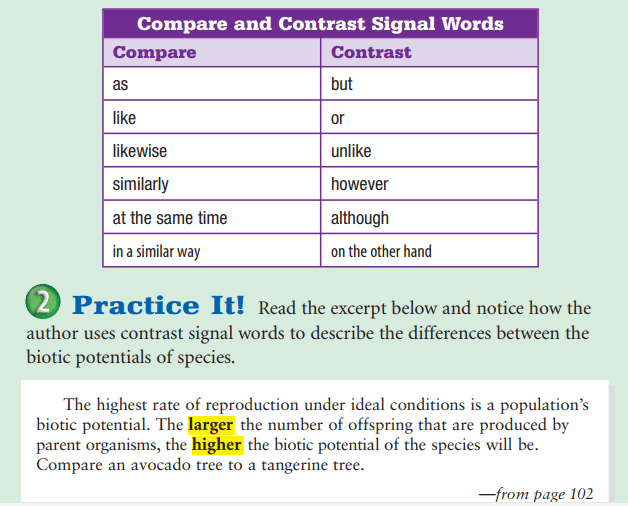
compare and contrasting: very different; differing strikingly
rinse out your beaker: to quickly wash the inside of something with clean water
pamphlets
hypothesis: an idea or explanation for something that is based on known facts but has not yet been proved.
constant: staying the same, or not getting less or more:
• independent variable
• dependent variable
tally your observations in your data table and graph your results.
interpret
2. Traits
germination: the growth of a plant contained within a seed; it results in the formation of the seedling
Fingertips: Loop, Arch, and whorl. Loops – prints that recurve back on themselves to form a loop shape. Whorls – form circular or spiral patterns, like tiny whirlpools. Arches – create a wave-like pattern and include plain arches and tented arches.
allele: also called allelomorph, any one of two or more genes that may occur alternatively at a given site (locus) on a chromosome
A Punnett square shows the actual offspring of two parents.
A phenotype is an individual’s observable traits, such as height, eye color, and blood type.
inherits: traits: chromosome
maize: teosinte: kernels
hereditary material: Any material of plant, animal, microbial or other origin that carries genetic information and that passes it from one generation to the next.
hydrangea: a flower that can flourish in sun or shade.
thyroid hormone: a butterfly-shaped gland(An organ that makes one or more substances, such as hormones, digestive juices, sweat, tears, saliva, or milk.) in your neck, just above your collarbone.
water buttercup: a plant.
submerged in water
pigment: the natural coloring matter of animal or plant tissue.
ratio: In mathematics, a ratio indicates how many times one number contains another.
sea anemone: is a genus of flowering plants in the buttercup family in the sea.
camouflage: the hiding or disguising of something by covering it up or changing the way it looks .
genetics: the scientific study of genes and heredity—of how certain qualities or traits are passed from parents to offspring as a result of changes in DNA sequence.
Gregor Mendel was the first researcher to use numbers to describe the results of genetics experiments. Mendel’s work was presented in the 1860s, but its importance was not recognized for many years. Although Mendel did not know about chromosomes or genes, he was able to develop principles of genetics by experimenting with thousands of pea plants. Mendel also concluded that each parent passes only one of the alleles for a trait to its offspring. This is known as the principle of segregation.
Dominant alleles will show their effect on the phenotype whenever they are present in the genotype.
Recessive alleles will show their effect on the phenotype only when two of them for a trait are present in the genotype.
Humans have 46 chromosomes, so more than 8 million combinations are possible every time an egg or sperm forms.
Mendel also found that alleles for one trait have no effect on how alleles for another trait are inherited. This discovery led to Mendel’s law of independent assortment. For instance, one baby could receive the bbgg genotype, giving it white fur and red eyes. Alternatively, a baby rabbit could also receive the genotype Bbgg, giving it black fur and red eyes. This is the law of independent assortment.
An assortment is a collection of things that aren’t the same.
hybrid: When an organism has two different alleles for a trait, the organism is called a hybrid.
blue jay and cactus wren: both are birds.
shrub: a small-to-medium-sized perennial woody plant
aspen tree:
elevation: the angular distance of something (such as a celestial object) above the horizon
stubby: Like a stub(trunk); short, especially cut short, thick and stiff; stunted.
evolve: develop gradually, especially from a simple to a more complex form.
finch: any of numerous passerine songbirds.
mutation: a change in a DNA sequence.
meet the criteria: A criterion is a factor on which you judge or decide something.
Selective breeding: (also called artificial selection) is the process by which humans use animal breeding and plant breeding to selectively develop particular phenotypic traits (characteristics) by choosing which typically animal or plant males and females will sexually reproduce and have offspring together.
Adaptive radiation: a process in which organisms diversify rapidly from an ancestral species into a multitude of new forms, particularly when a change in the environment makes new resources available, alters biotic interactions or opens new environmental niches.
Extinction occurs when the last individual of a species dies.
3.Human body
sand grain: Small loose grains of worn or disintegrated rock.
clay particles: A stiff, sticky sedimentary material that is soft and pliable when wet and consists mainly of various silicates of aluminum. Clay particles are smaller than silt, having a diameter less than 0.0039 mm. Clay is widely used to make bricks, pottery, and tiles.
Matter is made up of particles called atoms. An atom is the smallest part of matter. Matter that has
the same composition and properties throughout is a substance. Substances are either elements or compounds. An element is made up of only one kind of atom. Scientists have discovered 90 natural elements on Earth. Substances that are made of more than one element are called compounds. A compound is two or more elements that are chemically combined.
Chemicals in living things are classified as either inorganic or organic. Inorganic substances typically come from nonliving sources such as air, soil, or water. Minerals are inorganic substances that are involved in many of the body’s chemical reactions.
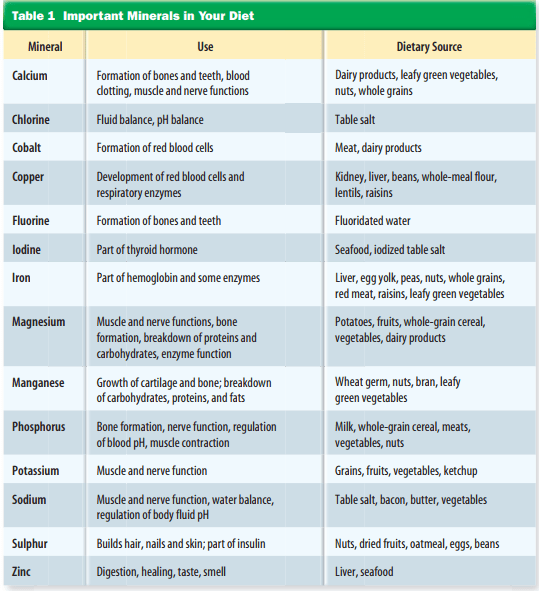
Living things are made of organic compounds, which are compounds containing carbon, with a few exceptions. Two of the carbon-containing compounds that are not considered organic are carbon dioxide and carbon monoxide. The four groups of organic compounds are carbohydrates, lipids (fats and oils), nucleic acids, and proteins.
table salt: sodium and chloride.
Fatigue: a feeling of constant tiredness or weakness and can be physical, mental or a combination of both.
Enzymes: proteins that help speed up metabolism, or the chemical reactions in our bodies.
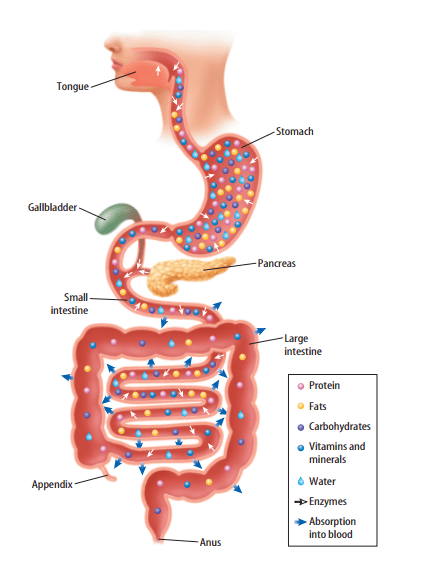

Amino acids: organic compounds composed mainly of nitrogen, carbon, hydrogen, and oxygen. Amino acids are the building blocks of proteins.
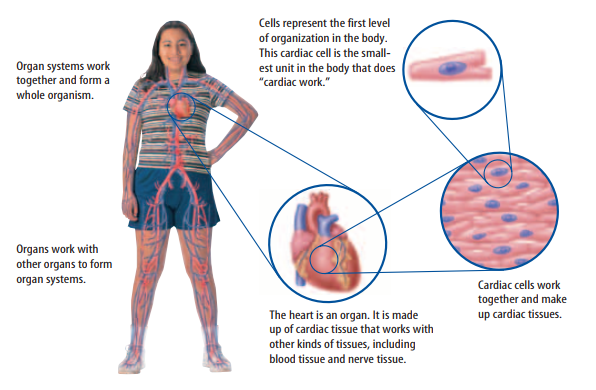
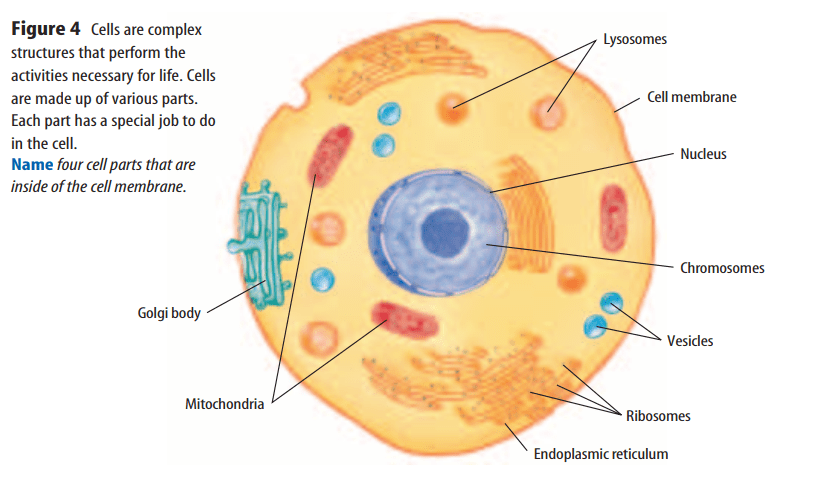
A cell is the smallest functional unit in an organism. Most cells can’t be seen with the unaided eye. (Naked eye, also called bare eye or unaided eye, is the practice of engaging in visual perception unaided by a magnifying, light-collecting optical instrument, such as a telescope or microscope, or eye protection. Vision corrected to normal acuity using corrective lenses is still considered “naked”.)
platelets: a small colorless disk-shaped cell fragment without a nucleus, found in large numbers in blood and involved in clotting. (They are not red blood cells)
epithelial cells: a type of cell that lines the surfaces of your body.
squamous epithelial cells: large, polygonal cells with small round nuclei. They tend to fold on themselves and sometimes are confused with casts. Their large size allows them to be easily distinguished from casts. Common in voided or catheterized samples due to urethral or vaginal contamination.
esophagus: a muscular tube connecting the throat (pharynx) with the stomach.
cuboidal epithelium cells: composed of epithelial cells that are distinctively cuboidal in shape.
insulate: keeping warm.
Tissue: a group of similar cells that do the same sort of work.
capillary: a small blood vessel from 5 to 10 micrometres (μm) in diameter.
forceps: an instrument for grasping, holding firmly, or exerting traction upon objects especially for delicate operations.
respiratory system: the network of organs and tissues that help you breathe.
glucose: blood sugar; the main sugar found in your blood.
villus, plural villi: a small, finger-like projection that extend into the lumen of the small intestine.
lymph vessels: A thin tube that carries lymph (lymphatic fluid) and white blood cells through the lymphatic system.
mitochondria: organelles, or parts of a eukaryote cell; are membrane-bound cell organelles (mitochondrion, singular) that generate most of the chemical energy needed to power the cell’s biochemical reactions.
lactic acid: an integral part of the human body. It assists in cell respiration, glucose production, and molecule signaling. Contrary to belief, lactic acid does not cause muscle soreness. However, the concentration of lactic acid in the blood does increase during exercise.
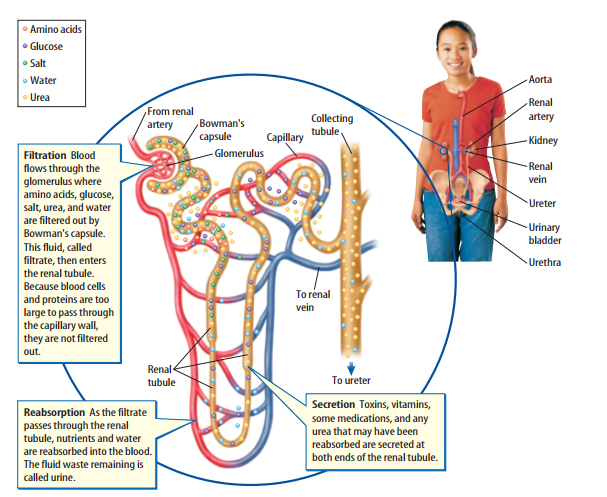
excretion: (in living organisms and cells) the process of eliminating or expelling waste matter.
nephrons: the minute or microscopic structural and functional unit of the kidney.
dilate: (of vessels) to become larger or wider.
homeostasis: any self-regulating process by which an organism tends to maintain stability while adjusting to conditions that are best for its survival.
insulin: is a hormone created by your pancreas that controls the amount of glucose in your bloodstream at any given moment.
glycogen: the molecular form of carbohydrates (glucose) stored in humans and other mammals.
indicator: a substance (as a dye) used to show visually (as by a change in color) the condition of a solution with respect to the presence of a particular material (as a free acid or alkali) litmus and phenolphthalein are acid-base indicators.
Bromthymol Blue: a dye used as an indicator in determining pH.
filtration: the process in which solid particles in a liquid or gaseous fluid are removed by the use of a filter medium that permits the fluid to pass through but retains the solid particles.
3
parasite: an animal or plant that lives on or in another animal or plant of a different type and feeds from it.
The biosphere includes the top portion of Earth’s crust, all the waters that cover Earth’s surface, and the atmosphere that surrounds Earth.
prairie: land in or predominantly (mainly) in grass.
bison(buffalo)–hooves(feet).
This ecologist is studying the members of a population. A population is made up of all organisms of the same species that live in an area at the same time. For example, all the bison in a prairie ecosystem are one population. This ecologist is studying a community. A community is all the populations of all species living in an ecosystem.
saguaro (suh GWAR oh) cactus, plant pots, radish seeds, robins
In any ecosystem, the availability of food, water, living space, mates, nesting sites, and other resources is often limited. A limiting factor is anything that restricts the number of individuals in a population. Limiting factors include living and nonliving features of the ecosystem.
Carrying capacity is the largest number of individuals of one species that an ecosystem can support over time.


Leave a comment