Chapter 1
locomotive
strata
sedimentary
wall mural or diorama
depicting
plate tectonics
artifact
excavation
captions
span
intact
probe
orientation
droopy
wilting
perk up
fig
thriving
shrivel
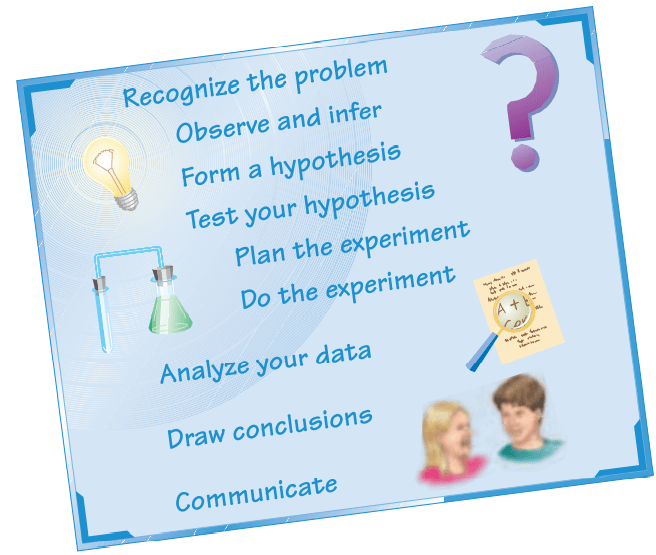
The one factor that you change in an experiment is called the independent variable.
A dependent variable is the factor, or outcome, that will be measured in an experiment.
Constants are factors in an experiment that stay the same.
A control is a standard used for comparison.
Literature:
Mama can be shrewd and cunning. She has uncanny perception and self-control. Her mind is formidable1, her beauty is enticing, but I’ve seen her use either to get in and out of places. I’ve seen her absolutely euphoric when her mind is deducing. She’s a self-styled private investigator who sees herself as the romantic loner.
Chapter 2
bike racks
opal
halite
feldspar
calcite
granulated sugar
thermal mitt
pyrite
shatter
talc
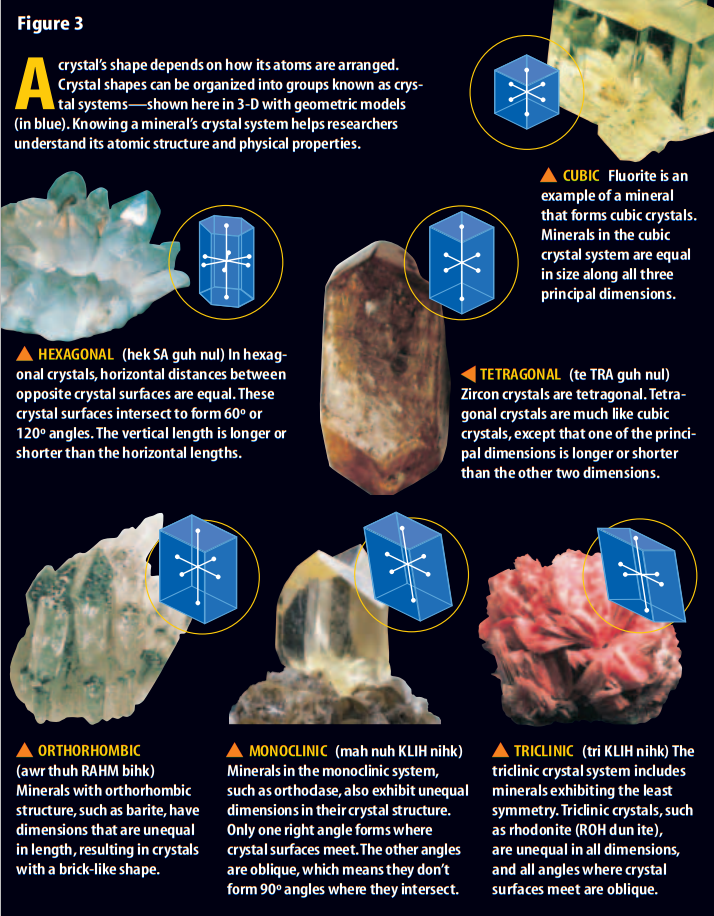
A mineral is a naturally occurring, inorganic solid with a definite chemical composition and an orderly arrangement of atoms.
Silicates (SIH luh kayts) are minerals that contain silicon (Si) and oxygen (O) and usually one or more other elements.
The way a mineral reflects light is known as luster. A measure of how easily a mineral can be scratched is its hardness.
utensils
The specific gravity of a mineral is the ratio of its weight compared with the weight of an equal volume of water. The term heft is sometimes used to describe how heavy a mineral sample feels.
streak, hardness, cleavage, and color.
Streak is the color of a mineral when it is in a powdered form.
Minerals that break along smooth, flat surfaces have cleavage.
Minerals that break with uneven, rough, or jagged surfaces have fracture.
lodestone
filings
remnants
readily
Amethyst
sapphire
emerald
Topaz
Peridot
abrasive
foil
A mineral or rock is an ore if it contains a useful substance that can be mined at a profit.
galvanization
vein mineral deposits
sphalerite
titanium: ilmenite and rutile,
Titanium is a durable, lightweight, metallic element derived from minerals that contain this metal in their crystal structures.
Titanium is used in automobile body parts, such as connecting rods, valves, and suspension springs. Low density and durability make it useful in the manufacture of aircraft, eyeglass frames, and sports equipment such as tennis rackets and bicycles.
immerse
tenacity
diffraction
diabete
insulin
compact
metamorphic rock
alluvial fan
deposit
shale rock
gneiss
redistribute
tilt
exert
mineral grains: mineral crystals or sediment particles that make up all rocks.
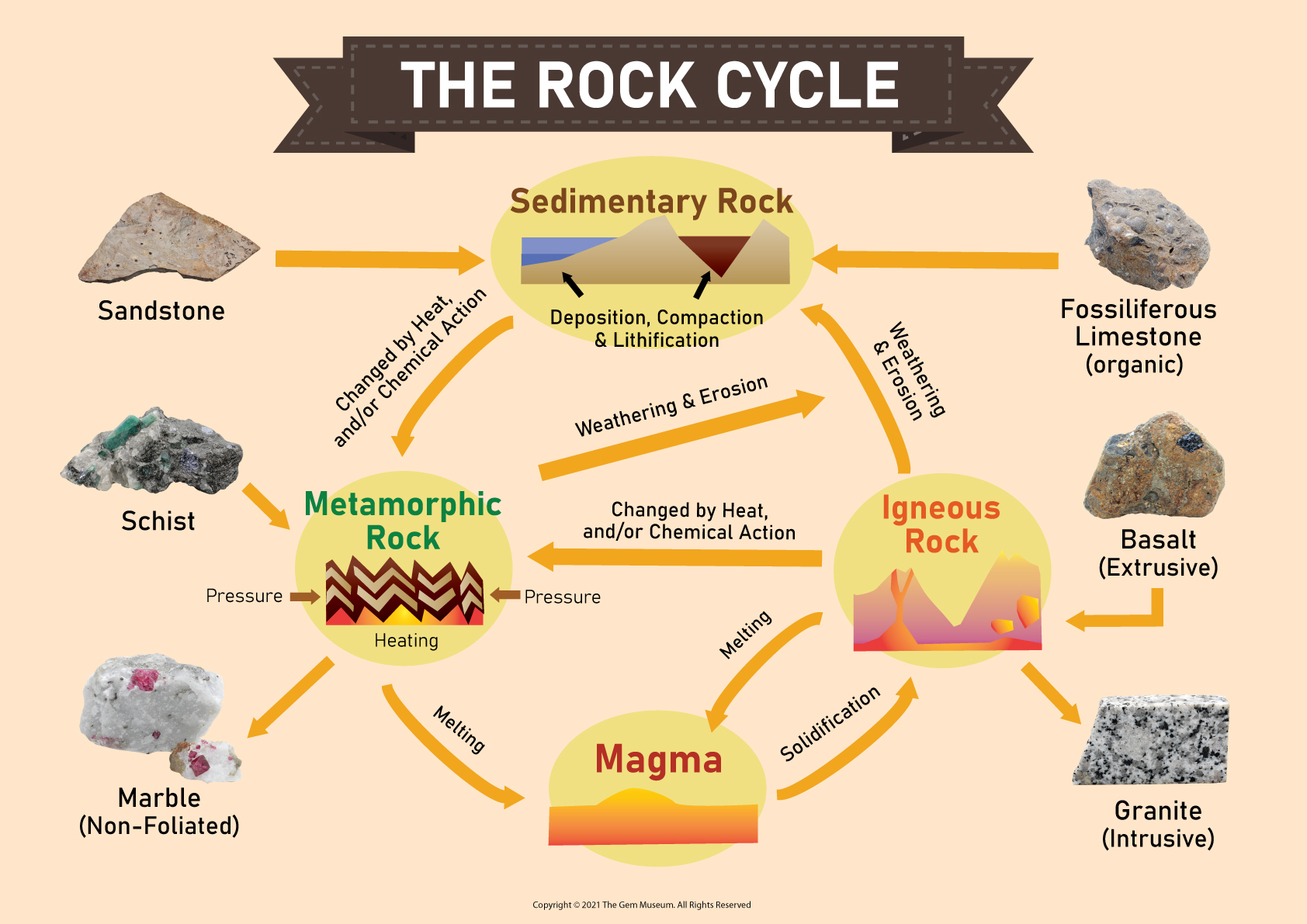
Intrusive igneous rocks are found at the surface only after the layers of rock and soil that once covered them have been removed by erosion. Extrusive igneous rocks are formed as lava cools on the surface of Earth, they are fine grained. Intrusive rocks form from magma trapped below Earth’s surface. Extrusive rocks form from lava flowing at the surface.
Common Igneous Rocks NAME LIST (basaltic, andesitic, granitic): Gabbro, Diorite, Granite, Basalt, Rhyolite, Obsidian, Scoria, Pumice.
Basaltic Rocks Basaltic (buh SAWL tihk) igneous rocks are dense, dark-colored rocks. They form from magma that is rich in iron and magnesium and poor in silica, which is the compound SiO2. The presence of iron and magnesium in minerals in basalt gives basalt its dark color.
Pumice, obsidian, and scoria are examples of volcanic glass.
Granitic Rocks Granitic igneous rocks are light-colored rocks of lower density than basaltic rocks. Granitic magma is thick and stiff and contains lots of silica but lesser amounts of iron and magnesium. Because granitic magma is stiff, it can build up a great deal of gas pressure, which is released explosively during violent volcanic eruptions.
Andesitic Rocks Andesitic igneous rocks have mineral compositions between those of basaltic and granitic rocks. Many volcanoes around the rim of the Pacific Ocean formed from andesitic magmas. Like volcanoes that erupt granitic magma, these volcanoes also can erupt violently.
Crystals you can see without a magnifying lens indicate slower cooling. Smaller, fine-grained crystals indicate quicker cooling, possibly due to volcanic activity.
Rocks that have changed because of changes in temperature and pressure or the presence of hot, watery fluids are called metamorphic rocks. Metamorphic rocks can form from igneous, sedimentary, or other metamorphic rocks.
Some mineral grains can change by dissolving and recrystallizing—especially in the presence of fluids. Sometimes, under these conditions, minerals exchange atoms with surrounding minerals and new, bigger minerals form.
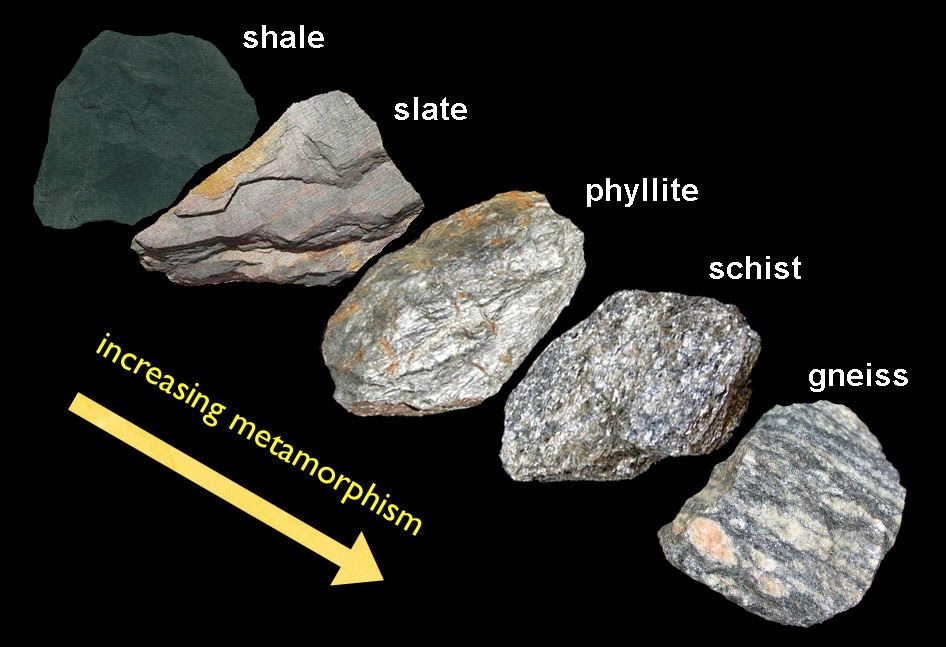
shale
slate
phyllite
schist
gneiss
comprise = include = constitute
Metamorphic rocks form from igneous, sedimentary, or other metamorphic rocks. Heat, pressure, and hot fluids trigger the changes.
foliation: The minerals in shale arrange into layers when they are exposed to heat and pressure.
patios
watertight
Sandstone is a sedimentary rock that’s often composed mostly of quartz grains.
Marble is another nonfoliated metamorphic rock. Marble forms from the sedimentary rock limestone, which is composed of the mineral calcite. Usually, marble contains several other minerals besides calcite. For example, hornblende and serpentine give marble a black or greenish tone, whereas hematite makes it red.
Hot fluids that move through and react with preexisting rock are composed mainly of water and carbon dioxide.
Sediments are loose materials such as rock fragments, mineral grains, and bits of shell that have been moved by wind, water, ice, or gravity. Sedimentary rock forms when sediments are pressed and cemented together, or when minerals form from solutions.
Sedimentary rocks usually are classified as detrital, chemical, or organic.
detrital: particles of rock derived from pre-existing rock through processes of weathering and erosion.
compaction: If the sediments are small, they can stick together and form solid rock.
cementation: As water moves through soil and rock, it picks up materials released from minerals during weathering. The resulting solution of water and dissolved materials moves through open spaces between sediments.
Detrital rocks have granular (powdery or grainy) textures, much like granulated sugar. They are named according to the shapes and sizes of the sediments that form them.
Shale Siltstone Sandstone Conglomerate or Breccia
conglomerate: a coarse-grained sedimentary rock composed of rounded fragments (> 2 mm) within a matrix of finer grained material.
Chemical sedimentary rocks form when dissolved minerals come out of solution. They are not made from pieces of preexisting rocks.
gypsum is a soft sulfate mineral composed of calcium sulfate dihydrate, with the chemical formula CaSO₄·2H₂O.
If a rock is made completely of shell fragments that you can see, the rock is called coquina (koh KEE nuh).
Chalk is another organic sedimentary rock that is made of microscopic shells.
Coal forms when pieces of dead plants are buried under other sediments in swamps. These plant materials are chemically changed by microorganisms.
hydrochloric acid (HCl) solution
spills
Chapter 4
The Doppler effect or Doppler shift is the change in frequency of a wave in relation to an observer who is moving relative to the wave source.
A collision is any event in which two or more bodies exert forces on each other in a relatively short time.
Pollen is a powdery substance produced by seed plants.
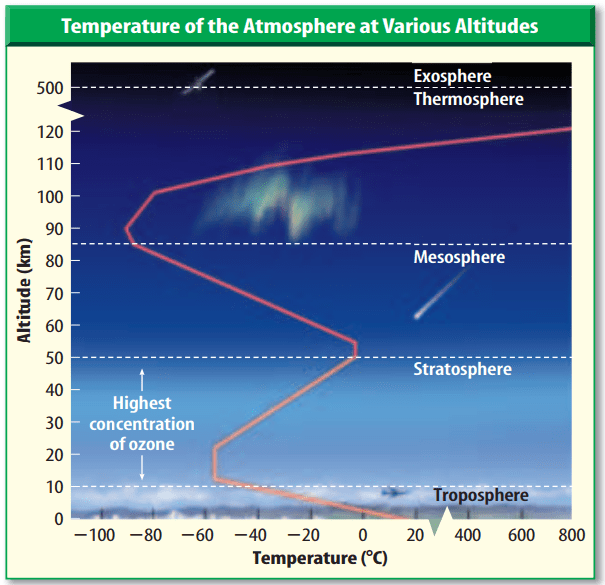
There are five layers in Earth’s atmosphere, each with its own properties. The lower layers include the troposphere and stratosphere. The upper atmospheric layers are the mesosphere, thermosphere, and exosphere. The troposphere and stratosphere contain most of the air.
The troposphere is the lowest of Earth’s atmospheric layers. It contains 99 percent of the water vapor and 75 percent of the atmospheric gases.
The stratosphere, the layer directly above the troposphere, extends from 10 km above Earth’s surface to about 50 km. A portion of the stratosphere contains higher levels of a gas called ozone.
The mesosphere extends from the top of the stratosphere to about 85 km above Earth. If you’ve ever seen a shooting star, you might have witnessed a meteor in the mesosphere. The thermosphere is named for its high temperatures. This is the thickest atmospheric layer and is found between 85 km and 500 km above Earth’s surface. Within the mesosphere and thermosphere is a layer of electrically charged particles called the ionosphere. The ionosphere allows radio waves to travel across the country to another city.
The space shuttle orbits Earth in the exosphere. The exosphere has so few molecules. Beyond the exosphere is outer space.
Air pressure is greater near Earth’s surface and decreases higher in the atmosphere.
Ultraviolet radiation is one of the many types of energy that come to Earth from the Sun. Too much exposure to ultraviolet radiation can damage your skin and cause cancer.
Blame has fallen on chlorofluorocarbons (CFCs), chemical compounds used in some refrigerators, air conditioners, and aerosol sprays, and in the production of some foam packaging. CFCs can enter the atmosphere if these appliances leak or if they and other products containing CFCs are improperly discarded.
sunscreen
Heat then is transferred through the atmosphere in three ways—radiation, conduction, and convection.
Radiation is energy that is transferred in the form of rays or waves. Conduction is the transfer of energy that occurs when molecules bump into one another. Convection is the transfer of heat by the flow of material.
Specific Heat Specific heat is the amount of heat required to raise the temperature of one kilogram of a substance one degree Celsius. Substances with high specific heat absorb a lot of heat for a small increase in temperature. Land warms faster than water does. Infer whether soil or water has a higher specific heat value.
When air is warmed, the molecules in it move apart and the air becomes less dense. Air pressure decreases because fewer molecules are in the same space. In cold air, molecules move closer together. The air becomes more dense and air pressure increases. Cooler, denser air sinks while warmer, less dense air rises, forming a convection current. Radiation, conduction, and convection together distribute the Sun’s heat throughout Earth’s atmosphere.
Hydrosphere is a term that describes all the waters of Earth. The constant cycling of water within the atmosphere and the hydrosphere plays an important role in determining weather patterns and climate types.
Energy from the Sun causes water to change from a liquid to a gas by a process called evaporation. Water that evaporates from lakes, streams, and oceans enters Earth’s atmosphere. If water vapor in the atmosphere cools enough, it changes back into a liquid. This process of water vapor changing to a liquid is called condensation.
Clouds form when condensation occurs high in the atmosphere. Clouds are made up of tiny water droplets that can collide to form larger drops. As the drops grow, they fall to Earth as precipitation. This completes the water cycle within the hydrosphere. Classification of world climates is commonly based on annual and monthly averages of temperature and precipitation that are strongly affected by the water cycle.
Earth’s atmosphere creates a delicate balance between energy received and energy lost.
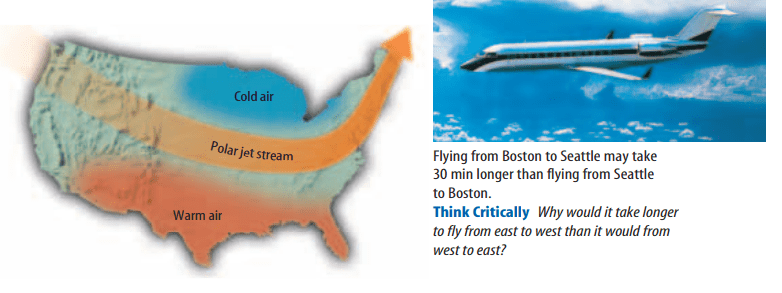
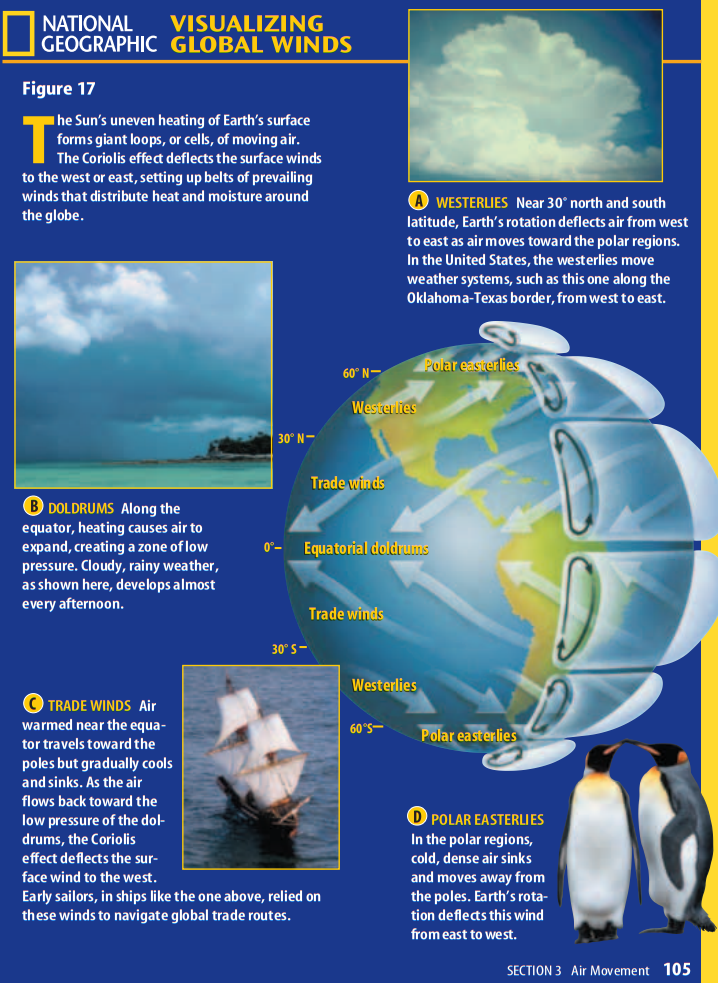
Wind is the movement of air from an area of higher pressure to an area of lower pressure. The heated air at the equator is less dense, so it is displaced by denser, colder air, creating convection currents. Uneven heating of Earth’s surface by the Sun causes some areas to be warmer than others.
The rotation of Earth causes moving air and water to appear to turn to the right north of the equator and to the left south of the equator. This is called the Coriolis (kohr ee OH lus) effect.
trade winds: a wind blowing steadily towards the equator from the northeast in the northern hemisphere or the southeast in the southern hemisphere, especially at sea. Two belts of trade winds encircle the earth, blowing from the tropical high-pressure belts to the low-pressure zone at the equator.

A sea breeze is created during the day because solar radiation warms the land more than the water. Air over the land is heated by conduction. This heated air is less dense and has lower pressure. Cooler, denser air over the water has higher pressure and flows toward the warmer, less dense air. A convection current results, and wind blows from the sea toward the land. The reverse occurs at night, when land cools much more rapidly than ocean water. Air over the land becomes cooler than air over the ocean. Cooler, denser air above the land moves over the water, as the warm air over the water rises. Movement of air toward the water from the land is called a land breeze.
Chapter 5
Weather refers to the state of the atmosphere at a specific time and place. Weather describes conditions such as air pressure, wind, temperature, and the amount of moisture in the air.
The amount of water vapor present in the air is called humidity.
Relative humidity is a measure of the amount of water vapor present in the air compared to the amount needed for saturation at a specific temperature.
When the temperature drops, less water vapor can be present in air. The water vapor in air will condense to a liquid or form ice crystals. The temperature at which air is saturated and condensation forms is
the dew point. The dew point changes with the amount of water vapor in the air.
wind vane
wind sock
anemometer
saturated: holding as much water or moisture as can be absorbed; thoroughly soaked.
suspended: supported by attachment from above; hanging.
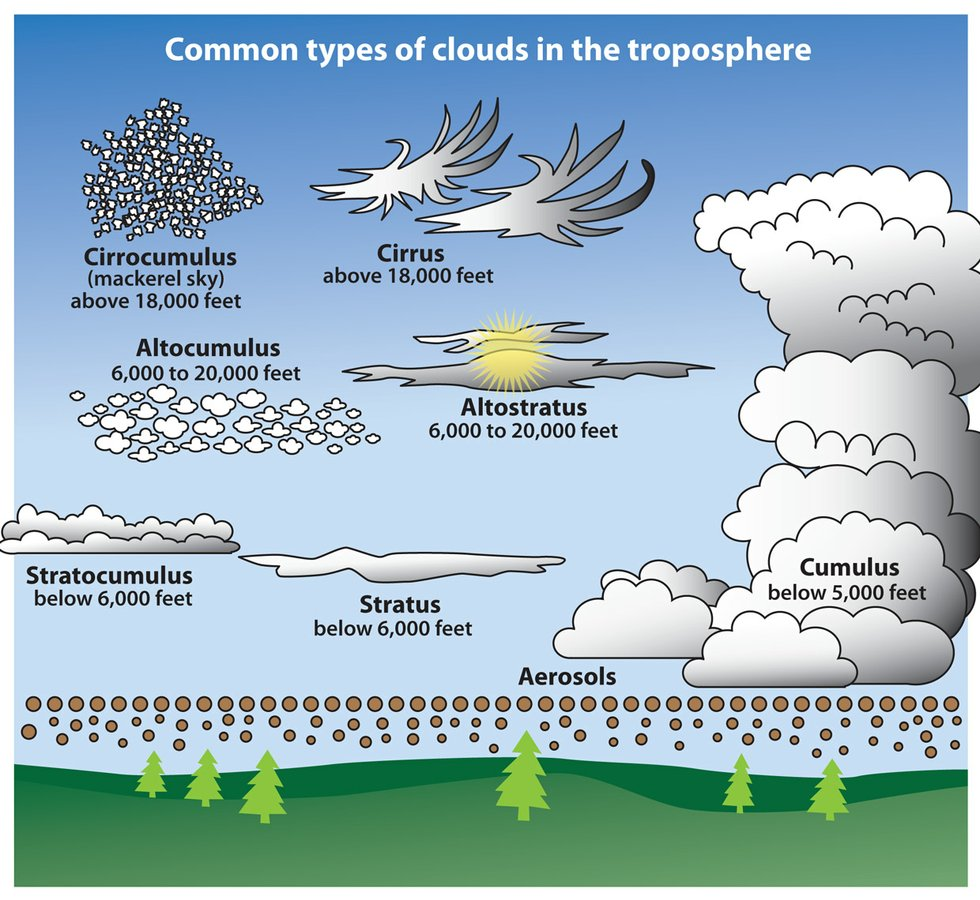
The three main cloud types are stratus, cumulus, and cirrus. Stratus clouds form layers, or smooth,
even sheets in the sky. Stratus clouds usually form at low altitudes and may be associated with fair weather or rain or snow. When air is cooled to its dew point near the ground, it forms a stratus cloud called fog.
Cumulus (KYEW myuh lus) clouds are masses of puffy, white clouds, often with flat bases. They sometimes tower to great heights and can be associated with fair weather or thunderstorms.
Cirrus (SIHR us) clouds appear fibrous or curly. They are high, thin, white, feathery clouds made of ice crystals. Cirrus clouds are associated with fair weather, but they can indicate approaching storms. The prefix cirro- describes high clouds, alto- describes middle-elevation clouds, and strato- refers to clouds at
low elevations. Some clouds’ names combine the altitude prefix with the term stratus or cumulus.
Cirrostratus clouds are high clouds. Usually, cirrostratus clouds indicate fair weather, but they also can signal an approaching storm. Altostratus clouds form at middle levels. If the clouds are not too thick, sunlight can filter through them.
nimbus: a large gray rain cloud.
When a cumulus cloud grows into a thunderstorm, it is called a cumulonimbus (kyew myuh loh NIHM bus) cloud.
Water falling from clouds is called precipitation.
Air temperature determines whether water forms rain, snow, sleet, or hail—the four main types of precipitation.
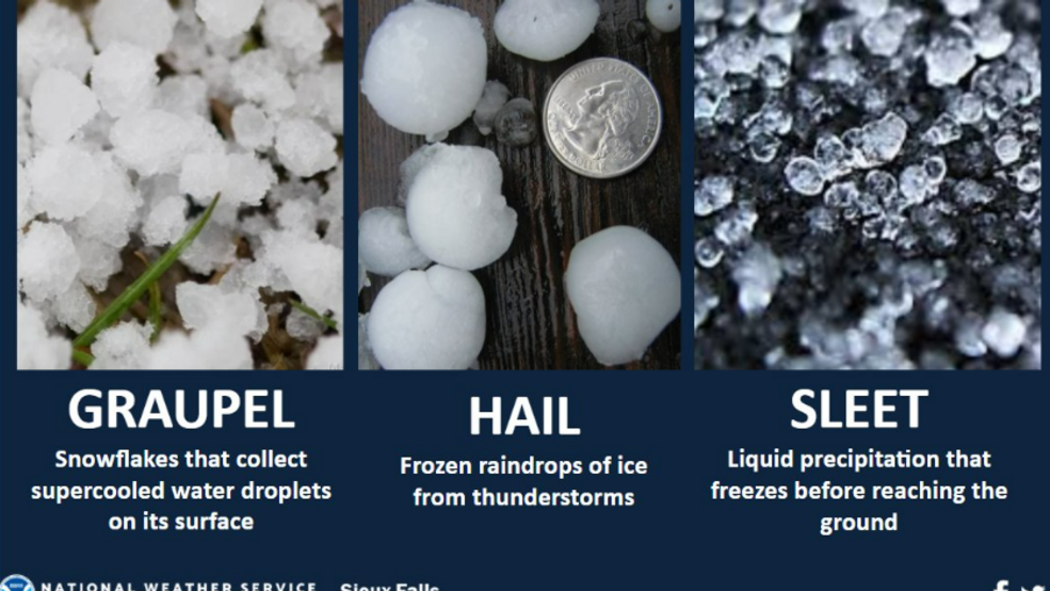
ice pellets
Hail is precipitation in the form of lumps of ice.
An air mass is a large body of air that has properties similar to the part of Earth’s surface over which it develops.
Large, swirling areas of low pressure are called cyclones and are associated with stormy weather. Winds blow away from a center of high pressure. High-pressure areas are associated with fair weather and are called anticyclones.
Air pressure is measured using a barometer. A barometer measures atmospheric pressure. The red pointer points to the current pressure.
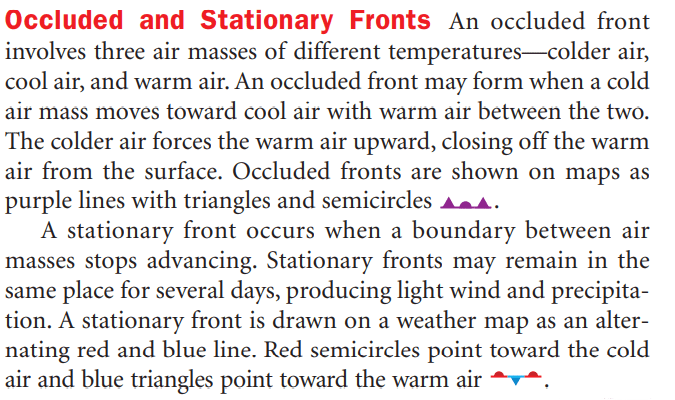
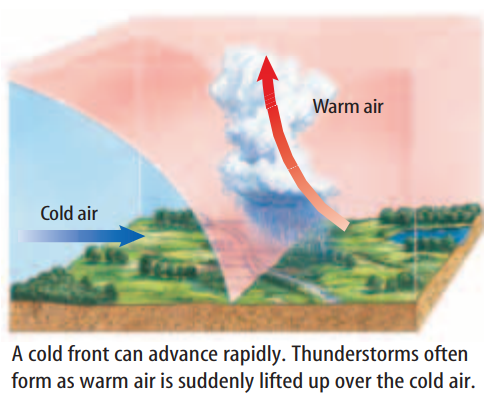
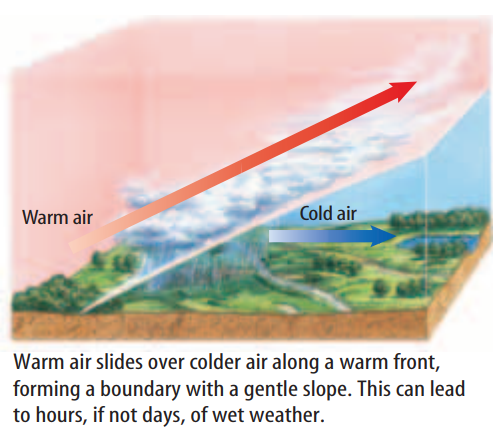
A boundary between two air masses of different density, moisture, or temperature is called a front.
Cloudiness, precipitation, and storms sometimes occur at frontal boundaries. Four types of fronts include cold, warm, occluded, and stationary.

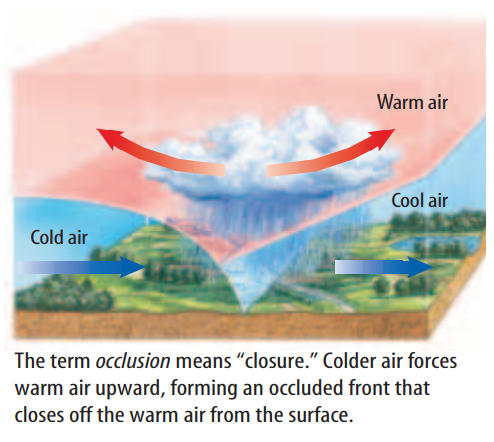
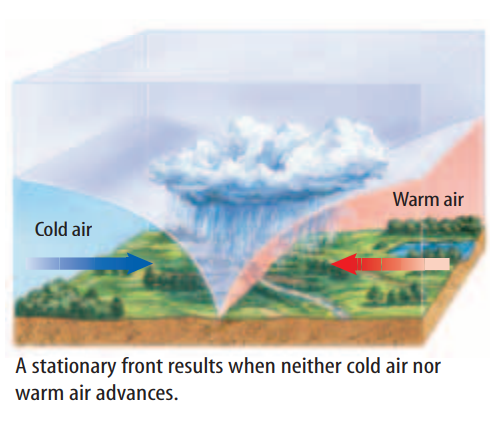
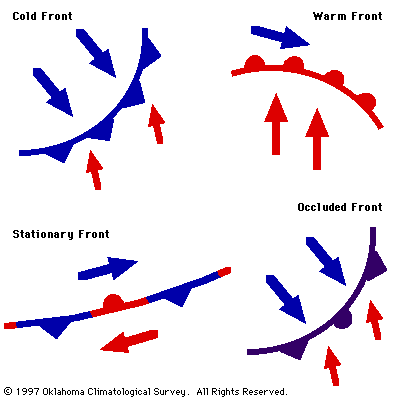

When meteorologists gather data from Earth’s surface, it is recorded on a map using a combination of symbols, forming a station model. A line that connects points of equal temperature is called an isotherm (I suh thurm). Iso- means “same” and therm- means “temperature.”
An isobar is a line drawn to connect points of equal atmospheric pressure.
Isobars that are close together indicate a large pressure difference over a small area. A large pressure difference causes strong winds. Isobars that are spread apart indicate a smaller difference in pressure. Winds in this area are gentler. Isobars also indicate the locations of high and low-pressure areas
Severe weathers: thunderstorms, tornadoes, floods, blizzards, and hurricanes.
In severe thunderstorms, wind at different heights blows in different directions and at different
speeds. This difference in wind speed and direction, called wind shear, creates a rotating column parallel to the ground. A thunderstorm’s updraft can tilt the rotating column upward into the thunderstorm creating a funnel cloud. If the funnel comes into contact with Earth’s surface, it is called a tornado.
descend: move or fall downward.
debris: scattered pieces of waste or remains.
steer: guide or control the movement of (a vehicle, vessel, or aircraft), for example by turning a wheel or operating a rudder. Drive, force.
A meteorologist (mee tee uh RAH luh jist) is a person who studies the weather. Meteorologists take measurements of temperature, air pressure, winds, humidity, and precipitation.
cloud seeding
Chapter 6
atlas: a collection maps.
leeward: downwind
canopy:
exotic bird
thrive
Climate is the pattern of weather that occurs in an area over many years. It determines the types of plants or animals that can survive, and it influences how people live.
The tropics—the region between latitudes 23.5°N and 23.5°S—receive the most solar radiation because the Sun shines almost directly over these areas. The tropics have temperatures that are always hot, except at high elevations. The polar zones extend from 66.5°N and 66.5°S latitude to the poles. Solar radiation hits these zones at a low angle, spreading energy over a large area. During winter, polar regions receive little or no solar radiation. Polar regions are never warm. Between the tropics and the polar zones are the temperate zones. Temperatures here are moderate.
Ocean currents affect coastal climates. Warm currents begin near the equator and flow toward higher
latitudes, warming the land regions they pass. When the currents cool off and flow back toward the equator, they cool the air and climates of nearby land. Winds blowing from the sea are often moister than those blowing from land.
Large bodies of water can affect the climate of coastal areas by absorbing or giving off heat. This causes many coastal regions to be warmer in the winter and cooler in the summer than inland areas at similar latitude.
At the same latitude, the climate is colder in the mountains than at sea level. Because Earth’s atmosphere gets thinner at higher altitudes, the air in the mountains has fewer molecules to absorb heat.
The temperature in a city can be several degrees warmer than the temperature of nearby rural areas. This difference in temperature is called the heat island effect. Cities contain asphalt and concrete which heat up rapidly as they absorb energy from the Sun. Rural areas covered with vegetation stay cooler because plants and soil contain water. Water heats up more slowly and carries away heat as it evaporates.
Mountains also affect regional climates. On the windward side of a mountain range, air rises, cools, and drops its moisture. On the leeward side of a mountain range air descends, heats up, and dries the land. Deserts are common on the leeward sides of mountains.
Climatologists—people who study climates—usually use a system developed in 1918 by Wladimir Köppen to classify climates. Köppen observed that the types of plants found in a region depended on the climate of the area. He classified world climates by using the annual and monthly averages of temperature and precipitation of different regions. He then related the types and distribution of native vegetation to the various climates.
The climate classification system shown in Figure 5 separates climates into six groups—tropical, mild, dry, continental, polar, and high elevation.
An adaptation is any structure or behavior that helps an organism survive in its environment. Structural adaptations are inherited. Once adapted to a particular climate, organisms may not be able to survive in other climates.
Some organisms have body structures that help them survive in certain climates. Some organisms display behavioral adaptations that help them survive in a particular climate. For example, rodents and certain other mammals undergo a period of greatly reduced activity in winter called hibernation
estivation: rodents and certain other mammals undergo a period of greatly reduced activity in summer.
Seasons are short periods of climatic change caused by changes in the amount of solar radiation an area
receives.
Because of fairly constant solar radiation near the equator, the tropics do not have much seasonal temperature change. However, they do experience dry and rainy seasons. The middle latitudes, or temperate zones, have warm summers and cool winters. Spring and fall are usually mild.
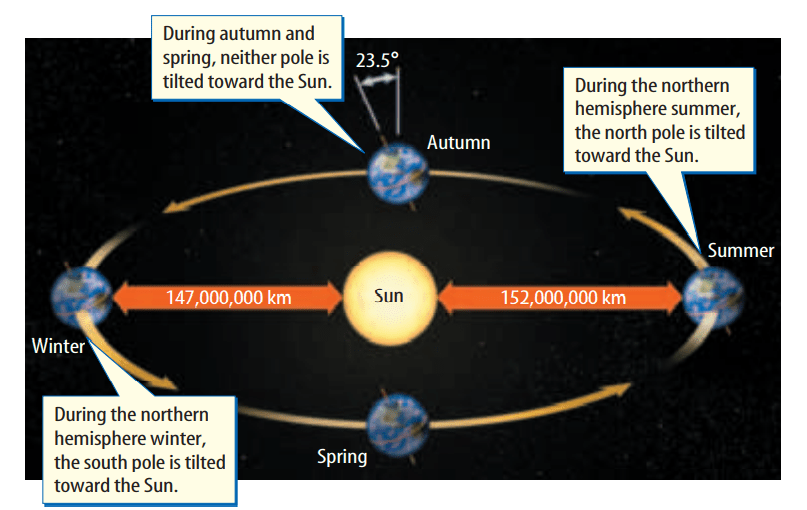
During the year, the high latitudes near the poles have great differences in temperature and number of daylight hours. As shown in Figure 8, during summer in the northern hemisphere, the north pole is tilted toward the Sun. During summer at the north pole, the Sun doesn’t set for nearly six months. During that same time, the Sun never rises at the south pole. At the equator days are about the same length all year long.
interglacial intervals
meteorite collisions
soot: a mass of impure carbon particles resulting from the incomplete combustion of hydrocarbons. Ash particles.
smokestack emissions
Sunspots are dark spots on the surface of the Sun.
perpendicular: In elementary geometry, two geometric objects are perpendicular if they intersect at a right angle.
earth wobble
spans
The greenhouse effect is a natural heating process that occurs when certain gases in Earth’s atmosphere trap heat.
Over the past 100 years, the average global surface temperature on Earth has increased by about 0.6°C. This increase in temperature is known as global warming. Over the same time period, atmospheric carbon dioxide has increased by about 20 percent. As a result, researchers hypothesize that the increase in global temperatures may be related to the increase in atmospheric carbon dioxide. Other hypotheses include the possibility that global warming might be caused by changes in the energy emitted by the Sun.
cope
Destroying and cutting down trees, called deforestation.
psychrometer: a hygrometer consisting of a wet-bulb and a dry-bulb thermometer. As moisture from the wet thermometer evaporates, it takes heat energy from its environment, and the environment immediately around the wet thermometer cools. The thermometer records a lower temperature. The difference in the two thermometer readings being used to determine atmospheric humidity.
Chapter 7
resemble: be similar to
Earth’s shape is not a perfect sphere. It bulges slightly at the equator and is somewhat flattened around the poles.
Earth’s axis is the imaginary line drawn from the north geographic pole through Earth to the south geographic pole. Earth spins around this imaginary line. The spinning of Earth on its axis, called rotation, causes you to experience day and night.
This motion of Earth around the Sun is called revolution.
Earth is really a satellite of the Sun, moving around it along a curved path called an orbit. The shape of Earth’s orbit is an ellipse, which is rounded like a circle but somewhat flattened.
The total amount of energy Earth receives from the Sun changes little during a year. However, the amount of energy that specific places on Earth receive varies quite a lot.
Earth’s axis forms a 23.5-degree angle with a line perpendicular to the plane of its orbit around the Sun.
Twice during the year, the Sun reaches its greatest distance north or south of the equator and is directly over either the Tropic of Cancer or the Tropic of Capricorn. These times are known as the summer and winter solstices.
At an equinox, (EE kwuh nahks) when the Sun is directly above Earth’s equator, the lengths of day and night are nearly equal all over the world.
You will see dark-colored maria (MAR ee uh) and lighter-colored highland areas.
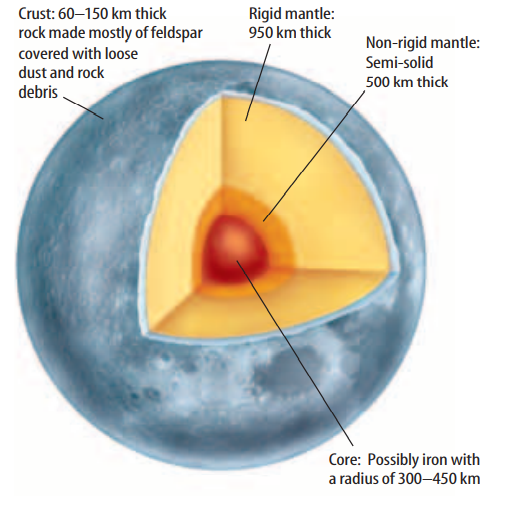
Craters are depressions formed by large meteorites—space objects that strike the surface.
As meteorites struck the Moon, cracks could have formed in the Moon’s crust, allowing lava flows to fill in the large depressions.
A seismograph is an instrument that detects tremors, or seismic vibrations.
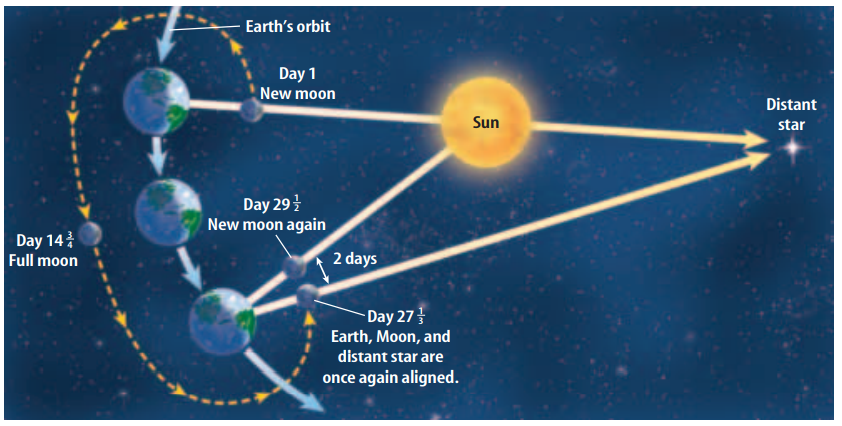
The Moon revolves around Earth at an average distance of about 384,000 km. It takes 27.3 days for the Moon to complete one orbit around Earth. The Moon also takes 27.3 days to rotate once on its axis. Because these two motions of the Moon take the same amount of time, the same side of the Moon is always facing Earth. Examine Figure 9 to see how this works.
Moon phases are the changing views of the Moon as seen from Earth.

solar eclipse
shadow or darkness
lunar eclipse
penumbra: the less dark outer part of a sunspot, surrounding the dark core.
fission
primordial
colossal
Our solar system, illustrated in Figure 16, is composed of the Sun, planets, asteroids, comets, and other objects in orbit around the Sun.
Earth, for example, is about 150,000,000 km from the Sun. This distance is referred to as 1 astronomical unit, or 1 AU.
The inner planets are Mercury, Venus, Earth, and Mars. Known as the terrestrial planets, after the Latin word terra (earth), they are similar in size to Earth and are made up mainly of rock.
The outer planets are Jupiter, Saturn, Uranus, and Neptune. They all are gaseous giant planets with dense atmospheres. The outer planets are mainly made up of light elements such as hydrogen and helium.
Asteroids are small, rocky objects that mostly lie in a belt located between the orbits of Mars and Jupiter.
Comets are made mainly of rocky particles and water ice.
When comets break up, some of the resulting particles remain in orbit. When asteroids collide, small pieces break off. Both of these processes produce small objects in the solar system known as meteoroids. If meteoroids enter Earth’s atmosphere, they are called meteors, and when they fall to Earth, they are called meteorites.
protractor: a measuring instrument, typically made of transparent plastic or glass, for measuring angles.


Leave a comment