Chapter 17-19
water ferns
sequoia trees
Heart problems were treated with foxglove, which is the main source of digitalis (dih juh TAH lus), a drug prescribed for heart problems.
Salicylates (suh LIH suh layts) are the main ingredient in aspirin.
A plant cell has a cell membrane, a nucleus, and other cellular structures. In addition, plant cells have cell walls that provide structure and protection.
Many plant cells contain the green pigment chlorophyll (KLOR uh fihl) so most plants are green. Plants need chlorophyll to make food using a process called photosynthesis. Chlorophyll is found in a cell structure called a chloroplast. Plant cells from green parts of the plant usually contain many chloroplasts.
Most plant cells have a large, membrane-bound structure called the central vacuole that takes up most of the space inside of the cell. This structure plays an important role in regulating the water content of the cell. Many substances are stored in the vacuole, including the pigments that make some flowers red, blue, or purple.
Today, plants and green algae have the same types of chlorophyll and carotenoids (kuh RAH tun oydz) in their cells. Carotenoids are red, yellow, or orange pigments that also are used for photosynthesis.
Covering the stems, leaves, and flowers of many plants is a cuticle (KYEW tih kul)—a waxy, protective layer secreted by cells onto the surface of the plant. The cuticle slows the loss of water. The cuticle and other adaptations shown in Figure 4 enable plants to survive on land.
Plant cells have cell membranes, but they also have rigid cell walls outside the membrane. Cell walls contain cellulose (SEL yuh lohs), which is a chemical compound that plants can make out of sugar. Long chains of cellulose molecules form tangled fibers in plant cell walls. These fibers provide structure and support.
secrete: produce.
Vascular plants have tubelike structures that carry water, nutrients, and other substances throughout the plant. Nonvascular plants do not have these tubelike structures and use other ways to move water and substances.
binomial nomenclature
Most nonvascular plants have stalks that look like stems and green, leaflike growths. Instead of roots, threadlike structures called rhizoids (RI zoydz) anchor them where they grow. Most nonvascular plants grow in places that are damp. Water is absorbed and distributed directly through their cell membranes and cell walls. Nonvascular plants also do not have flowers or cones that produce seeds. They reproduce by spores. Mosses, liverworts, and hornworts are examples of nonvascular plants. Mosses often are among the first plants to grow in new or disturbed environments, such as lava fields or after a forest fire.
Organisms that are the first to grow in new or disturbed areas are called pioneer species. As pioneer plants grow and die, decaying material builds up. This, along with the slow breakdown of rocks, builds soil. When enough soil has formed, other organisms can move into the area.
Ferns and mosses are alike in one way. Both reproduce by spores instead of seeds. However, ferns are different from mosses because they have vascular tissue. The vascular tissue in seedless vascular plants, like ferns, is made up of long, tubelike cells. These cells carry water, minerals, and food to cells throughout the plant. Nonvascular plants are usually just a few cells thick and only 2 cm to 5 cm in height. Vascular plants, on the other hand, can grow bigger and thicker because the vascular tissue distributes water and nutrients to all plant cells.
Fossil records show that some horsetails grew 15 m tall, unlike modern species, which grow only 1 m to 2 m tall.
Fern leaves are called fronds. Ferns produce spores in structures that usually are found on the underside of their fronds.
Ground pines and spike mosses are groups of plants that often are called club mosses. They are related more closely to ferns than to mosses. These seedless vascular plants have needlelike leaves. Spores are produced at the end of the stems in structures that look like tiny pine cones. Ground pines are found from arctic regions to the tropics, but rarely in large numbers.
Spike mosses resemble ground pines. One species of spike moss, the resurrection plant, is adapted to desert conditions. When water is scarce, the plant curls up and seems dead. When water becomes available, the resurrection plant unfurls its green leaves and begins making food again. The plant can repeat this process whenever necessary.
horsetails
A bog is a freshwater wetland of soft, spongy ground consisting mainly of partially decayed plant matter called peat. When bog plants die, the waterlogged soil slows the decay process. Over time, these decaying plants are compressed into a substance called peat. Peat, which forms from the remains of sphagnum moss, is mined from bogs to use as a low-cost fuel in places such as Ireland and Russia.
Sphagnum moss is the living plant that grows on top of the bog.
The rhizomes (underground stems) and young fronds of some ferns are edible. The dried stems of one type of horsetail can be ground into flour. Seedless plants have been used as folk medicines for hundreds of years. For example, ferns have been used to treat bee stings, burns, fevers, and even dandruff (a common condition that causes the skin on the scalp to flake).
The seed plants generally are classified into two major groups—gymnosperms (JIHM nuh spurmz, from Greek, gymnos, ‘naked’ and sperma, ‘seed’) and angiosperms (AN jee uh spurmz, from Greek, angeion ‘container, vessel’ and sperma ‘seed’).
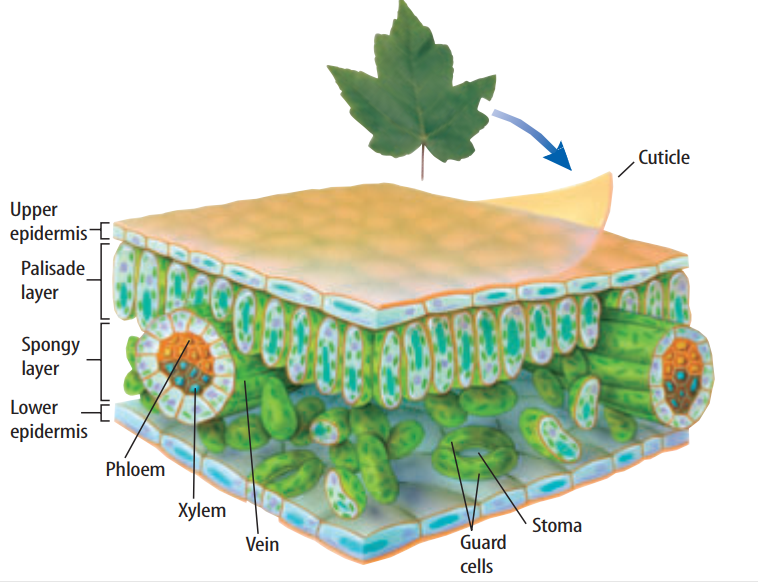
On the upper and lower surfaces of a leaf is a thin layer of cells called the epidermis (late Latin from Greek, from epi ‘upon’ + derma ‘skin’.), which covers and protects the leaf. A waxy cuticle coats the epidermis of some leaves. Most leaves have small openings in the epidermis called stomata (STOH muh tuh, from Greek stoma ‘mouth’.) (singular, stoma). Stomata allow carbon dioxide, water, and oxygen to enter into and exit from a leaf. Each stoma is surrounded by two guard cells that open and close it.
Just below the upper epidermis is the palisade (Latin palus ‘stake’) layer. It consists of closely packed, long, narrow cells that usually contain many chloroplasts. Most of the food produced by plants is made in the palisade cells. Between the palisade layer and the lower epidermis is the spongy layer. It is a layer of loosely arranged cells separated by air spaces. In a leaf, veins containing vascular tissue are found in the spongy layer.
The trunk of a tree is really the stem of the tree. Stems usually are located above ground and support the branches, leaves, and reproductive structures. Materials move between leaves and roots through the vascular tissue in the stem. Stems also can have other functions. Plant stems are either herbaceous (hur BAY shus) or woody. Herbaceous stems usually are soft and green, like the stems of a tulip, while trees and shrubs have hard, rigid, woody stems. Lumber comes from woody stems.
Potatoes are stems that grow underground and store food for the plant.
Roots are important to plants. Water and other substances enter a plant through its roots. Roots have vascular tissue in which water and dissolved substances move from the soil through the stems to the leaves. Roots also act as anchors, preventing plants from being blown away by wind or washed away by moving water. Underground root systems support other plant parts that are aboveground—the stem, branches, and leaves of a tree. Sometimes, part of or all of the roots are aboveground, too.
Roots can store food. When you eat carrots or beets, you eat roots that contain stored food. Plants that continue growing from one year to the next use this stored food to begin new growth in the spring. Plants that grow in dry areas often have roots that store water.
Root tissues also can perform functions such as absorbing oxygen that is used in the process of cellular respiration. Because water does not contain as much oxygen as air does, plants that grow with their roots in water might not be able to absorb enough oxygen. Some swamp plants have roots that grow partially out of the water and take in oxygen from the air. In order to perform all these functions, the root systems of plants must be large.
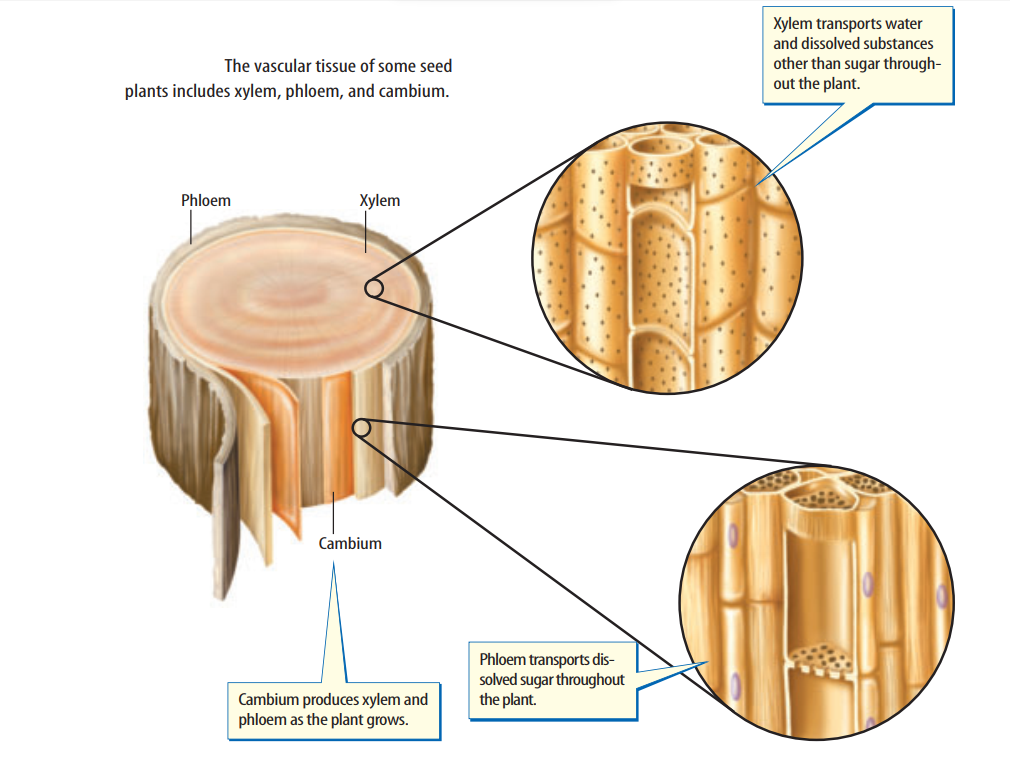
Xylem (ZI lum, Greek xulon, ‘wood’) tissue is made up of hollow, tubular cells that are stacked one on top of the other to form a structure called a vessel. These vessels transport water and dissolved substances from the roots throughout the plant. The thick cell walls of xylem are also important because they help support the plant.
Phloem (FLOH em, Greek phloiós, ‘bark’.) is a plant tissue also made up of tubular cells that are stacked to form structures called tubes. Tubes are different from vessels. Phloem tubes move food from where it is made to other parts of the plant where it is used or stored. In some plants, a cambium is between xylem and phloem.
Cambium (KAM bee um, medieval Latin, ‘change, exchange’) is a tissue that produces most of the new xylem and phloem cells. The growth of this new xylem and phloem increases the thickness of stems and roots.
Gymnosperms are vascular plants that produce seeds that are not protected by fruit. The word gymnosperm comes from the Greek language and means “naked seed.” Another characteristic of gymnosperms is that they do not have flowers. Leaves of most gymnosperms are needlelike or scalelike. Many gymnosperms are called evergreens because some green leaves always remain on their branches.
Coniferophyta (kuh NIH fur uh fi tuh), the conifers. Pines, firs, spruces, redwoods, and junipers belong to this division. It contains the greatest number of gymnosperm species. All conifers produce two types of cones—male and female. Both types usually are found on the same plant. Cones are the reproductive structures of conifers. Seeds develop on the female cone but not on the male cone.
An angiosperm is a vascular plant that flowers and produces fruits with one or more seeds, such as the peaches. The fruit develops from a part or parts of one or more flowers. Angiosperms make up the plant division Anthophyta (AN thoh fi tuh).
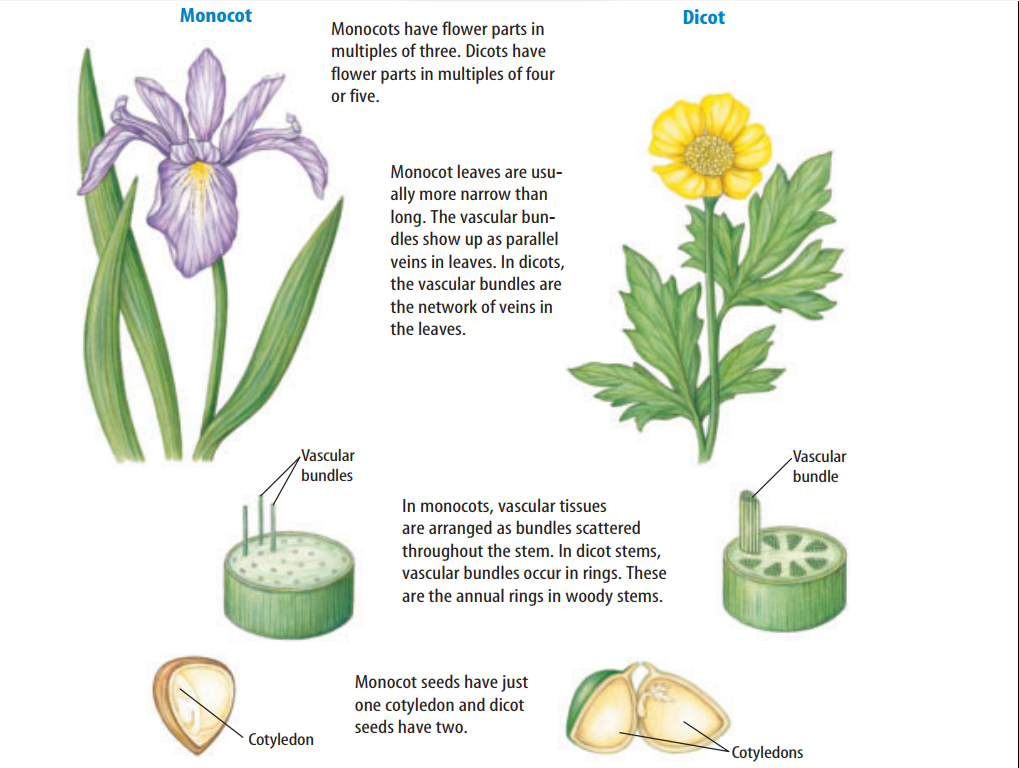
Angiosperms are divided into two groups—the monocots and the dicots—shortened forms of the words monocotyledon (mah nuh kah tuh LEE dun) and dicotyledon (di kah tuh LEE dun).
A cotyledon is part of a seed often used for food storage. The prefix mono means “one,” and di means “two.” Therefore, monocots have one cotyledon inside their seeds and dicots have two.
Many important foods come from monocots, including corn, rice, wheat, and barley. If you eat bananas, pineapple, or dates, you are eating fruit from monocots. Lilies and orchids also are monocots.
Dicots also produce familiar foods such as peanuts, green beans, peas, apples, and oranges. You might have rested in the shade of a dicot tree. Most shade trees, such as maple, oak, and elm, are dicots.
Plants called biennials (bi EH nee ulz) complete their life cycles within two years. Biennials such as parsley store a large amount of food in an underground root or stem for growth in the second year. Biennials produce flowers and seeds only during the second year of growth. Angiosperms that take more than two years to grow to maturity are called perennials. Herbaceous perennials such as peonies appear to die each winter but grow and produce flowers each spring. Woody perennials such as fruit trees produce flowers and fruits on stems that survive for many years.
wood pulp
Echinacea
mint
Mentha
Ecology is the study of the interactions among organisms and their environment. Abiotic (ay bi AH tihk) factors are the nonliving parts of the environment. Living or once-living organisms in the environment are called biotic (bi AH tihk) factors.
In any environment, birds, insects, and other living things, including humans, depend on one another for food and shelter. They also depend on the abiotic factors that surround them, such as water, sunlight, temperature, air, and soil. All of these factors and others are important in determining which organisms are able to live in a particular environment.
penetrate: go in or through.
airborne: transmitted by or carried through the air.
Various kinds of soil contain different amounts of nutrients, minerals, and moisture. Different plants need different kinds of soil.
Abiotic factors do not provide everything an organism needs for survival. Organisms depend on other organisms for food, shelter, protection, and reproduction.
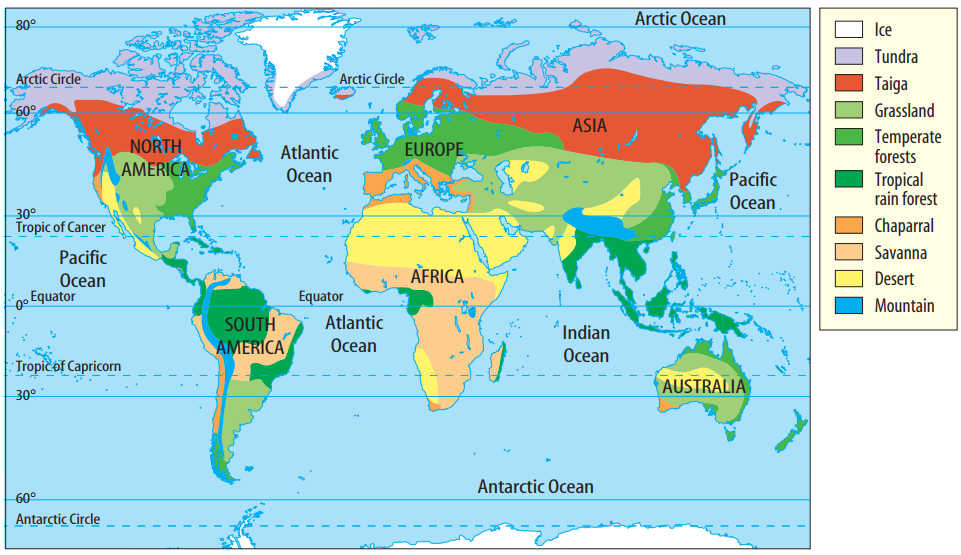
The living world is highly organized. Atoms are arranged into molecules, which in turn might be organized into cells. Cells form tissues, tissues form organs, and organs form organ systems. Together, organ systems form organisms. An organism is one individual from a population. All of the individuals of one species that live in the same area at the same time make up a population. The populations of different species that interact in some way are called a community. All of the communities in an area and the abiotic factors they interact with make up an ecosystem. A biome is a large region with plants and animals well adapted to the soil and climate of the region. The level of biological organization that is made up of all the ecosystems on Earth is the biosphere.
The resources of the environment and the ways the organisms use these resources determine how large a population or community can become.
tundra
The number of individuals in the population is the population’s size.
Pasture lands in the narrow sense are enclosed tracts of farmland, grazed by domesticated livestock, such as horses, cattle, sheep, or swine.
The number of individuals in a population that occupy a definite area is called population density.
Another characteristic of populations is spacing, or how the organisms are arranged in a given area. They can be evenly spaced, randomly spaced, or clumped together. If organisms have a fairly consistent distance between them, they are evenly spaced. In random spacing, each organism’s location is independent of the locations of other organisms in the population. Random spacing of plants usually results when wind or birds disperse seeds. Clumped spacing occurs when resources such as food or living space are clumped. Clumping results when animals gather in groups or plants grow near each other in groups.
A limiting factor is any biotic or abiotic factor that limits the number of individuals in a population. Competition is the struggle among organisms to obtain the same resources needed to survive and reproduce. As population density increases, so does competition among individuals for the resources in their environment.
Carrying capacity is the largest number of individuals of a species that an environment can support and maintain for a long period of time. If a population gets bigger than the carrying capacity of the environment, some individuals are left without adequate resources. They will die or be forced to move elsewhere.
The maximum rate at which a population increases when plenty of food and water are available, the weather is ideal, and no diseases or enemies exist, is its biotic potential. Most populations never reach their biotic potential, or they do so for only a short period of time. Eventually, the carrying capacity of the environment is reached and the population stops increasing.
Symbiosis (sihm bee OH sus) is any close interaction between two or more different species. Symbiotic relationships can be identified by the type of interaction between organisms. Mutualism is a symbiotic relationship in which two different species of organisms cooperate and both benefit. Commensalism is a form of symbiosis that benefits one organism without affecting the other organism. Parasitism is a symbiotic relationship between two species in
which one species benefits and the other species is harmed.
Predation is the act of one organism hunting, killing, and feeding on another organism. Predators are biotic factors that limit the size of the prey population. Availability of prey is a biotic factor that can limit the size of the predator population. Because predators are more likely to capture old, ill, or young prey, the strongest individuals in the prey population are the ones that manage to reproduce. This improves the prey population over several generations.
In a community, every species plays a particular role. For example, some are producers and some are consumers. Each also has a particular place to live. The role, or job, of an organism in the ecosystem is called its niche (NICH). The place where an organism lives is called its habitat.
Aeration involves perforating the soil with small holes to allow air, water and nutrients to penetrate the grass roots.
Producers are organisms that take in and use energy from the Sun or some other source to produce food. Some use the Sun’s energy for photosynthesis to produce carbohydrates. For example, plants, algae, and some one-celled, photosynthetic organisms are producers. Consumers are organisms that take in energy when they feed on producers or other consumers. The transfer of energy does not end there. When organisms die, other organisms called decomposers, take in energy as they break down the remains of organisms. This movement of energy through a community can be diagrammed as a food chain or a food web. A food web is a series of overlapping food chains that exist in an ecosystem.
herbivore
carnivore
top carnivore
Phytoplankton are microscopic marine algae.
Certain bacteria take in energy through a process called chemosynthesis. In chemosynthesis, the bacteria produce food using the energy in chemical compounds instead of light energy.
The law of conservation of mass states that matter on Earth is never lost or gained. It is used over and over again. In other words, it is recycled.
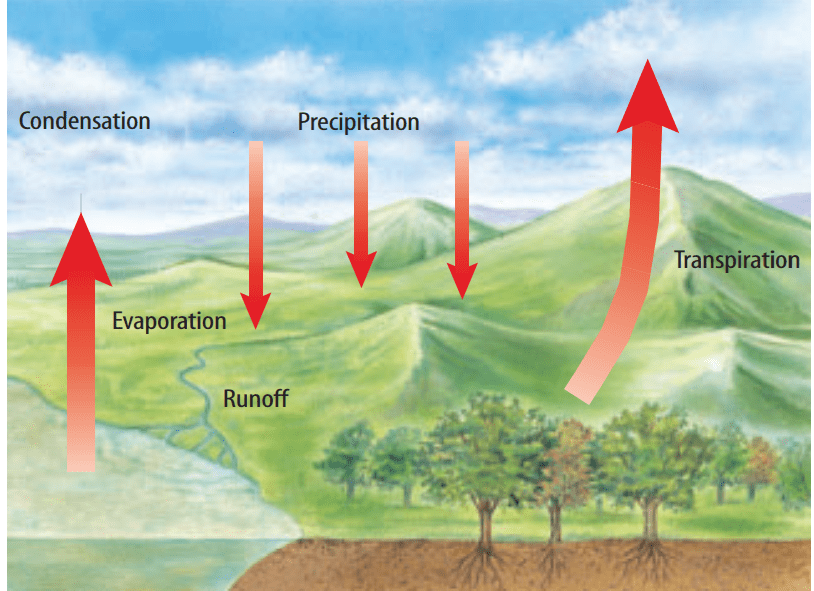
The water cycle involves the processes of evaporation, condensation, and precipitation. Heat from the Sun causes water on Earth’s surface to evaporate, or change from a liquid to a gas, and rise into the atmosphere as water vapor. As the water vapor rises, it encounters colder and colder air and the molecules of water vapor slow down. Eventually, the water vapor changes back into tiny droplets of water. It condenses, or changes from a gas to a liquid. These water droplets clump together to form clouds. When the droplets become large and heavy enough, they fall back to Earth as rain or other precipitation.
germination of seeds: spore.
ordeal
imperious
boghole
buck off: fall off
bump up: increase
lather: foam.
errant: wandering.
steer: vehicle.
replenish: fill up.
Living things rely on Earth’s natural resources—the parts of the environment that are useful or necessary for the survival of living organisms. Natural resources supply energy for automobiles and power plants.
A renewable resource is any natural resource that is recycled or replaced constantly by nature.
reservoirs: an enlarged lake behind a dam.
Natural resources that are used up more quickly than they can be replaced by natural processes are nonrenewable resources.
Petroleum is formed mostly from the remains of microscopic marine organisms buried in Earth’s crust. Fossil fuels are fuels formed in Earth’s crust over hundreds of millions of years.
wind power
Water is a renewable energy source that can be used to generate electricity. Hydroelectric power is electricity that is produced when the energy of falling water is used to turn the turbines of an electric generator.
Nuclear power does not contribute to air pollution. However, uranium is a nonrenewable resource, and mining it can disrupt ecosystems. Nuclear power plants also produce radioactive wastes that can seriously harm living organisms. Some of these wastes remain radioactive for thousands of years, and their safe disposal is a problem that has not yet been solved. Accidents also are a danger.
The heat energy contained in Earth’s crust is called geothermal energy. Most geothermal power plants use this energy to produce steam to generate electricity.
A geyser is a spring characterized by an intermittent discharge of water ejected turbulently and accompanied by steam.

solar energy and solar cells: Photovoltaic (PV) cells are small and easy to use.
insulate: protect from heat, cold, or noise.
A pollutant is a substance that contaminates (corrupts) the environment. Air pollutants include soot, smoke, ash, and gases such as carbon dioxide, carbon monoxide, nitrogen oxides, and sulfur oxides.
Air pollutants include soot, smoke, ash, and gases such as carbon dioxide, carbon monoxide, nitrogen oxides, and sulfur oxides.
Acidity is measured by a value called pH. Acid precipitation has a pH below 5.6. Acid precipitation washes nutrients from the soil, which can lead to the death of trees and other plants. Runoff from acid rain that flows into a lake or pond can lower the pH of the water. If algae and microscopic organisms cannot survive in the acidic water, fish and other organisms that depend on them for food also die.
Using low-sulfur fuels, such as natural gas or low-sulfur coal, can help reduce acid precipitation. However, these fuels are less plentiful and more expensive than highsulfur coal. Smokestacks that remove sulfur dioxide before it enters the atmosphere also help. Reducing automobile use and keeping car engines properly tuned can reduce acid rain caused by nitrogen oxide pollution. The use of electric cars, or hybrid-fuel cars that can run on electricity as well as gasoline, also could help.
Malaria is a serious parasite infection that is transmitted by the bite of female mosquitoes.
Atmospheric gases that trap heat are called greenhouse gases. One of the most important greenhouse gases is carbon dioxide (CO2). CO2 is a normal part of the atmosphere. It is also a waste product that forms when fossil fuels are burned. Over the past century, more fossil fuels have been burned than ever before, which is increasing the percentage of CO2 in the atmosphere. The atmosphere might be trapping more of the Sun’s heat, making Earth warmer. A rise in Earth’s average temperature, possibly caused by an increase in greenhouse gases, is known as global warming.
ozone depletion
CFC
kerosene: paraffin, or lamp oil.
Ozone damages the lungs and other sensitive tissues of animals and plants. For example, it can cause the needles of a Ponderosa pine to drop, harming growth.
formaldehyde
secondhand smoke
Radon is a naturally occurring, radioactive gas that is given off by some types of rock and soil. Radon has no color or odor. It can seep into basements and the lower floors of buildings. Radon exposure is the second leading cause of lung cancer in the United States.
Some pollutants, especially those containing mercury and other metals, can build up in the tissues of fish. Eating contaminated fish and shellfish can transfer these metals to people, birds, and other animals.
Sewage is a type of wastewater that is produced by a community of people.
An algal bloom is the overgrowth of microscopic algae or algae-like bacteria in fresh, salt, or brackish waters.
Oil spills are a well-known ocean pollution problem.
If this water comes into contact with pollutants as it moves through the soil and into an aquifer (an underground layer of water-bearing permeable rock), the aquifer could become polluted.
When a farmer plows a field or a forest is cut down, soil is left bare. Bare soil is more easily carried away by rain and wind. The movement of soil from one place to another is called erosion (ih ROH zhun).
Waste materials that are harmful to human health or poisonous to living organisms are hazardous wastes. They include dangerous chemicals, such as pesticides, oil, and petroleum-based solvents used in industry. They also include radioactive wastes from nuclear power plants, from hospitals that use radioactive materials to treat disease, and from nuclear weapons production. Leftover paints, batteries, pesticides, drain cleaners, and medicines are hazardous wastes that should not be discarded in the trash. They should never be poured down a drain, onto the ground, or into a storm sewer.
Carpooling is the sharing of car journeys so that more than one person travels in a car, and prevents the need for others to have to drive to a location themselves.
Reduce-Reuse-Recycle
utensils: a tool with a particular use, especially in a kitchen or house: In the drawer was a selection of kitchen utensils – spoons, spatulas, knives, and whisks.
curbside: a side of a pavement or street bordered by a curb. A curb, or kerb, is the edge where a raised sidewalk or road median/central reservation meets a street or other roadway.
A batch means a group or collection of objects or the amount of something produced at one time.
Compost is a mixture of ingredients used as plant fertilizer and improve soil physical, chemical and biological properties. Clippings are a valuable source of nutrients and you can use less nitrogen fertilizer if you recycle clippings to the lawn.
rancher: someone who owns or works on a ranch, or farm.
Tongs are a type of tool used to grip and lift objects instead of holding them directly with hands.


Leave a comment