The five themes: Location
Where is it?
Place
What is it like?
Region
How are places similar or different?
Movement
How do people, goods, and ideas
move from one location to another?
Human-Environment Interaction
How do people relate to the physical
world?
Commuter Rail
prime meridian
Greenwich meridian
Headquarters
brochure: a type of small magazine that contains pictures and information on a product or a company.
FORMAL REGIONS A formal region is defined by a limited number of
related characteristics.
FUNCTIONAL REGIONS A functional region is organized around a set
of interactions and connections between places.
PERCEPTUAL REGIONS A perceptual region is a region in which people perceive, or see, the characteristics of the region in the same way.
irrigation ditches: a ditch that artificially supplies water to an area of dry land.
Geographers analyze movement by looking at three types of
distance: linear distance, time distance, and psychological distance.
PSYCHOLOGICAL DISTANCE Psychological distance refers to the way
people view distance. When you were younger, some locations seemed
very far away. As you grew older, the distance to these locations probably seemed to shrink. Studies show that, as we become familiar with a
place, we think it is closer than it actually is. Less familiar places seem
to be further away. Psychological distance may influence decisions
about many different human activities.
cartographer, mapmaker.
The three types of maps are general reference maps,
thematic maps, and navigational maps. One kind of general reference
map is called a topographic map, which is a representation of natural
and man-made features on the earth. Thematic maps emphasize specific kinds of information, such as climate or population density. Sailors
and pilots use the third type of map—navigation maps.
emit: release.
composite map
Geographic Information Systems (GIS).
GLOBAL POSITIONING SYSTEM (GPS) The exact position—latitude, longitude, altitude,
and time—is displayed on a hand–held receiver.
A cartogram is a map in which the geometry of regions is distorted in order to convey the information of an alternate variable.
Nigerian surveyors use
a theodolite, a type of
surveying instrument.
It precisely measures
angles and distances
on the earth.
LEGEND A legend or key lists
and explains the symbols and
use of color on the map.
Ratio Scale
Bar Scale
Tropic of Cancer
Tropic of Capricorn
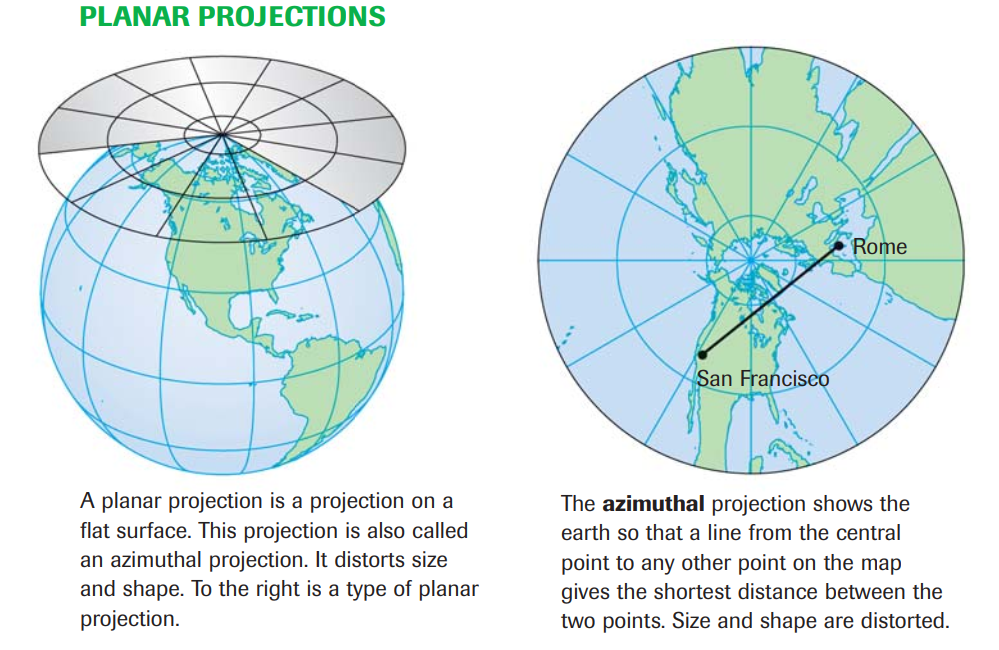
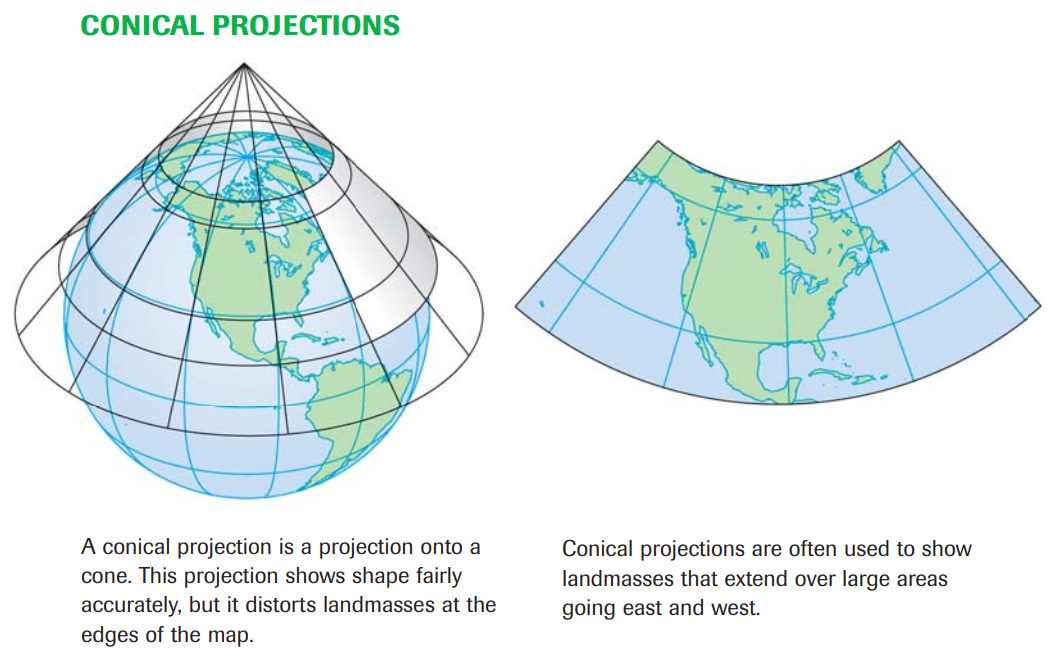
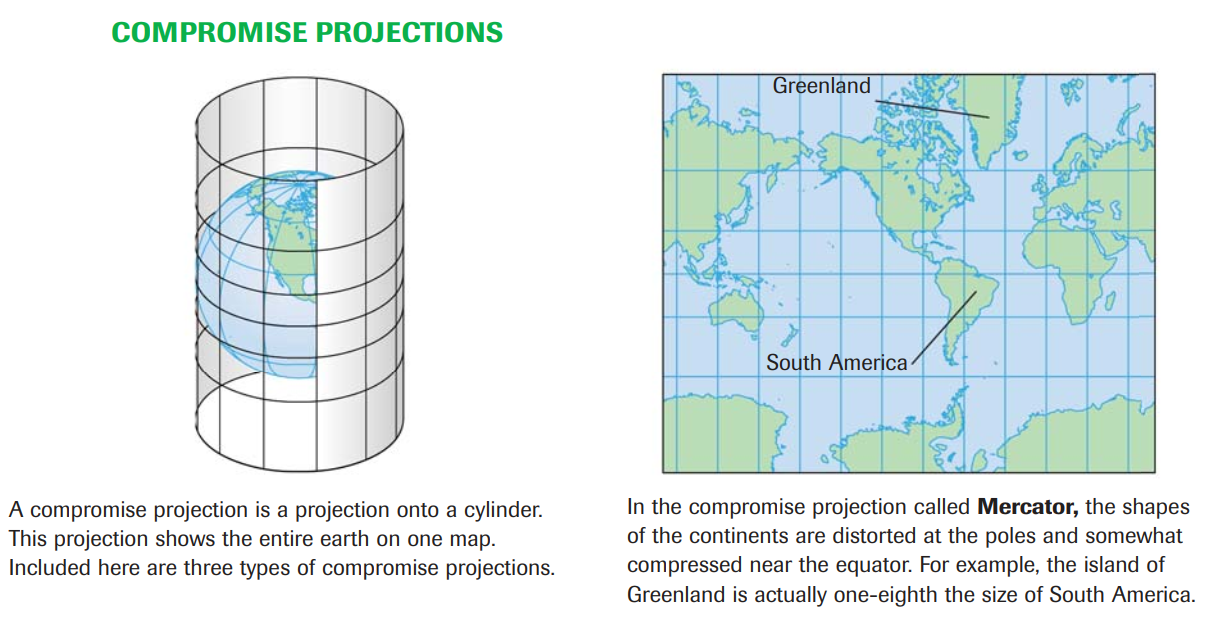
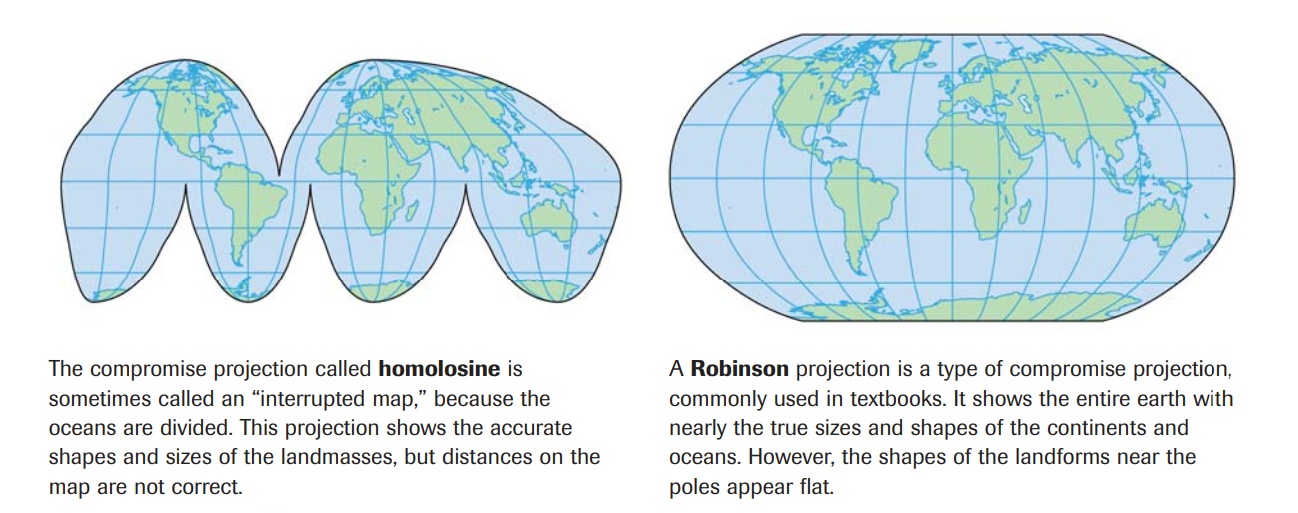
A projection is a way of showing the curved surface of the earth on a
flat map.
contour lines
elevation
Qualitative maps
use colors, symbols, dots, or lines to
help you see patterns related to a specific idea.
Flow-line maps
illustrate movement of people,
goods, ideas, animals, or even glaciers. The information is usually
shown in a series of arrows.
Location, direction, and scope of
movement can be seen. The width
of the arrow may show how extensive the flow is. Often the information is given over a period of time.
The earth is about 24,900 miles in circumference and about 7,900 miles
in diameter.
hydrosphere
atmosphere.
Asthenosphere
lithosphere
biosphere
crust
Mantle
The supercontinent called Pangaea. An ocean called Panthalassa surrounded it.
Fragments of asteroids that reach
the earth are called meteorites.
thrive
The salty water of the ocean
circulates through three basic motions: currents,
waves, and tides.
Waves are swells or ridges
produced by winds.
hydrologic cycle
The largest saltwater lake is the Caspian Sea in Western Asia.
The largest freshwater lake is Lake Baikal
in Russia.
drainage
tributaries
Geographers call
an area drained by a major river and its tributaries a drainage basin.
The water table can
rise or fall depending on the amount of precipitation in the region and
on the amount of water pumped out of the ground.
Rock layers that
store water are
called aquifers.
BUTTE
a raised, flat area of land
with steep cliffs, smaller
than a mesa
MESA
a wide, flat-topped
mountain with steep
sides, larger than a butte
CATARACT
a step-like series
of waterfalls
STEPPE
a wide, treeless
grassy plain
PRAIRIE
a large, level area
of grassland with
few or no trees
tectonic plates
Relief is the difference in elevation of
a landform from its lowest point to its highest point. There
are four categories of relief: mountains, hills, plains, and
plateaus.
A topographic map shows the landforms
with their vertical dimensions and their relationship to
other landforms.
Divergent boundary—Plates move apart, spreading horizontally.
• Convergent boundary—Plates collide, causing either one plate to
dive under the other or the edges of both plates to crumple.
• Transform boundary—Plates slide past one another
seismograph
Aftershocks
vent: an opening that allows air, gas, or liquid to pass out of or into a confined space.
Ring of Fire
Hot springs and geysers are indicators of high temperatures in the earth’s crust.
A geyser is a hot spring that occasionally erupts with
steam jets and boiling water.
Weathering processes create smaller and smaller pieces of rock called
sediment.
Mechanical weathering
does not change the composition
of the rock—only its size.
crivice: a narrow opening or fissure, especially in a rock or wall.
Chemical weathering
abrasion
erosion
sand dunes
Deposits of loess (LOH•uhs), windblown silt and clay sediment that produce very fertile soil, are found across
the world.
Rocks left behind by a glacier may form a ridge or a hill called moraine.
esker
kettles
humus
decaying corpses: decomposition
debris: rubbish
turmoil: disorder
trolley
trestle
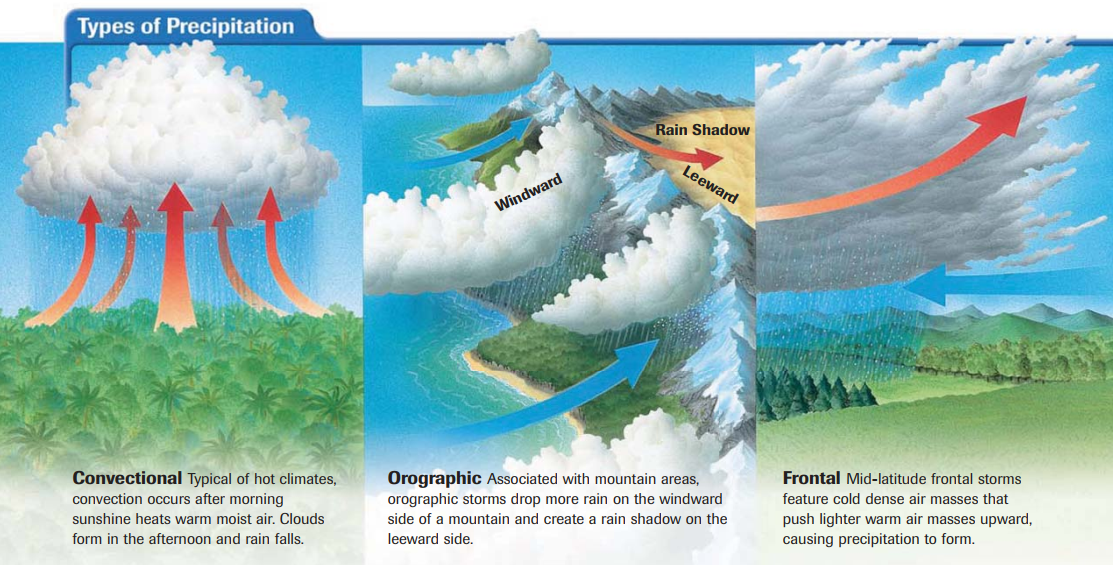
Convectional precipitation occurs in hot, moist climates where the
sun quickly heats the air. The heated air rises, and by afternoon clouds
form and rain falls. Orographic precipitation falls on the windward side
of hills or mountains that block moist air and force it upward. The air
cools and rain or snow falls. The land on the leeward side is called a rain
shadow because it gets little rain from the descending dry air. Frontal
movement causes most precipitation in the middle latitudes. A front is
the boundary between two air masses of different temperatures or density. Rain or snow occurs when lighter, warm air is pushed upward by
the colder, denser air. The rising air cools, water vapor condenses, and
precipitation falls.
drastically
floodplain
tributary: a river or stream flowing into a larger river or lake.
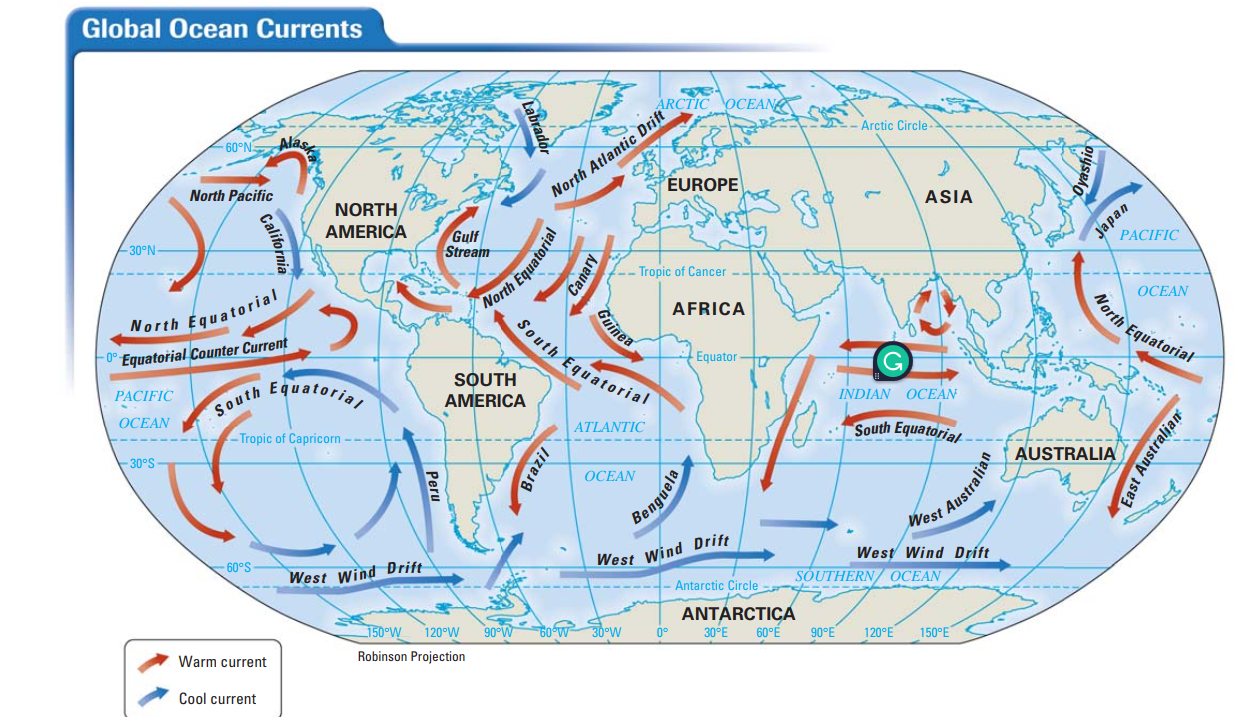
Wind and ocean currents help
distribute the sun’s heat from one part of the
world to another through convection, the transfer
of heat in the atmosphere by upward motion of
the air.
convection, process by which heat is transferred by movement of a heated fluid such as air or water.
The winds would blow in
straight lines, but since the earth rotates they are
turned at an angle. In the Northern Hemisphere,
they turn to the right. In the Southern Hemisphere, they turn to the left. This bending of the
winds is called the Coriolis effect.
Geographers divide the earth into three general
zones of latitude: low or tropical, middle or temperate, and high or polar.
prevailing
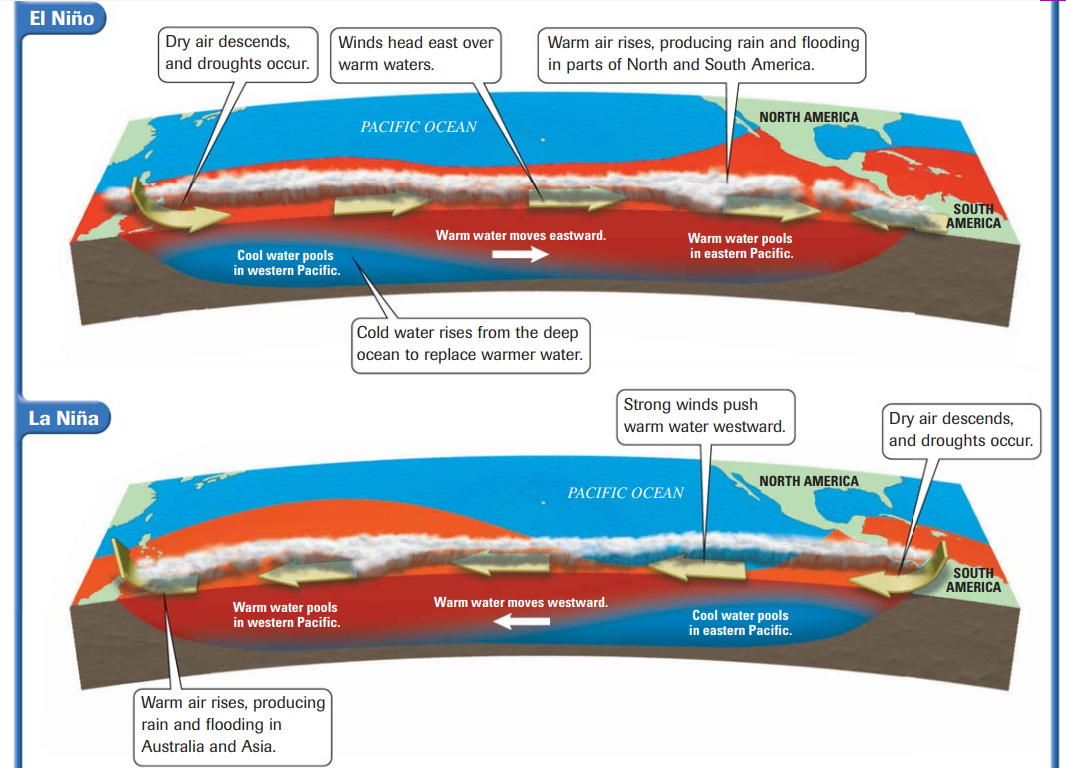
controversy: disagreement
World climates are generally divided into five large regions: tropical,
dry, mid-latitude, high latitude, and highland.
taiga
A climograph shows the average daily temperature
and precipitation for each month of the year for a specific location.
The ecosystem of a region is
referred to as a biome. Biomes are further divided into forest, grassland,
desert, and tundra.
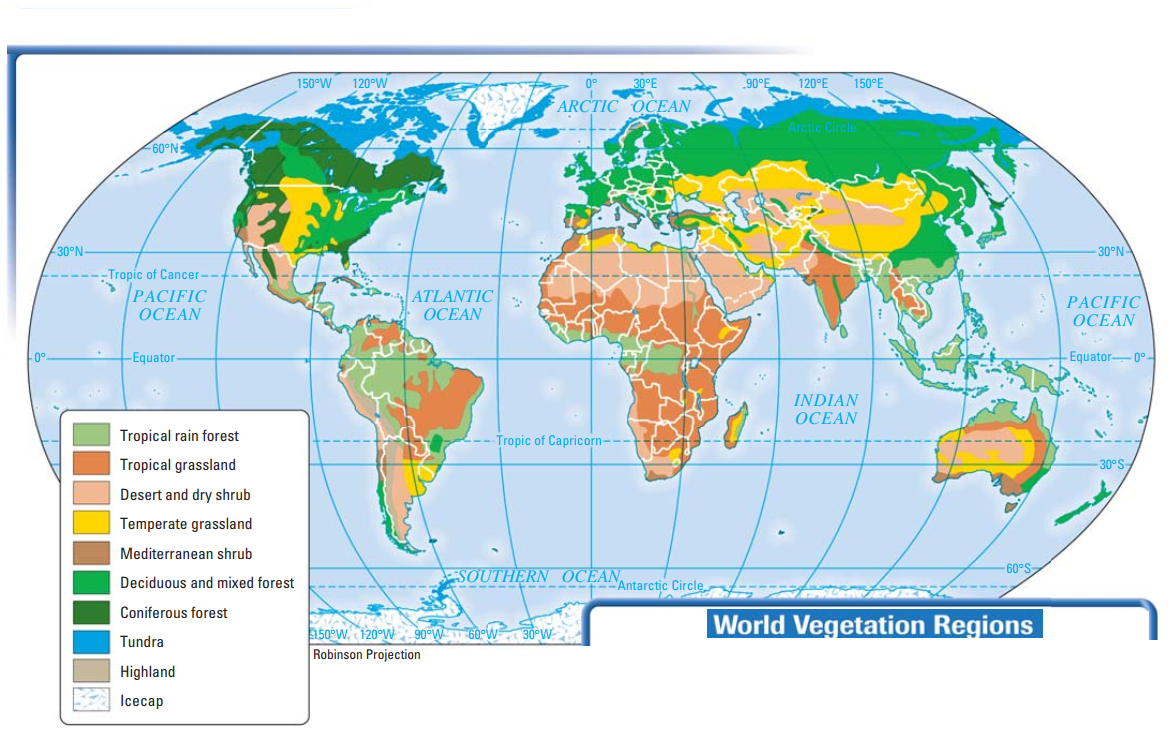
Broadleaf trees, such as maple, oak,
birch, and cottonwood, are also called deciduous trees.
Needleleaf trees are also called coniferous trees because they are
cone bearing.
In the
Northern Hemisphere, the terms steppe or prairie are used to identify temperate grasslands. Vast areas of Eurasia are covered with steppe.
In the Southern Hemisphere, the temperate grasslands may be
referred to as pampas.
Irrigation is the artificial application of water to the soil through various systems of tubes, pumps, and sprays.
Biomes are areas of the planet with a similar climate and landscape, where similar animals and plants live.
- Tropical Rainforest.
- Temperate Forest.
- Desert.
- Tundra.
- Taiga (Boreal Forest)
- Grassland.
- Savanna.
Culture is the total of knowledge, attitudes, and
behaviors shared by and passed on by the members
of a specific group. Culture acts as a blueprint for
how a group of people should behave if they want to
fit in with the group. It ties us to one group and sep
arates us from other groups—and helps us to solve
the problems that all humans face. Culture involves
the following factors:
• food and shelter • education
• religion • security/protection
• relationships to family and others • political and social organization
• creative expression
• language
A group that shares a geographic region, a sense of
identity, and a culture is called a society. Sometimes
you will hear the term ethnic group used to refer to a
specific group that shares a language, customs, and a
common heritage.
individual, family, clan, tribe.
Taking existing technology and resources and creating
something new to meet a need is called innovation. This spread of ideas, inventions, or patterns of behavior is
called diffusion.
facilitate: make (an action or process) easy or easier.
A cultural hearth is a site of innovation from which basic ideas, materials, and technology diffuse to many cultures. River civilizations such
as those along the Indus River in South Asia, Huang He in East Asia,
the Nile River in Africa, and the Tigris and Euphrates in Southwest Asia
are the best known cultural hearths.
Acculturation occurs when a society changes because it
accepts or adopts an innovation.
Religion consists of a belief in a supernatural power or powers that are regarded as the creators and maintainers of the universe.
Religions establish beliefs and values that define how people worship the
divine being or divine forces and how they behave toward each other.
Traditionally, religions have been categorized as one of three types:
• monotheistic, with a belief in one god
• polytheistic, with a belief in many gods
• animistic or traditional, often with a belief in divine forces in nature
missionary: a person sent on a religious mission, especially one sent to promote Christianity in a foreign country.
Cultures produce performing arts, visual arts, and literature.
Performing arts developed by a culture often include music, dance,
theater, and film. Music is a cultural aspect found in all societies. The
instruments on which the music is played and the style of music are
unique to each group.
Visual arts include architecture, painting, sculpture, and textiles. The
style of the visual arts will reflect materials available in the region and
cultural themes.
Oral and written literature, such as poems, folk tales, and stories, often
illustrate aspects of the culture such as attitudes and behaviors. They can
also be a reflection of the environment in which they are produced.
sanitation: conditions relating to public health, especially the provision of clean drinking water and adequate sewage disposal.
The fertility rate shows the average number of children a woman of childbearing
years would have in her lifetime, if she had children at the current rate for her country.
bulge: a rounded swelling or protuberance that distorts a flat surface.
To find the rate at which population is growing, subtract the mortality rate from the birthrate. The
difference is the rate of natural increase, or population growth rate.
Another way to analyze populations is to use
a population pyramid, a graphic device that shows sex and age distribution of a population. A population pyramid allows geographers to
examine how events in society, such as wars, famine, or epidemics,
affect the population of a country or region.
Reasons for migrating
are sometimes referred to as push-pull factors. Push factors are those that
cause people to leave their homeland and migrate to another region.
Environmental conditions, such as drought or other natural disasters, are
examples of push factors. Other push factors are political, such as war or
the persecution of certain groups of people for ethnic or religious reasons.
Pull factors
draw or attract people to another location. Countries with good economic opportunities and high salaries are the likely destinations for migrants.
Favorable climate is another pull factor.
census
shack
When a nation and a state
occupy the same territory, that territory is called a nation-state.
compact: small
Levels of Government
NATIONAL
Size Very large units composed
of many medium and small units
Effect Little direct contact with
the people
Role Deals with issues affecting the entire nation,
such as security or international diplomatic relations
Example United States
STATE/REGIONAL
Size Larger units composed
of many smaller units
Effect More direct contact
with the people than national units
Role Deals with issues that affect all of the
smaller units, such as licensing drivers
Example States or regional groups, such as the
Tennessee Valley Authority
LOCAL
Size Smaller units of government
Effect Very direct contact with the
people
Role Deals with issues that are
narrow in scope, such as streets and sanitation
Example A school district or town
Smaller cities or towns with open land between
them and the central city are called exurbs. The
city, its suburbs, and exurbs link together economically to form a functional area called a
metropolitan area. A megalopolis is formed when
several metropolitan areas grow together. An example of a megalopolis is the corridor in the northeastern United States including Boston, New York,
Philadelphia, Baltimore, and Washington, D.C.
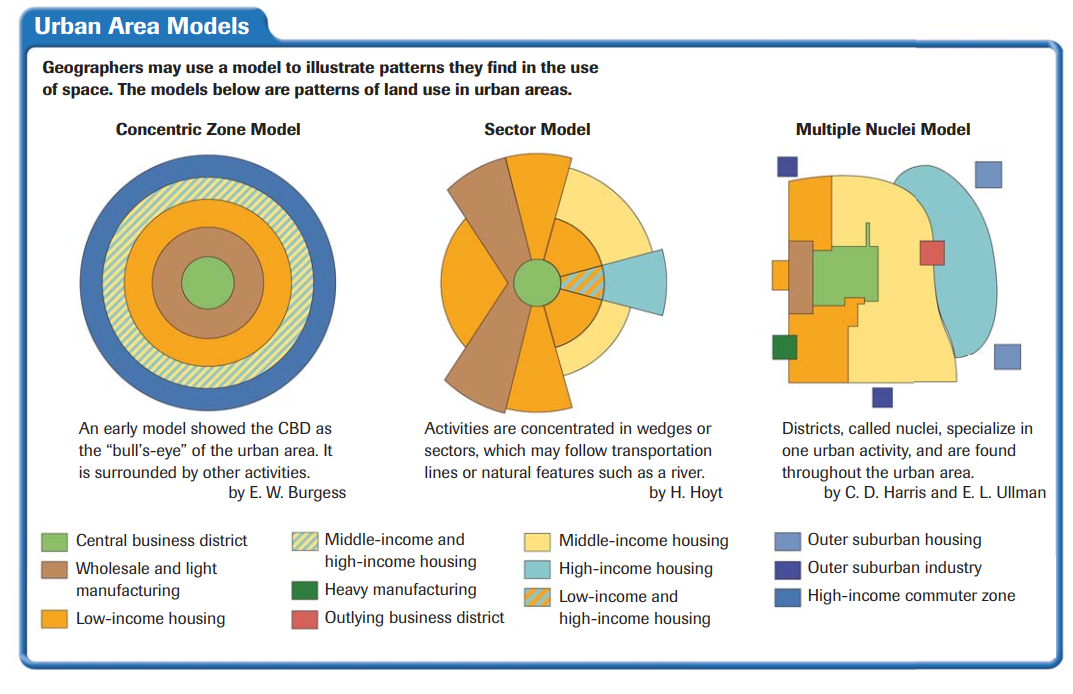
Basic land use patterns found in all cities are:
• residential, including single-family housing and apartment buildings
• industrial, areas reserved for manufacturing of goods
• commercial, used for private business and the buying and selling of
retail products
The core of a city is almost always based on commercial activity. This
area of the city is called the central business district (CBD).
The way people produce and
exchange goods and services is called an economic system. In the world
today, there are four basic types of economic systems:
• Traditional Economy Goods and services are
traded without exchanging money. Also called
“barter.”
• Command Economy Production of goods and
services is determined by a central government,
which usually owns the means of production.
Production does not necessarily reflect the consumer demand. Also called a planned economy.
• Market Economy Production of goods and
services is determined by the demand from
consumers. Also called a demand economy or
capitalism.
• Mixed Economy A combination of command
and market economies provides goods and services so that all people will benefit.
People may choose from a variety of methods to meet their basic needs.
Some groups simply raise enough food or animals to meet their need to
eat, but have little left over to sell to others. This is called subsistence
agriculture. In other areas, market-oriented agriculture produces crops
or animals that farmers sell to markets.
The four levels of
economic activity describe how materials are gathered and processed
into goods or how services are delivered to consumers.
Primary Activities involve gathering raw materials such as timber for
immediate use or to use in the making of a final product.
Secondary Activities involve adding value to materials by changing
their form. Manufacturing automobiles is an example.
Tertiary Activities involve providing business or professional services.
Salespeople, teachers, or doctors are examples.
Quaternary Activities provide information, management, and
research services by highly-trained persons.
The more developed an economy is, the greater the number and variety
of activities you will find.
Renewable—These resources can be replaced through natural
processes. Examples include trees and seafood.
• Non-renewable—These resources cannot be replaced once they have
been removed from the ground. Examples include metals, such as
gold, silver, and iron, and non-metals, such as gemstones, limestone,
or sulfur. Also included are fossil fuels, petroleum, natural gas, and
coal. They are the basis of energy production.
• Inexhaustible energy sources—These resources, which are used for
producing power, are the result of solar or planetary processes and
are unlimited in quantity. They include sunlight, geothermal heat,
winds, and tides.
A nation’s infrastructure consists of the basic support
systems needed to keep an economy going, including power, communications, transportation, water, sanitation (public health), and education systems. The more sophisticated the infrastructure, the more developed the country.
One is per capita income, the average amount of money
earned by each person in a political unit. Another way of comparing
economies examines levels of development based on economic activities
such as industry and commerce. Still others use a standard of living that
reflects a society’s purchasing power, health, and level of education.
A commonly-used statistic to measure the economy of
a country is the gross national product (GNP). The GNP is the total value
of all goods and services produced by a country over a year or some
other specified period of time.
Because economies have become so interconnected, the GNP may
reflect the value of goods or services produced in one country by a company based in another country.
GDP, or gross
domestic product—which is the total value of all goods and services produced within a country in a given period of time.
There are several mountain
ranges in the Appalachian system. Among them are the
Green and the Catskill mountains in the north and the
Blue Ridge and the Great Smoky mountains in the south.
North America’s highest peak—Mt. McKinley (also called by its Native
American name, Denali)—is in Alaska, towering 20,320 feet above sea
level. Major earthquakes occur near the Pacific ranges.

Three
of the islands—Ellesmere, Victoria, and Baffin—are
huge. In North America, only Greenland is larger.
freight: goods or cargo carried by ship, train, truck, or airplane.
The continent’s longest and busiest river system is
the Mississippi-Missouri-Ohio. The Mississippi River
runs almost the north-south length of the United
States, from Minnesota to the Gulf of Mexico. (See
map at right.) The Mississippi’s main tributaries, the
Ohio and Missouri rivers, are major rivers in their own
right. Canada’s longest river is the Mackenzie River,
which is part of a river system that flows across the
Northwest Territories to the Arctic Ocean.
An avalanche is a rapid flow of snow down a slope, such as a hill or mountain.
prospector, a person who searches for the natural occurrence of gold, petroleum, etc.
sparse: thinly dispersed or scattered.
deciduous: broadleaved, (of a tree or shrub) shedding its leaves annually.
the prevailing westerlies—winds that blow from west to east
in the middle of the latitudes.
Large desert areas in the US are the Mojave and the Sonoran.
Mount Waialeale
(wy•AH•lay•AH•lay) on Kauai island receives about
460 inches of rain annually, and is one of the wettest
spots on earth.
obstacle: block, a thing that blocks one’s way or prevents or hinders progress.
formidable: forbidden.
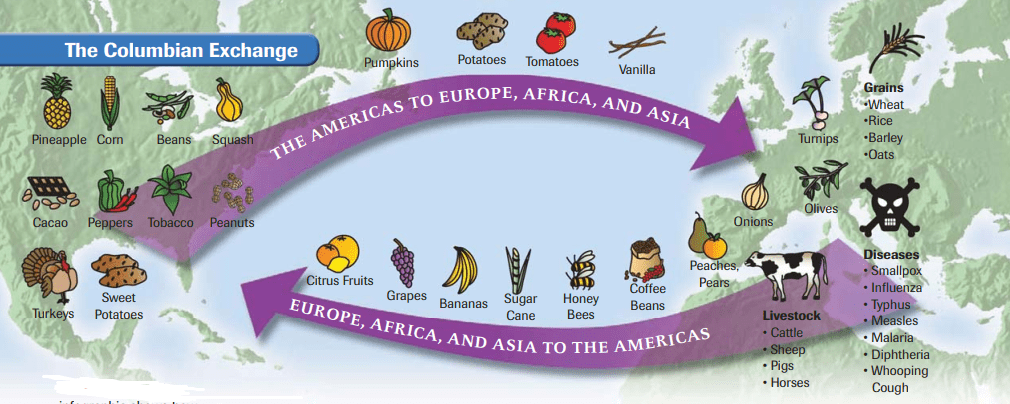
When Europeans from England and France crossed the Atlantic to
North America, they set up colonies along the coast. Then, they moved
inland. As they did, they carved overland trails, including the National
and Wilderness roads and the Oregon and Santa Fe trails.
criss-cross
In 1803, the United States nearly doubled
in size when the government purchased the vast plains region between
the Mississippi and the Rocky Mountains from France. This territory
became known as the Louisiana Purchase.
1913
Use of an
assembly line in
Ford auto plants
streamlines
manufacturing.
1920
Regular radio
programming by
station KDKA in
Pittsburgh begins
the era of mass
communication
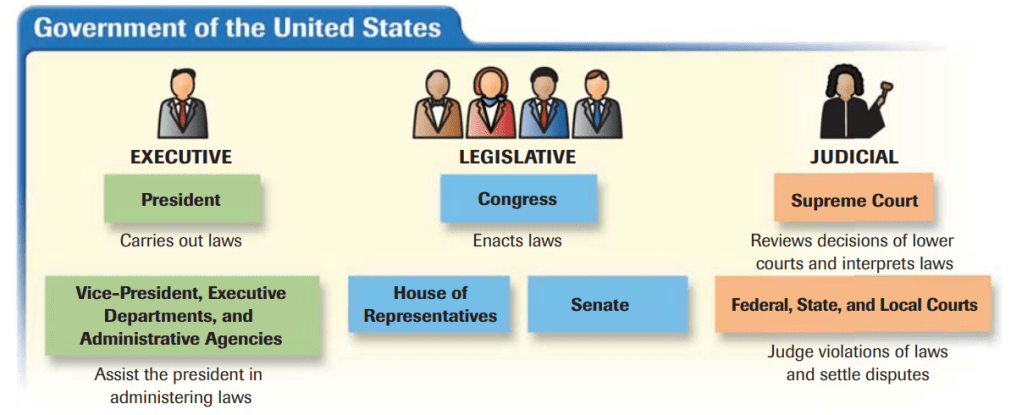
The United States is
a representative democracy, where the people rule through elected representatives. It is also a federal republic, where powers are divided among
the federal, or national, government and various state governments.
The executive branch, headed by
the president, carries out the laws. The president also approves or
vetoes proposed laws. The legislative branch makes the laws, and the
judicial branch interprets the laws by reviewing decisions of lower
courts. The 50 states also have executive, legislative, and judicial
branches. They exercise powers not specifically granted to the federal
government by the Constitution.
The economy is run
largely on free enterprise.
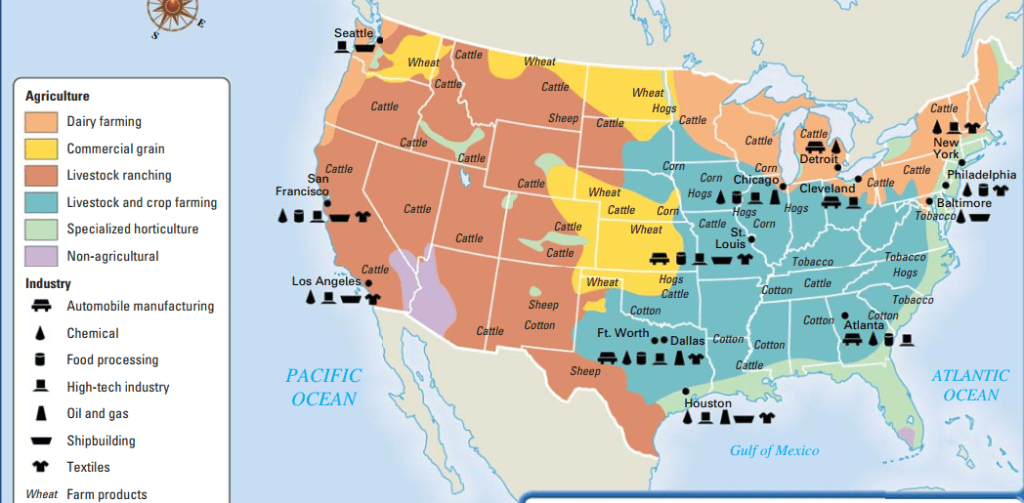
Many American corporations engage in
business worldwide and are called multinationals.
depict: represent by a drawing, painting, or other art form.
The six northern states of the subregion—Maine, Vermont,
New Hampshire, Massachusetts, Rhode Island, and Connecticut—are
called New England. The other three—Pennsylvania, New York, and
New Jersey—are sometimes referred to as Middle Atlantic states.
(Maryland and Delaware, which are included in the South in this book,
are sometimes included in the Middle Atlantic states.) The
region served as the “gateway” to America for millions of immigrants
from all over the world.
unrelenting: continuous
blot out: wipe out, destroy
overplowing: break up clods and crusted top soil, leaving a fine surface mulch for planting or for plant growth.
• contour plowing, or plowing across
a hill rather than up and down, to
stop wind and water erosion
• terracing, or planting crops in
stair-stepped rows, to prevent
soil erosion
• planting trees to hold the soil in
place and to slow the force of
the wind
expedition: voyage
Utilities (water, electricity and gas) are essential services that play a vital role in economic and social development. Public services.
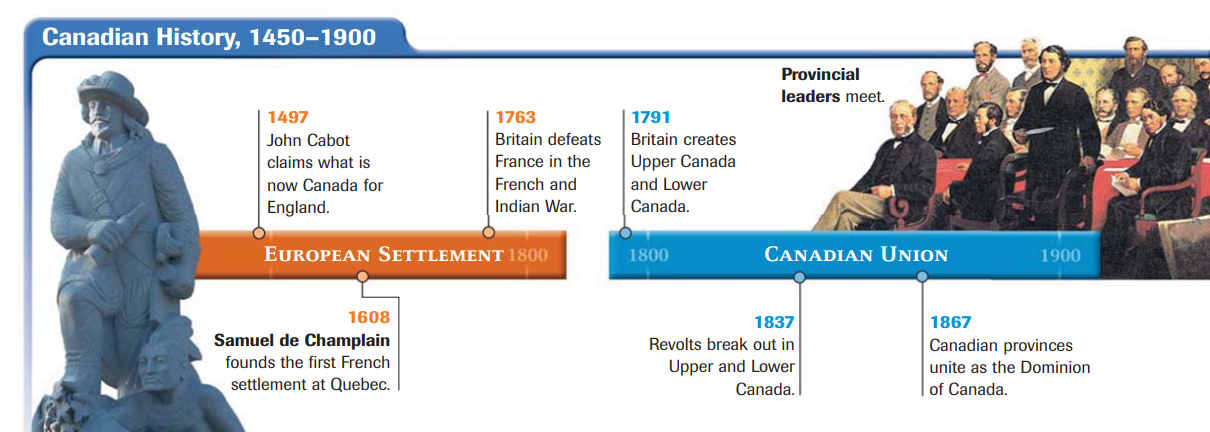
the métis (may•TEES), people of mixed French and native heritage.
consent: promise, agreement.
Many of Canada’s native peoples are found on the country’s 2,300
reserves, public land set aside for them by the government.
The Stratford Festival in Ontario, honoring
William Shakespeare, is known worldwide.
primitive: of or pertaining to the beginning or origin, or to early times; original; primordial; primeval; first.
the abundance of fish—including
cod, haddock, herring, and mackerel
prosperous: successful and boom.
dispersed: distribute or spread over a wide area.
sophomore: a second-year college or high school student.
evacuated: remove (someone) from a place of danger to a safer place.
intimidating: having a frightening, overawing, or threatening effect.
overwhelmed: defeat completely.
coalition: partnership
topple: overbalance or become unsteady and fall slowly.
anthrax: a serious bacterial disease of sheep and cattle, causing acute and often fatal septicemia, and also transmissible to humans.
Poorly planned development that
spreads a city’s population over a wider and wider
geographical area is called urban sprawl.
gobble up: to swallow or eat hastily or hungrily in large pieces; gulp. to seize upon eagerly (often followed by up).
Urban sprawl has a negative impact on the quality of life in many ways.
As suburbs grow, more commuter traffic strains the infrastructure.
Infrastructure consists of the basic facilities, services, and machinery
needed for a community to function.
deplete: use up the supply or resources of.
bracket: place (one or more people or things) in the same category or group.
controversy: disagreement.
Bounded-area maps use lines, colors, and patterns to
communicate information.
Assimilation
forge: fake
slum: a squalid and overcrowded urban street or district inhabited by very poor people.
Angel Falls in eastern
Venezuela is the world’s
tallest waterfall.
span: the full extent of something from end to end; the amount of space that something covers.
Colombia and Venezuela
contain vast plains called llanos (LAH•nohs), which are grassy, treeless
areas used for livestock grazing and farming.
Brazil also contains expansive
plains in the interior of the country. These are the cerrado
(seh•RAH•doh), savannas with flat terrain and moderate rainfall that
make them suitable for farming.
gaucho: cowboy in Argentina.
The Rio Grande, which forms
part of the border between the United States and Mexico, is
longer than any other river in Mexico, Central America, or
the Caribbean.
South America has three major river systems. The Orinoco
is the northernmost river system, with the Amazon also in
the north, and the Paraná in the south of the continent
An estuary is the wide lower
course of a river where its current is met by the tides.
The Caribbean Islands consist of three major groups: the Bahamas, the
Greater Antilles, and the Lesser Antilles. (See the map on page 191.)
These islands together are sometimes called the West Indies and were
the first land encountered by Christopher Columbus when he sailed to
the Western Hemisphere in 1492.
bauxite (aluminum ore)
These include quinine,
which is used to treat malaria,
and curare, which is used to
relax muscles.
jaguars, the great cats of Latin America.
exotic: originating in or characteristic of a distant foreign country.
anaconda: snake
piranha: sharp-toothed fish
chaparral: is a shrubland plant community and geographical feature.
haciendas (estates or ranches)
remedy: a medicine or treatment for a disease or injury.
The name of the
country comes from Mexica, an
older name for the Aztecs. Mexico
has a large mestizo population—
people of mixed Spanish and
Native American heritage.
zocalo: (in Mexico) a public square or plaza.
Maquiladoras: a factory in Mexico run by a foreign company and exporting its products to the country of that company.
eligible: having the right to do or obtain something; satisfying the appropriate conditions.
The pyramids at Tikal
revolt: rebellion.
Rastafarianism is a religious and political movement based in Jamaica.
a smattering of: a few of
Both
reggae and calypso music started
in the Caribbean. Calypso music
began in Trinidad. Calypso combines musical elements from
Africa, Spain, and the Caribbean.
Calypso songs are accompanied by
steel drums and guitars, and they
have improvised lyrics.
Reggae developed in Jamaica in
the 1960s. Many reggae songs deal
with social problems and religion.
African music, Caribbean music, and American music all fed into the
roots of reggae. Bob Marley of Jamaica was a pioneer of reggae. The
music of the Caribbean is one of the elements that lures tourists to the
region, creating jobs for local residents.
resorts:
fishing excursions: to a short journey of fishing.
hiking expeditions: The definition of an expedition is a journey that is taken to accomplish a specific goal, or the people who go on the journey.
street vending: the displaying, offering or solicitation for sale or the actual sale of goods, food, wares, merchandise, artwork or similar items on a public street or sidewalk with the receipt or expectation of consideration.
ransom: obtain the release of (a prisoner) by making a payment demanded.
viceroyalty: the office, position, or authority of a viceroy.
Coup: a sudden, violent, and illegal seizure of power from a government.
Oligarchy (government by the few)
Musicians play drums, guitars, marimbas, maracas, and flutes,among other instruments. This music combines Indian, African, and European elements to make a thick cultural brew (make (beer) by soaking, boiling, and fermentation.), as can be heard in the tango of Argentina.
• Mercosur is an economic common market that began operating in the southern cone of South America in 1995. The name Mercosur is formed from the Spanish phrase Mercado Común del Sur, which means Southern Common Market.
In the resulting Treaty of Tordesillas (1494), Portugal gained control over the land that became present-day Brazil.
ethanol: alcohol
That is because of the cerrado—the fertile grasslands, similar to the Great Plains in the United States, that provide rich farmland.
Capoeira is a martial art and dance that developed in Brazil from African origins. Angolans who were taken to Brazil by the Portuguese brought this martial art and dance with them.
Desperately poor slums, called favelas,dot the hillsides.
penitence: the action of feeling or showing sorrow and regret for having done wrong; repentance.
pilgrim: a person who journeys to a sacred place for religious reasons.
pygmy marmoset
huddle: crowd together; nestle closely.
tropical hardwoods,such as mahogany and cedar.
pasture: land covered with grass and other low plants suitable for grazing animals, especially cattle or sheep.
In a debt–for–nature swap, an environmental organization agrees to pay off a certain amount of government debt. In return, the government agrees to protect a certain portion of the rain forest. Governments get debt relief; environmentalists get rain forest preservation.
If the government was unable to control the people, the military would step in, seize power, and form a new, harsher government known as a junta (HOON•tah), which was run by the generals. Throughout the 20th century, many Latin American countries were ruled by a caudillo (kow•DEE•yoh), a military dictator or political boss, such as Juan Perón in Argentina.
A lack of prosperity (success, boom) is usually accompanied by social and political unrest(unsteady).
A boulevard is a type of broad avenue planted with rows of trees, or in parts of North America, any urban highway.t
A MORAL ISSUE Some people argue that Latin America’s income gap raises important ethical questions. How can any caring society, they ask, justify vast wealth in the hands of a few while most people live in poverty from which they will likely never escape? The Catholic Church and other religious faiths in Latin America have argued that narrowing the gap between rich and poor is more than just an economic necessity; it is a matter of social justice.
AN ECONOMIC DILEMMA Most Latin American countries now have free-market economies with a minimum of government rules. A freemarket economy offers many people the freedom and rewards they need to create wealth. However, in Latin America the poor often lack the basic skills that would make taking part in the economy possible.Often, the poor have little education. Many cannot read. Most cannot find jobs. Those who find work may end up sweeping streets or shining shoes. Conditions in the slums breed disease and encourage crime. In fact, the life spans of slum dwellers are shorter than those of the middle and upper classes. To the poor of Latin America, the doors to economic equality appear shut.
A POLITICAL PROBLEM Poverty can make people desperate. Those who think they have nothing to lose are sometimes willing to take great risks.
initiative: a new attempt to achieve a goal or solve a problem, or a new method for doing this.
squad: a small group of people having a particular task, gang.
convict: declare (someone) to be guilty of a criminal offense by the verdict of a jury or the decision of a judge in a court of law.
shack: a roughly built hut or cabin.
perch: a thing on which a bird alights or roosts, typically a branch or a horizontal rod or bar in a birdcage.
idle: unwanted
reveal: show
blotch: an irregular patch or unsightly mark on a surface, typically the skin.
obstacle: a thing that blocks one’s way or prevents or hinders progress.
culprit: a person who is responsible for a crime or other misdeed.
deprive: deny (a person or place) the possession or use of something.
municiple: relating to a city or town or its governing body.
ravage: use severe and extensive damage to.
cyanide: a rapidly acting, potentially deadly chemical.
triumph: a great victory or achievement.
In Norway, glaciers also carved out fjords
(fyawrdz), which are steep U-shaped valleys that
connect to the sea and that filled with seawater
after the glaciers melted.
traverse: travel across or through.
rig: drilling plantform.
bog: wet muddy ground too soft to support a heavy body.
sugar beets
Conifers are a group of cone-bearing seed plants.
An exception to
this pattern is the Mediterranean
coast of France, which is not protected by high mountains. In winter, this coast receives the mistral
(MIHS•truhl), a cold, dry wind
from the north.
The sirocco (suh•RAHK•oh) is
a hot, steady south wind that
blows from North Africa across
the Mediterranean Sea into southern Europe.
stunt: prevent from growing or developing properly.
prone: likely or liable to suffer from, do, or experience something unpleasant.
Land that is reclaimed by diking and draining is called a polder.
The dikes hold
back the sea, while the terpen provide places to go for safety during
floods and high tides.
Since no saltwater flowed into that body of water, it eventually became a freshwater lake. It is now called Ijsselmeer (EYE•suhl•MAIR).
A lagoon is a shallow body of water protected from a larger body of water (usually the ocean) by sandbars, barrier islands, or coral reefs.
stench: a strong and very unpleasant smell.
A furnace (American English), referred to as a heater or boiler in British English, is an appliance used to generate heat for all or part of a building.
Charcoal is a lightweight black carbon residue produced by strongly heating wood in minimal oxygen to remove all water and volatile constituents.
A city-state is
a political unit made up of a city and its surrounding lands.
emission: the production and discharge of something, especially gas or radiation.
assembly: a group of people gathered together in one place for a common purpose.
turmoil: a state of great disturbance, confusion, or uncertainty, disorder.
Bubonic plague (black death): The incubation period of bubonic plague is usually 2 to 8 days. Patients develop fever, headache, chills, and weakness and one or more swollen, painful lymph nodes (called buboes).
Aqueducts required a great deal of planning. They were made from a series of pipes, tunnels, canals, and bridges.
vulnerable: at risk.
intriguing: arousing one’s curiosity or interest; fascinating.
A rivalry is the state of two people or groups engaging in a lasting competitive relationship.
the Benelux countries: Belgium, the Netherlands, and Luxembourg have their own cultures.
Mutual hostility: A state of unfriendly between people or groups.
The Nazis also carried out the Holocaust (from holos ‘whole’ + kaustos ‘burnt’ (from kaiein ‘burn’),
a program of mass murder of European Jews and other minorities.
strenuous: requiring or using great effort or exertion.
thigh: the part of the human leg between the hip and the knee.
gourmet foods: Gourmet is a cultural ideal associated with the culinary arts of fine food and drink, or haute cuisine, which is characterized by refined, even elaborate preparations and presentations of aesthetically balanced meals of several contrasting, often quite rich courses.
Germany used
blitzkriegs to invade Poland, Belgium, the Netherlands, and France.
A jury is a sworn body of people convened to hear evidence and render an impartial verdict officially submitted to them by a court, or to set a penalty or judgment.
seize: take hold of suddenly and forcibly.
A famine is a widespread scarcity of food, caused by several factors including war, natural disasters, crop failure, population imbalance.etc.
Pharmaceuticals is a peer-reviewed, open access journal of medicinal chemistry and related drug sciences, published monthly online by MDPI.
A playwright or dramatist is a person who writes plays.
intensely: with extreme force or strength.
Strides are 20 to 35 second sprints at your mile race pace, or roughly 85 to 95% effort.
A smorgasbord is basically means a buffet made up of many smaller dishes.
plunge: jump or dive quickly and energetically.
cricket wickets:
terrain: a stretch of land, especially with regard to its physical features.
A nomad is a member of a community without fixed habitation who regularly moves to and from the same areas.
Balkanization: The term refers to the
process of a region breaking up into small, mutually hostile units.
embroidered: (of cloth) decorated with patterns sewn on with thread.
quaint: attractively unusual or old-fashioned.
thriving: flourishing.
discrimination: the unjust or prejudicial treatment of different categories of people, especially on the grounds of race, age, sex, or disability.
anti-Semitism
cling: hold on tightly to.
contaminate: make (something) impure by exposure to or addition of a poisonous or polluting substance.
Breathing polluted air can contribute to respiratory diseases such as asthma, bronchitis, and emphysema.
irreversible: not possible to change.
integration: a way of adding slices to find the whole.
intervene: to intentionally become involved in a difficult situation in order to improve it or prevent it from getting worse.
foster: encourage the development of (something, especially something desirable).


Leave a comment