Unit 1
recurring: occurring again periodically or repeatedly.
confront: come face to face with (someone) with hostile or argumentative intent.
strive: struggle or fight vigorously.
radical: advocating or based on thorough or complete political or social change; representing or supporting an extreme or progressive section of a political party.
encounter: meet (someone) unexpectedly.
prosperous: prosperous: bringing wealth and success.
expedition: a journey or voyage undertaken by a group of people with a particular purpose, especially that of exploration, scientific research, or war.
astounding: surprisingly impressive or notable.\
remnant: a small remaining quantity of something.
sift: examine (something) thoroughly so as to isolate that which is most important or useful.
poignant: evoking a keen sense of sadness or regret.
intensely: with extreme force or strength.
transcend: be or go beyond the range or limits of (something abstract, typically a conceptual field or division).
ritual: a fixed set of actions and words, especially as part of a religious ceremony.
rite: a religious or other solemn ceremony or act.
ravine: a deep, narrow gorge with steep sides.
forage: (of a person or animal) search widely for food or provisions.
rove: constantly moving from one area or place to another.
pry: inquire too closely into a person’s private affairs.
fashion: make into a particular or the required form, make, create.
harpoon: a barbed (spike) missile resembling a spear that is attached to a long rope and thrown by hand or fired from a gun, used for catching whales and other large sea creatures.
chisel: A cutting tool used to remove parts of stone, wood or metal by pushing or pounding the back when the sharp edge is against the material.
adorn: make more beautiful or attractive.
inhabited: (of a person, animal, or group) live in or occupy (a place or environment).
flint: (a piece of) stone or metal used in a musket to make it fire or in a cigarette lighter to produce a flame.
dagger: (a piece of) stone or metal used in a musket to make it fire or in a cigarette lighter to produce a flame.
enclosure: an area surrounded by fences or walls.
The millet group of plants, like rice and wheat, are grasses that produce small, edible seeds.
Obsidian has been used across history to make weapons, implements, tools, ornaments, and mirrors.
dedicate: (GIVE TIME/ENERGY) to give all of your energy, time, etc.
elaborate: involving many carefully arranged parts or details; detailed and complicated in design and planning.
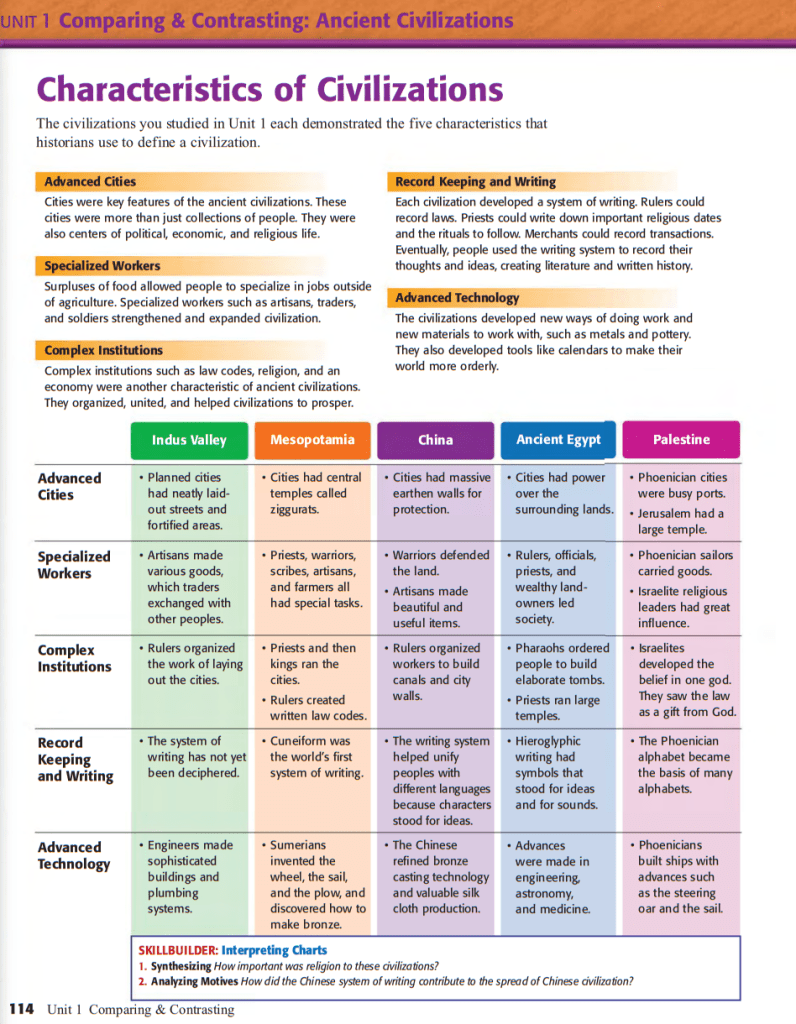
A civilization is often defined as a complex culture with five characteristics: (1) advanced cities, (2) specialized workers, (3) complex institutions, (4) record keeping, and (5) advanced technology.
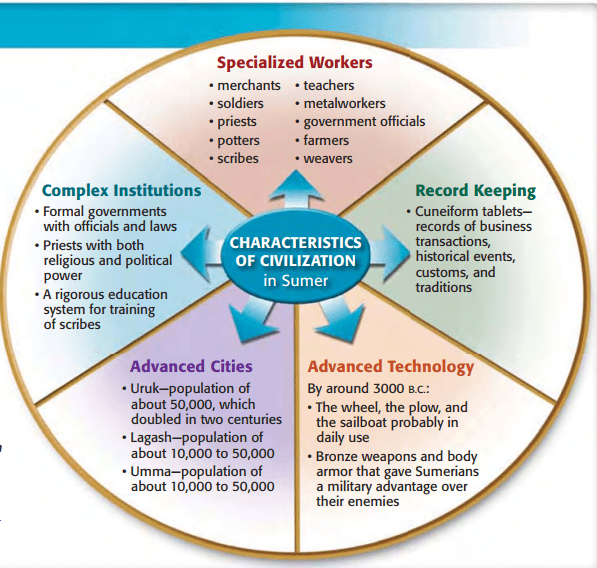
Food surpluses provided the opportunity for specialization—the development of skills in a specific kind of work. An abundant food supply allowed some people to become expert at jobs besides farming. Some city dwellers became artisans—skilled workers who make goods by hand.
cuneiform
stylus: an ancient writing implement, consisting of a small rod with a pointed end for scratching letters on wax-covered tablets, and a blunt end for obliterating them.
awn: a stiff bristle, especially one of those growing from the ear or flower of barley, rye, and many grasses.
But merchants and their customers know roughly how many pots of grain a farmer must give to buy a jug of wine. This way of trading goods and services without money is called barter.
Cuneiform is a logo-syllabic script that was used to write several languages of the Ancient Middle East.
Ziggurat, pyramidal stepped temple tower that is an architectural and religious structure characteristic of the major cities of Mesopotamia
Unit 2
recede: go or move back or further away from a previous position.
silt: fine sand, clay, or other material carried by running water and deposited as a sediment, especially in a channel or harbor.
supervise: observe and direct the execution of (a task, project, or activity).
Cultural diffusion is defined as the spread of cultural elements due to the interaction among people from different cultures.
triumph: a great victory or achievement.
fare: a range of food of a particular type.
ramp: a slope or inclined plane for joining two different levels, as at the entrance or between floors of a building.
ward off: prevent someone or something from harming or affecting one.
chaste: not having any sexual nature or intention.
retaliation: revenge, an eye for an eye and a tooth for a tooth.
righteousness: the quality of being morally right or justifiable.
compensate: repay, give (someone) something, typically money, in recognition of loss, suffering, or injury incurred; recompense.
procure: obtain (something), especially with care or effort.
parch: make or become dry through intense heat.
spill over: of a bad situation or strong emotion reach a point at which it can no longer be controlled or contained.
granary: a storehouse for threshed grain.
churning: agitate or turn (milk or cream) in a machine in order to produce butter.
marshy: characteristic of or resembling a marsh; waterlogged. soggy, muddy.
northbound: traveling or leading toward the north.
chieftain: the leader of a people or clan.
shrewdly: in a way that shows sharp powers of judgment; astutely. cleverly.
theocracy: a system of government in which priests rule in the name of God or a god.
quarry: a place, typically a large, deep pit, from which stone or other materials are or have been extracted.
bleak: (of an area of land) lacking vegetation and exposed to the elements.
incision: a surgical cut made in skin or flesh.
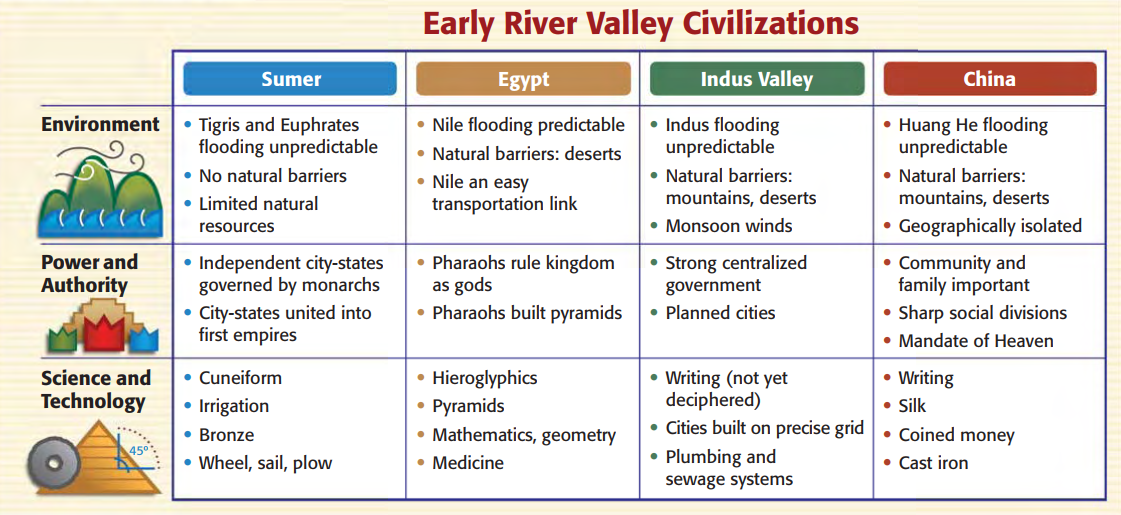
Hieroglyphs are always read from top to bottom but sometimes you start on the left side (like in English) and sometimes on the right.
decipher: convert (a text written in code, or a coded signal) into normal language.
reed: a tall, slender-leaved plant of the grass family, which grows in water or on marshy ground.
dike: a long wall or embankment built to prevent flooding from the sea.
isthmus: a narrow strip of land with sea on either side, forming a link between two larger areas of land.
Harappan civilization
citadel: a fortress, typically on high ground, protecting or dominating a city. fortress, castle.
aqueduct: an artificial channel for conveying water, typically in the form of a bridge across a valley or other gap.
nonessential: not absolutely necessary.
rump: the hind part of the body of a mammal or the lower back of a bird.
The Huang He, whose name means “yellow river,” deposits huge amounts of yellowish silt when it overflows its banks. This silt is actually fertile soil called loess (LOH•uhs), which is blown by the winds from deserts to the west and north.
chariot: A chariot is a type of cart driven by a charioteer, usually using horses to provide rapid motive power.
The use of oracle bones, animal bones and tortoise shells on which priests had scratched questions for the gods.
The Chinese system of writing had one major advantage. People in all parts of China could learn the same system of writing, even if their spoken languages were very different. Thus, the Chinese written language helped unify a large and diverse land, and made control much easier.
The disadvantage of the Chinese system was the enormous number of written characters to be memorized—a different one for each unit of language. A person needed to know over 1,500 characters to be barely literate. To be a true scholar, one needed to know at least 10,000 characters. For centuries, this severely limited the number of literate, educated Chinese. As a general rule, a nobleperson’s children learned to write, but peasant children did not.
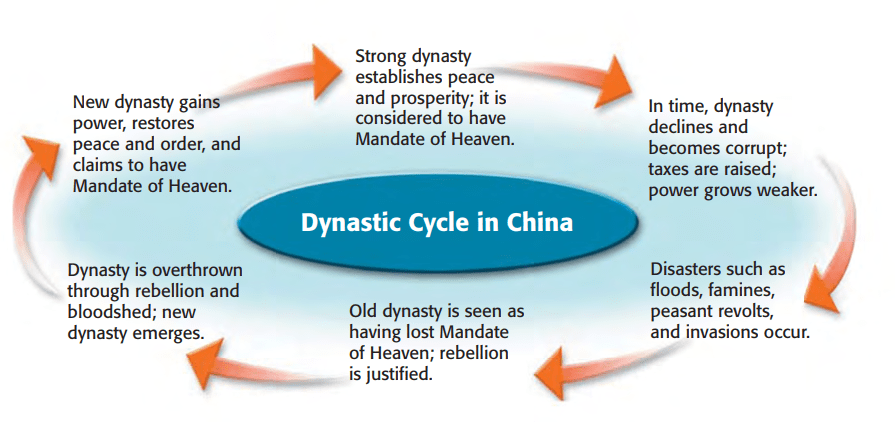
This justification developed over time into a broader view that royal authority came from heaven. A just ruler had divine approval, known as the Mandate of Heaven.
aide: an assistant to an important person, especially a political leader.
reverent: feeling or showing deep and solemn respect.
Feudalism is a political system in which nobles, or lords, are granted the use of lands that legally belong to the king. In return, the nobles owe loyalty and military service to the king and protection to the people who live on their estates.
A furnace is a structure in which heat is produced with the help of combustion.
sickle: a short-handled farming tool with a semicircular blade, used for cutting grain, lopping, or trimming.
amidst: in the middle of; amid.
emmer: is an ancient tetraploid wheat.
covetousness: (formal) the feeling of having a strong desire for the things that other people have synonym envy.
jubilation: a feeling of great happiness and triumph.
Unit 3
jut: extend out, over, or beyond the main body or line of something.

The four major groups came to be known as the varnas. Later, in the 15th century A.D., explorers from Portugal encountered this social system and called these groups castes (kasts).
intermingle: mix or mingle together.
verse: writing arranged with a metrical rhythm, typically having a rhyme.
moksha: (in Hinduism) release from the cycle of rebirth impelled by the law of karma. nirvana.
reincarnation (rebirth)
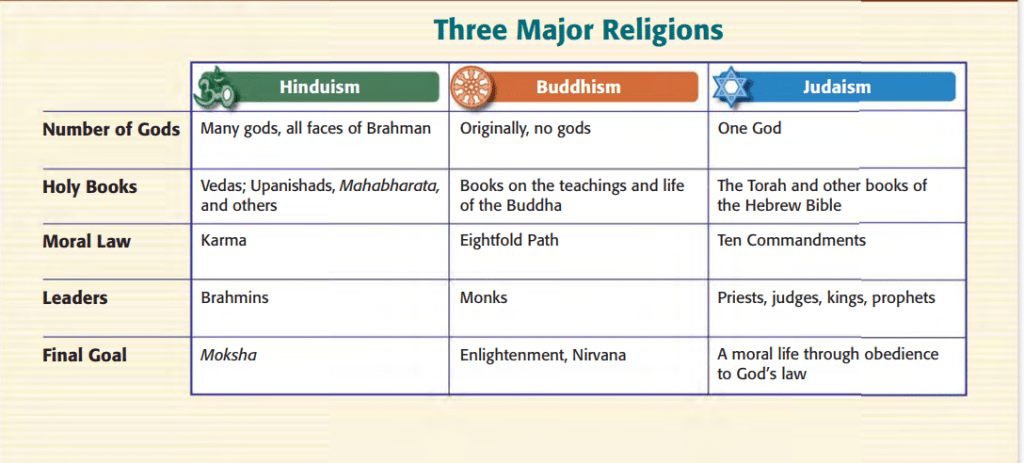
Hinduism has gone through many changes over the last 2,500 years. The world soul, Brahman, was sometimes seen as having the personalities of three gods: Brahma, the creator; Vishnu, the protector; and Shiva, the destroyer. Vishnu also took on many forms or personalities, for example, as Krishna, the divine cowherder, and as Rama, the perfect king.
Mahavira, the founder of Jainism, was born about 599 B.C. and died in 527 B.C. Mahavira believed that everything in the universe has a soul and so should not be harmed.
preach: deliver a sermon or religious address to an assembled group of people, typically in church.
prophecy: a prediction.
fig tree
thousand-spoked wheel
sermon: a talk on a religious or moral subject, especially one given during a church service and based on a passage from the Bible.
Eightfold Path: the path to nirvana, comprising eight aspects in which an aspirant must become practiced: right views, intention, speech, action, livelihood, effort, mindfulness, and concentration.
cyclical: repetitive
reclining: leaning or lying back in a relaxed position with the back supported.
reincarnation: the rebirth of a soul in a new body.
figurine: a statuette, especially one of a human form.
burial customs
Knossos
acrobatic: performing, involving, or adept at spectacular gymnastic feats.
somersault: an acrobatic movement in which a person turns head over heels in the air or on the ground and lands or finishes on their feet.
initiation: the action of admitting someone into a secret or obscure society or group, typically with a ritual.
wicker: pliable twigs, typically of willow, plaited or woven to make items such as furniture and baskets.
amphorae: a tall ancient Greek or Roman jar with two handles and a narrow neck.
Monotheism
covenant: an agreement.
the Exodus
covet: yearn to possess or have (something).
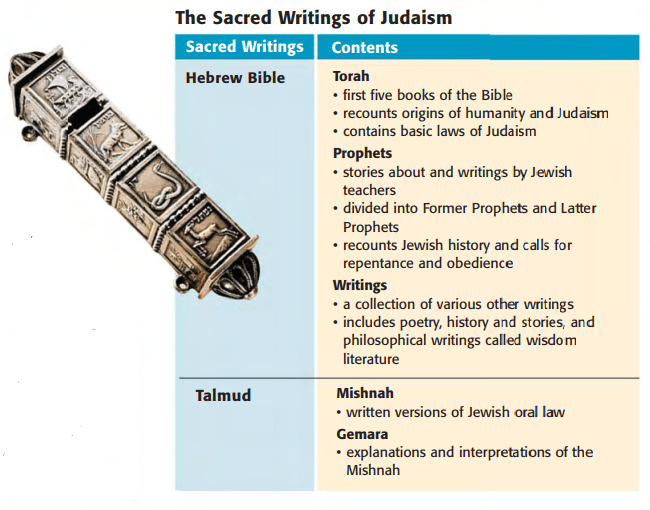
bouts of: a period of
discontent: lack of contentment; dissatisfaction with one’s circumstances.
ferocious: savagely fierce, cruel, or violent.
Hittite kingdom
caravan: a group of people, especially traders or pilgrims, traveling together across a desert in Asia or North Africa.
outlaw: a person who has broken the law, especially one who remains at large or is a fugitive.
cavalry: (in the past) soldiers who fought on horseback.
escort: accompany (someone or something) somewhere, especially for protection or security, or as a mark of rank.
forge: make or shape (a metal object) by heating it in a fire or furnace and beating or hammering it.
infantry: soldiers marching or fighting on foot; foot soldiers collectively.
frankincense: an aromatic gum resin obtained from an African tree and burned as incense.
ointment: a smooth oily preparation that is rubbed on the skin for medicinal purposes or as a cosmetic.
cataract: a large waterfall.
oust: drive out or expel (someone) from a position or place.
Assyria was a society that glorified military strength.
weaponry: weapons regarded collectively.
pontoon: a flat-bottomed boat or hollow metal cylinder used with others to support a temporary bridge or floating landing stage.
battering rams: a heavy beam, originally with an end in the form of a carved ram’s head, formerly used in breaching fortifications.
blue lapis lazuli
looting and burning
anoint: smear or rub with oil, typically as part of a religious ceremony.
begrudge: envy (someone) the possession or enjoyment of (something).
stud: a large-headed piece of metal that pierces and projects from a surface, especially for decoration.
Zoroastrianism is an Iranian religion and one of the world’s oldest organized faiths, based on the teachings of the Iranian-speaking prophet Zoroaster. It has a dualistic cosmology of good and evil within the framework of a monotheistic ontology and an eschatology which predicts the ultimate conquest of evil by good.
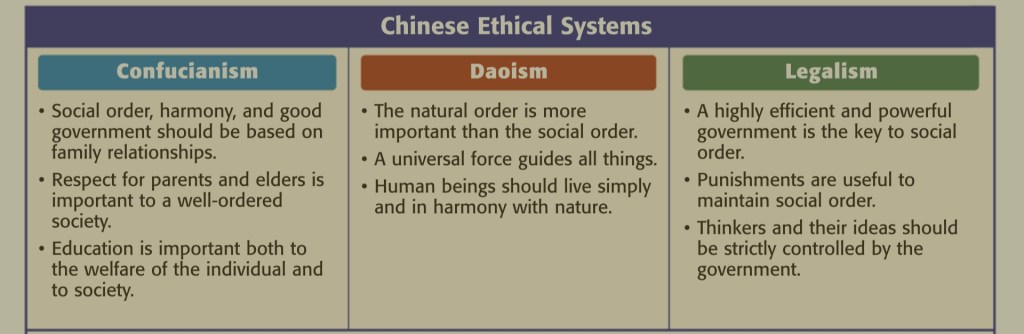
Confucius was born at a time of crisis and violence in China. He had a deep desire to restore the order and moral living of earlier times to his society.Confucius believed that social order, harmony, and good government could be restored in China if society were organized around five basic relationships.These were the relationships between: (1) ruler and subject, (2) father and son, (3) husband and wife, (4) older brother and younger brother, and (5) friend and friend. A code of proper conduct regulated each of these relationships. For example, rulers should practice kindness and virtuous living. In return, subjects should be loyal and law-abiding.Confucius’s five relationships were based upon the family. Confucius stressed that children should practice filial piety, or respect for their parents and ancestors. Filial piety, according to Confucius, meant devoting oneself to one’s parents during their lifetimes. It also required honoring their memories after death through the performance of certain rituals.
Virtue: behavior showing high moral standards.
alchemy: the medieval forerunner of chemistry, based on the supposed transformation of matter.
Legalists believed that a highly efficient and powerful government was the key to restoring order in society. They got their name from their belief that government should use the law to end civil disorder and restore harmony. Hanfeizi and Li Si were among the founders of Legalism.
oracle: wise man.
emblem: a visible symbol representing an abstract idea.
subdue: put down by force or intimidation.
sap: gradually weaken or destroy (a person’s strength or power).
decisively: with finality; conclusively. With firmness.
rubble: the remains of something that has been destroyed or broken Arbitrariness is the quality of being “determined by chance, whim, or impulse, and not by necessity, reason, or principle”.
rut: a long, deep track made by the repeated passage of the wheels of vehicles.



Leave a comment