answer a query or complaint or convince your colleagues to adopt a certain
course of action
is likely to evoke (bring to mind) the response you want
What it does not do is provide a set of model documents for particular situations. You should think about what you want to say, not just copy someone else’s models. So although you will find a great many examples of documents throughout the book, they are just that – examples to illustrate particular points and techniques, not models to be copied.
from start to finish or dipping into it
imprecise language, clumsy sentences or long-winded ‘waffle’
clearly and succinctly
All the characters and organisations in the examples and exercises are purely fictional, and any resemblance to real individuals or organisations is purely coincidental.
These are some of the reasons why we may need to communicate with others in a business setting:
● to pass on information
● to persuade people to buy a product or use a service
● to discuss an issue
● to recommend a course of action
● to make or answer a request
● to make or answer a complaint
● to keep a record of something that has happened or been agreed
● to explain or clarify a situation
● to give an instruction
The main reasons for communicating orally are:
● To have a discussion. It is very difficult to hold a meaningful discussion by letter, memo or e-mail.
● To receive instant feedback from your audience. Speaking to someone means that you do not have to wait for their response. However, this can sometimes be a disadvantage; in some circumstances, a considered response might be better.
● To be able to judge your audience’s reaction to what you are saying. This usually only applies in face-to-face communication, but it can sometimes be useful to be able to judge from your audience’s comments, expressions or body language what they think of what you are saying and perhaps adapt your style or tone accordingly.
● For speed. Even the fastest typist or writer cannot match the speed at which we speak, so if you want to communicate something quickly, it might be better to do so orally.
● If the person with whom you are communicating has initiated the conversation. If you are responding to an oral request, for example, you are likely to do so orally, unless your response is so complex that it would be better explained in writing (see below).
The main reasons for communicating in writing are:
● To retain a permanent record. A conversation can be forgotten, misunderstood or even deliberately twisted. But if something is in writing (and if it is well written), everyone who reads it will be sure to get the right information. It also provides something to refer to if there is any dispute in the future. This is particularly important if the document constitutes a form of agreement, but it can also be useful in the case
of a complaint.
● To provide a basis for discussion. We saw above that a discussion is usually best conducted orally, but it can be very useful for a discussion document to be available beforehand, setting out the facts of the case and perhaps giving the writer’s own views and recommendations. This saves time, as it means that the meeting itself can discuss the implications and people’s opinions, instead of having to go over the facts before
any useful discussion can begin.
● To clarify a complex subject. Some subjects do not lend themselves easily to spoken communication. A graph or bar chart, for example, may be a better way of presenting figures, as you will see in Chapter 3, and it is easier to explain a confused situation in writing than orally (see Chapter 6).
● To send the same message to a number of people. If you want to give a number of people the same information (perhaps the date and venue of a meeting), then an e-mail or a circular memo or letter would be quicker and cheaper than speaking to each person individually.
● To be able to think carefully about what you want to say. You can plan your document and correct any errors before sending it out. It is easier to make a mistake when you are speaking spontaneously.
deliberately (consciously and intentionally; on purpose twisted
turnover: the amount of money taken by a business in a particular period.
● Spoken English uses unnecessary words and phrases. When we speak, we generally use more words than we need to. Even when speaking, we should always try to be as concise as possible, but it is inevitable, unless we have gone to extremes in planning what we want to say, that we will introduce unnecessary and generally meaningless phrases such as:
– ‘I must say’ – which adds nothing to the sense of the report.
– ‘Oh, by the way’ – which means much the same as ‘I forgot to mention’.
– ‘Really’ – which is too vague to add anything to the word it goes with (what is the difference between a good meeting and a really good one?).
These words and phrases do not matter in spoken English – indeed, they give us an opportunity to gather our thoughts, so they serve a useful purpose – but in writing they look sloppy and add to the length of the document.
● Spoken English can be vague. She talks about:
– ‘A really good meeting’. What does this mean? Was it productive, informative,
enjoyable? Was the food good? She could mean any of these things.
– ‘All over South America’. In fact, as she indicates in her reply to Peter Morgan’s question, she means ‘in a number of the major countries’, not ‘all over’.
– ‘Things like who matters in each country, how they do business there …’ etc. This is a round about way of saying ‘the business climate’.
This vagueness does not matter when you are speaking, because your tone or gestures will indicate to your audience what you actually mean, or they can ask if anything is unclear. But when you are writing in business you need to be precise. Since your readers cannot ask you to clarify anything that is unclear, they will either make their own interpretations, which may be wrong, or ignore points they do not understand, which may give them an incomplete picture.
● In spoken English you can go back and correct what you have said. When you are speaking you can stop in midstream and correct yourself if you have said something wrong, or add in something you have forgotten. So she says:
– ‘Sorry, I mean’ – when she realises she has said the opposite of what she means.
– ‘Oh, by the way, I forgot to mention’ – when something occurs to her that she should have said earlier in the report.
When you are writing you should not have to go back and correct yourself. This kind of afterthought is fine in spoken English, but in written form it gives the document a disjointed appearance, making it difficult to follow.
● When speaking you can respond to feedback from your audience. As we have seen, this is one of the main reasons why you may decide to communicate orally rather than in writing. You can then explain things or amend your presentation accordingly.
– When Peter Morgan asks Jane where Rodriguez does business, she clarifies her vague ‘all over South America’ statement.
– In response to Sarah Brown’s scepticism about his willingness to accept the company’s usual terms, she is quick to point out that he will probably agree to them initially.
– She explains the concept of a sliding scale of commission in response to James Robinson’s question.
– She sees from some people’s reaction that they are still not convinced (‘Now I know what some of you may be thinking’), so she introduces the point about the increase in turnover.
● Spoken English often uses colloquialisms. Slang is seldom acceptable in business English, unless you are speaking to a close friend, but using the odd colloquialism makes your speech sound less formal and constrained. So Jane says:
– ‘He might be the man for us’.
– ‘All that kind of thing’.
Colloquialisms are out of place in business documents, however. They look lazy, and they seldom have the precision of meaning that is needed. colloquial language
● Personal communication uses slang. As we have seen, a bit of colloquial language is quite acceptable when speaking in a business context, but outright slang is not. So, for example, Jane Lee says of Carlos Rodriguez, ‘He might be the man for us’, which is acceptable, although it is something of a colloquialism. In a personal letter, she might have said, ‘He’s got what it takes’ or ‘He’s the guy for the job’; neither of these expressions would be acceptable in business, even when speaking – unless, of course, the person you are speaking or writing to is a personal friend with whom you have a very informal business relationship.
A Guide to Good Business Communication
● Personal communication is subjective. When you are writing or speaking to a friend, you are talking about what you have been doing and thinking – that is the main reason for writing. So your letter is likely to be full of references to your own actions, feelings and reactions. Therefore in a personal letter or conversation, Jane might say, ‘I could find it very easy to work with him’, or ‘I was really pleased when he agreed to our terms’, etc. But business communication should be more objective – the only relevance your actions or feelings have is their impact on your business and the person you are addressing.
● Business correspondence is not read for pleasure. Very often when writing personal letters or e-mails, our aim is to give pleasure to the recipient. So we might introduce funny or interesting anecdotes. In business correspondence you should not try to entertain your audience. People read business documents to gain information as quickly and easily as possible; they read other things for pleasure.
● Personal communication sometimes exaggerates or uses euphemisms. It is not uncommon for statements in personal letters or conversations to stretch the truth a little, in order to show someone in a good light, or perhaps to spare the feelings of the audience. Most of us do it at some time: we might say for example, ‘I have left my job’ rather than ‘I have been made redundant’. So in a personal letter, Jane might try to give the impression that she charmed Rodriguez into accepting the company’s usual commission when in fact he agreed very reluctantly to do so, and only on certain conditions. In business, you should give the facts objectively.
deviate: do something that is different or to be different from what is usual or expected.
You should plan what you are going to say to ensure that:
● you say everything that has to be said
● the information you give is correct
● your arguments are logically expressed
● you use the right language to suit your purpose
● you are not emotional
initially: at first
Before you plan what you are going to say, you should ask yourself the following questions:
● Should you be writing or speaking to the person concerned?
● Are you addressing the right person? You can waste a lot of time being passed from one person in the organization to another if you address the wrong person initially, and in the case of a written document it could be lost or ignored in the process.
● Should anyone else be aware of what you want to say? All your planning can come to nothing if you do not address everyone who needs the information you are giving.
● Do you need a reply? If you do, and you do not let the other person know, you will have failed to achieve your purpose. (See Chapter 3 for more on how to ensure that a correspondent knows what you expect him or her to do.)
● What is your purpose in writing or speaking?
● What do you want to achieve?
have undertaken a thorough investigation of the problem.
coming off: to happen; occur.
picked up the fault: found the fault.
batch: delivery, shipment, a quantity or consignment of goods produced at one time.
procedure: a surgical operation.
Overdue payment: overdue sums of money have not been paid, even though it is later than the date on which they should have been paid.
Here are some examples to illustrate the difference between the purpose of your communication and what you want to achieve.
● The purpose of a sales letter is to tell people about your product or service. What you want to achieve is a sale.
● The purpose of a complaining telephone call is to point out an error or fault. What you want to achieve is the correction of that error or fault, or else compensation.
● The purpose of a credit control letter is to chase an overdue account. What you want to achieve is payment.
● The purpose of a report on the advantages and disadvantages of different work practices is to inform the decision-makers of the options available. What you want to achieve is acceptance of the most efficient option.
Your Purpose and What You Want to Achieve
● The purpose of a sales letter is to tell people about your product or service. What you want to achieve is a sale.
● The purpose of a complaining telephone call is to point out an error or fault. What you want to achieve is the correction of that error or fault, or else compensation.
● The purpose of a credit control letter is to chase an overdue account. What you want to achieve is payment.
● The purpose of a report on the advantages and disadvantages of different work practices is to inform the decision-makers of the options available. What you want to achieve is acceptance of the most efficient option.
accusatory: indicating or suggesting that one believes a person has done something wrong.
excuse: explain away, a reason or explanation put forward to defend or justify a fault or offense.
Your audience can be categorised according to theirknowledge of your business.
● There are people who will know very little, such as members of the public for example.
● There are those who will know something about the business you are in, but not about your particular organisation, such as your customers.
● There are those who will not only know about the business you are in, but also about your organisation, such as your colleagues or an agent.
jargon: special words or expressions that are used by a particular profession or group and are difficult for others to understand.
To help you gain a better understanding of the people you will be addressing, ask yourself the following questions:
● Do they know anything about the subject you will be speaking or writing about, or are there ideas or technical terms that will need explaining?
● What is your relationship with them? Is it formal or informal?
● Are they expecting to hear from you? If not, will they be interested in what you have to say?
● What do they believe is important? For example, if you are presenting a report suggesting that your organisation sets up a staff social club, you should not simply say how good it would be for staff morale if the person to whom you are addressing it is more concerned with profit margins than staff morale. You would be better off pointing out how cheap it would be to do, and then suggesting that the improvement in staff morale could bring a further improvement in commitment and productivity.
● What are they likely to agree to readily, and what will they need to be persuaded about? This will affect the order in which you present your points, and the space you devote to them.
vulnerable: unprotected, in danger, susceptible to physical or emotional attack or harm.
fluctuation: an irregular rising and falling in number or amount; a variation.
As you will know….
I am sure you’re aware…
modification: change
assemble: (of people) gather together in one place for a common purpose.
marshall: arrange or assemble (a group of people, especially soldiers) in order.
deduction: inference; the inference of particular instances by reference to a general law or principle.
idle: spend time doing nothing.
deduction: inference; the inference of particular instances by reference to a general law or principle.
nullified: make legally null and void; invalidate.
There are two ways of making a convincing point, both equally valid:
● By deduction. This involves reasoning from one statement to another to reach a conclusion – deducing the answer. For example, an employee of a furniture manufacturer might want to make a case for changing their timber supplier.
● By induction. This involves reasoning from your experience, or from your own investigation. Unlike a conclusion arrived at by deduction, one arrived at by induction cannot usually be proved beyond any doubt. But you should be able to show that:
– the conclusion is reasonable given the information at your disposal
– your knowledge or experience covers a wide area or sample
– the sample on which you are basing your conclusion is typical of the circumstances, people, areas, etc. of the whole group.
deficiency: a failing or shortcoming.
criterion: a principle or standard by which something may be judged or decided.
trivial: of little value or importance.
chronological: (of a record of events) starting with the earliest and following the order in which they occurred.
compensation: something, typically money, awarded to someone as a recompense for loss, injury, or suffering.
conscientious: (of a person) wishing to do what is right, especially to do one’s work or duty well and thoroughly.
suffer fools gladly: to be tolerant of stupidity or incompetence in other people. : to be kind to and patient with people who are annoying or bothersome. usually used in negative statements.
setting the scene or whetting the person’s appetite
herewith: with this letter.
A Checklist for Editing
● Is your document polite and unemotional?
● Are there any unnecessary words or phrases? If you are not sure try leaving certain phrases out – does this affect the sense of what you are saying?
● How would you react if you were receiving it? Is that the reaction you want from your audience?
● Do you assume too much knowledge on the part of your reader?
● Is it clear, or is anything ambiguous?
● If it needs a reply, do you say so? Should you set a time by which you expect to hear from your correspondent?
● Is it likely to achieve the result you want?
● Have you included everything your reader needs to know?
● Have you included anything that is irrelevant to your aim or your audience?
● Is the information logically presented?
● If you are presenting an argument, have you thought of all the counter-arguments?
insulting: disrespectful or scornfully abusive.
slipshod: (typically of a person or method of work) characterized by a lack of care, thought, or organization.
initial: the first letter of a name or word, typically a person’s name or a word forming part of a phrase.
indent: start (a line of text) or position (a block of text, table, etc.) further from the margin than the main part of the text.
premise: base an argument, theory, or undertaking on.
complimentary: expressing a compliment; praising or approving.
The term esquire, often abbreviated Esq., often appears at the end of an attorney’s name. You may have seen it in your attorney’s letterhead or the attorney’s signature, both on formal letters and emails. What, exactly, does the term mean? In legal terms, the definition of esquire, in America, simply means someone who can practice law.
stuffy: lacking in vitality or interest : stodgy, dull.
‘I hope it is Mr (or Ms) Robinson. Your letter was just signed J. Robinson, so I am not sure.’
Addressing People by Title
If you are writing to an organisation rather than a named individual, you should try to address it to the person who is most likely to deal with your letter: the Sales Manager, the Customer Service Director, the Accountant, etc. If you do not know who might deal with it, here are some tips on who to address it to.
● a company, the Managing Director or the Manager
● a club or a professional institution, the Secretary
● a firm with a sole owner, the Proprietor
● a local authority, the Chief Executive
● a government department in the UK, the Minister or the Permanent Secretary
● a partnership (such as a firm of lawyers or accountants), the Senior Partner. It used to be a rule that they should be addressed as Messrs, as in Messrs Black and Green, but since Messrs is the plural of Mr and the partners are now quite likely to be women, this could give offence.
If you know him or her well, you could begin ‘Dear John’ or ‘Dear Mary’. If you do not want to be quite so informal, you could use their title: ‘Dear Mr Black’ or ‘Dear Ms White’. One thing you should not do is address someone whose name you know as ‘Dear Sir’ or ‘Dear Madam’. This is so formal and unfriendly as to be almost rude.
Some people try to get round the formality and clumsiness of ‘Dear Sir or Madam’ by writing ‘Dear Managing Director’ or ‘Dear Sales Manager’, but this has not caught on, and is just as clumsy as ‘Dear Sir or Madam’.
halfway house
It is important to get a good reaction from your readers, and in order to do so you need to make them want to read on. For this reason, it is best to avoid tired old clichés like ‘With reference to your letter of 20 March …’ or ‘I am writing to tell you …’ Even ‘Thank you for your letter of 20 March’ can be avoided with a little thought. Here are a few possible options:
● I was delighted to receive your letter of 20 March about …
● I was very sorry to see from your letter of 20 March that …
● Thank you for taking the trouble to write and tell me about …
● I was concerned to read your letter of 20 March and to see that you have been having problems with …
● I have thought carefully about the points you raised in your letter of 20 March and …
Ending your letter
Your closing paragraph is as important as your opening one. This is the last thing your correspondent will read (apart from your signature), and the last impression he or she will be left with. You should use it for three purposes:
● To summarise your position. This does not mean that you should provide a summary of everything you have said – that would be boring. You should simply summarise your views, or how you want your reader to feel. The exact wording will depend on the type of letter, but here are a few examples.
– I hope this has helped you to understand our position.
– These are the problems I would like to review when we meet.
– I think you will agree that this is a very special offer.
– I am sure you will appreciate our concern about this matter.
● To indicate any action you are expecting, and who will take it. There are five different forms of action ending, depending on the kind of response you expect. A positive reader response means that you expect the reader to take some action. Typical endings of this kind include:
– I would be grateful if you could let me know as soon as possible what action you intend to take.
– I look forward to hearing from you.
– Perhaps you could give me your views on these proposals within the next week or so.
– Please let me have your cheque in settlement of this account.
A positive writer response means that you will be taking some action. For example:
– I will thoroughly investigate the problem and contact you as soon as I have an answer.
– I will consider your proposal carefully and let you have my response within the next few days.
– I am waiting to hear from my accountant and will be in touch as soon as I do.
A passive reader response means that the reader has the option of taking some action if he or she wants to, but that you do not expect it. Here are some examples:
– If you need any further information, please let me know.
– If I can be of further assistance, please get in touch .
– If I do not hear from you within the next two weeks, I will assume that you are happy with the new arrangements.
A passive writer response means that you might take some action, but that your correspondent should not expect it. Typical endings of this sort might be:
– I will contact you if the situation changes.
– If I receive any further information, I will let you know.
If you do not want to continue the correspondence under any circumstances, then you should make this clear with a no response ending. However, do not be rude or abrupt about it; there are polite ways of saying this. Here are some examples which indicate quite clearly that you do not expect to hear from them again:
– Thank you for writing.
– I am grateful for your views.
– I found your comments interesting, and will bear them in mind for the future.
The elements of a memo
● the name of the writer
● the name of the addressee
● the date
● the subject
● the body of the memo
To: David Cousins
From: Simon Kitchener
Date: 22 May 20XX
● From: Simon Kitchener
To: David Cousins
Date: 22 May 20XX
● Date: 22 May 20XX
To David Cousins
From: Simon Kitchener
You do not have to have a heading in a memo, but it is sometimes a good idea to do so; it tells your reader what the memo is going to be about, and it saves having to explain the subject in the memo itself. So you memo might read:
To: David Cousins
From: Simon Kitchener
Date: 22 May 20XX
ARRANGEMENTS FOR GRADUATE INTERVIEWS
This tells your reader immediately what to expect. It also saves you having to include a sentence such as ‘I would like to discuss this year’s arrangements for graduate interviews.’ This might provide all the introduction you need, but you might also want to write a short introductory paragraph as well, giving some of the background.
The main part of the memo should be laid out in a logical sequence, as described in Chapter 2, and should be followed by a final paragraph, which might serve a variety of purposes, depending on the subject: it might indicate any action to be taken, present any recommendations or conclusions, or summarise your arguments.
Although most memos, being internal communications between colleagues, may be expressed in slightly less formal language than letters, they should still conform to the requirements of all business communications and be brief, clear and direct.
preliminary: an action or event preceding or preparing for something fuller or more important.
Types of Report
There are three main categories of report, each with a slight variation on the basic pattern.
● Recommendation reports, as their name suggests, are written with the aim of recommending some sort of action. They may include a conclusion or conclusions as well, but they need not
always do so.
● Conclusion reports are similar in that they probably present different arguments for and against a course of action. The difference is that they do not make recommendations. A feasibility study is an example of this kind of report. You might be asked to look into the feasibility of a certain course of action; you would reach a conclusion as to whether it was a viable proposition or not, but you would not make any recommendation.
● Information reports only present information. You might brief someone or provide background information, and you would probably present your main findings, but because of the nature of this kind of report, it would contain no conclusion or recommendation.
alleviate: make (suffering, deficiency, or a problem) less severe.
temptation: the desire to do something, especially something wrong or unwise.
tabulate: arrange (data) in tabular form; to count, record, or list systematically.
aberration: the act of differing especially from a moral standard or normal state.
fluctuation: an irregular rising and falling in number or amount; a variation.
gradation: a gradual (slow) change, or a stage in the process of change.
expenditure: an amount of money spent.
Types of Sentence
There are four types of sentences, distinguished by their complexity.
● A simple sentence has only one predicate, although it can have more than one subject. It is usually short. For example:
– I have received your letter.
– You and I must meet next week.
● A compound sentence consists of two or more simple sentences joined by a conjunction. For example:
– I have received your letter and I agree with what you say.
– You and I must meet next week, but I am out of the office on Tuesday and I am involved in meetings all day on Wednesday.
● A complex sentence consists of a main clause and one or more subordinate clauses (for an explanation of clauses, see Chapter 7). For example:
– I have received your letter, which sets out your views very clearly.
– You and I must meet next week, because we need to make arrangements for the Sales
Clerk interviews.
● A compound-complex sentence has two or more main clauses as well as subordinate ones.
For example:
– I have received your letter, which sets out your views very clearly, and the Manager, to whom I showed it, agrees with what you say.
– You and I must meet next week, because we need to make arrangements for the Sales Clerk interviews, but I am out of the office on Tuesday, which could be a problem.
There are two types of sentence construction: loose and periodic.
● A loose sentence has the subject first, as in: ‘I will circulate a paper before the meeting.’
● A periodic sentence puts subsidiary phrases or clauses before the subject, as in: ‘Before the meeting, I will circulate a paper.’
Loose sentences are more direct, and since one of the rules of business communication is to be direct, they are to be preferred. However, periodic sentences can be useful for building up to your subject, conveying a sense almost of suspense. They are therefore good for sales letters, where your aim is to hold the reader’s attention and make them want to know what is coming next:
Welcome to our brand new, exciting autumn catalogue. As you browse through it, you will, I am sure, be delighted by the superb range of furniture we now offer. Whether you are looking for something traditional or ultra-modern, you will find it here. We have furniture for every room in the house, from beds to armchairs, dining tables to desks, all from the top manufacturers, and all at very attractive prices. Indeed, for value for money, you will find our terms hard to beat.
Can you see how periodic sentences are used in this way? ‘As you browse through it’, ‘Whether you are looking for something traditional or ultra-modern’, ‘Indeed, for value for money’ are all used to keep people reading, to whet their appetite. Periodic sentences are also useful to make a connection between two sentences, to refer back from one to the other. Look at the following two passages:
● Can we meet soon? Before the meeting I will circulate a paper.
● Can we meet soon? I will circulate a paper before the meeting.
The first is better than the second, because ‘before the meeting’ connects the two sentences by referring back to the first.
Don’t say: “I enclose your latest statement, I would like to point out that there is an amount of £270 outstanding.” The sentence contains two ideas: the statement and the amount outstanding. They are probably close enough to be included in the same sentence, but they are not joined by a conjunction, a relative pronoun or a semicolon. The comma does not provide enough of a pause between the two ideas, and the sentence looks wrong (and would probably sound wrong if read).
Try to say:
● I enclose your latest statement, and would like to point out that there is an amount of £270 outstanding.
● I enclose you latest statement, which I would like to point out shows an amount of £270 outstanding.
● I enclose your latest statement; I would like to point out that there is an amount of £270 outstanding.
How long should your sentences be?
Short sentences generally give a sense of rapid movement and tension, a feeling of urgency. Longer ones are often used in descriptive passages, to develop your argument or perhaps to provide background information. They can give an impression of having been well thought out, and so are good to use from time to time in a report, for example.
Because your aim is to be direct and brief, you should generally prefer short sentences. This is especially true when speaking, because if your sentences become too long you may well find it difficult yourself to keep track of what you are saying, let alone your audience! But do not feel that you must always use them. Apart from the fact that there are times when longer sentences are more in keeping with what you want to convey, it is also good to have a mixture of sentence lengths to avoid monotony and the ‘scrappy’ (disorganized) appearance of too many short, simple sentences. It can sometimes be harder for your audience to absorb a number of different simple sentences, all with what appear to be unconnected bits of information, than to make sense of one longer one. Look at the following passage from an e-mail.
We must operate as efficiently as possible. I have therefore asked all staff for their ideas on ways to do this. Here are some of their ideas. We could send all mail by second-class post. This would save us several thousand pounds. It would also make our service worse. We would have to weigh the saving against the loss of customer goodwill.
We could introduce more flexible working practices. Staff could be trained to do several jobs. This would mean that they could be switched to different activities if necessary. For example, the order input clerks might be overloaded. In that case some of the accounts clerks could be moved across to help them.
As you can see, using just short, simple sentences makes the document disjointed, and the reader finds it difficult to follow the flow of the argument. Now look at the following.
Because it is important that we operate as efficiently as possible, I have asked all staff for their ideas on ways to do this. Here are some of those ideas. We could send all mail by second-class post, which would save us several thousand pounds. However, we would have to weigh the saving against the loss of customer goodwill caused by the worsening of service that would result.
We could introduce more flexible working practices. Staff could be trained to do several jobs, so that they could be switched to different activities if necessary. For example, if the order input clerks were overloaded, some of the accounts clerks could be moved across to help them.
This is very much easier to read because there is a mixture of sentence types and lengths, and the document flows more fluidly because closely connected subjects are linked.
As we have seen, a sentence should convey a single idea or two related ideas, and it should therefore be as long as is necessary to convey that idea, or those ideas, but no longer.
Avoiding awkward sentences
There are several ways in which your sentences can become clumsy and awkward. Sometimes this is because they are incorrect grammatically, but even sentences that are quite correct can occasionally sound wrong. The most common causes of clumsy sentences are:
● incorporating two ideas in one sentence without a conjunction, relative pronoun or semicolon
● putting too many subsidiary clauses before the subject in a periodic sentence
● leaving hanging participles
● letting a sentence get out of parallel
Incorporating two ideas in one sentence without a conjunction, relative pronoun or semicolon
Look at the following sentence: ‘The customer’s complaint, which concerned the poor quality of our products, should have been dealt with immediately.’ It is not particularly long, but it is awkward, because it contains two ideas: the nature of the complaint and the fact that it should have been dealt with immediately. These ideas are not close enough to justify being in the same sentence, so it should have been written: ‘The customer’s complaint concerned the poor quality of our products. It should have been dealt with immediately.’ If the subsidiary clause had been ‘which was received a week ago’ then it would have been acceptable to have just one sentence, as the idea that it was received a week ago is linked to the idea that it should have been dealt with immediately.
On the other hand, you can have some quite long sentences that are acceptable, since they convey just one idea; it all depends on the idea. For example, the following sentence has one idea, and it is short: ‘If we promote John Smith, he might not be able to cope with the extra responsibility.’ The idea is that John Smith might not be able to cope.
On the other hand, the following sentence, which incorporates the above and is considerably longer, is still acceptable: ‘Filling the post presents a problem, because if we appoint from outside we will increase our workforce at a time when we should be cutting back, whereas if we promote John Smith he might not be able to cope with the extra responsibility.’ There is still only one idea, but this time it is that filling the post is a problem. The clause about John Smith only qualifies it.
Putting too many subsidiary clauses before the subject in a periodic sentence
Look at the following sentence, for example:
‘I am afraid that we are out of stock of that item and are not expecting new stocks for four weeks, at which time we will supply your order unless you decide that you would prefer to cancel, in which case I would be grateful if you would let me know.’
This is far too unwieldy, and incorporates four ideas, only two of which are sufficiently related to be included in the same sentence:
● the idea that you are out of stock
● the closely linked idea that you are expecting new stocks in four weeks
● the idea that you will supply the customer’s order when the stocks arrive, unless they cancel
● the idea that if they do cancel, you would like them to let you know
So the passage should be written as three sentences:
‘I am afraid that we are out of stock of that item and are not expecting new stocks for four weeks. As soon as they arrive, we will supply your order, unless you decide that you would prefer to cancel. If you do decide to cancel, I would be grateful if you would let me know.’
As we have seen, periodic sentences can be useful for building up to a subject and keeping your audience’s interest. But putting too many subsidiary clauses before the subject can make the sentence unwieldy, as the following sentence shows:
‘When I came to the end of my familiarisation exercise, having spent eight week looking in great detail at the way we operate at all levels, during which time I visited all our branches and spoke to most of our staff at all grades, I felt that I knew the company intimately.’
There is nothing wrong with this sentence grammatically, but it is awkward to read or to listen to because it takes so long to get to the main clause, ‘I felt I knew the company intimately’. Your audience will probably have lost interest by the time you get to the nub of what you want to say.
Hanging participles are participles (in this case the present participle, the ‘-ing’ form of the verb) which start adjectival phrases that have become separated from the nouns they qualify. The following sentence is an example: ‘Our February statement has not yet been attended to, showing an outstanding balance of £3,560.’ Here, ‘showing an outstanding balance of £3,560’ is an adjectival phrase which is meant to qualify ‘our February statement’. But because the two phrases are separated, it looks awkward – the audience is left wondering what ‘showing an outstanding balance of £3,560’ refers to. The participle ‘showing’ is therefore said to be hanging. The sentence should read: ‘Our February statement, showing an outstanding balance of £3,560, has not yet been attended to.’
Keeping your sentences in parallel means ensuring that you do not combine two different parts of speech in the same construction. It is wrong, for example, to say: ‘The meeting was chaotic and a disaster.’ ‘Chaotic’ is an adjective and ‘a disaster’ is a noun,
so the sentence looks clumsy. They must be one or the other. So it should read: ‘The meeting was chaotic and disastrous.’ Now they are both adjectives, and the sentence is in parallel.
The same rule applies to different forms of the verb. The following is wrong: ‘Our aims are to reduce costs and maintaining our service.’ ‘To reduce’ is an infinitive, and ‘maintaining’ is a present participle. They should both be one or the other. So you can say one of the following:
● Our aims are to reduce costs and to maintain our service.
● Our aims are reducing costs and maintaining our service.
unwieldy: clumsy or weird
incorporate: include; take in or contain (something) as part of a whole.
consignment: a batch of goods destined for or delivered to someone.
You can change the emphasis in your sentences simply by changing the order of the words. The parts of a sentence that most people remember are the beginning and the end, so any points you want to emphasise should go there. Consider the following sentence: ‘I notified you three weeks ago that I had received the wrong consignment, and despite several telephone calls I have had no response to date.’ The emphasis here is on the notification and on the lack of response.
But the writer could have written: ‘Three weeks ago, I notified you that I had received the wrong consignment, and I have received no response to date, despite several telephone calls.’ Now the emphasis is on the fact that it was three weeks ago that they were notified and on the telephone calls.
redundancy: the state of being not or no longer needed or useful.
voluntary: done, given, or acting of one’s own free will.
easel: a self-supporting wooden frame for holding an artist’s work while it is being painted or drawn.
compulsory: required by law or a rule; obligatory.
Paragraphing
There are a number of reasons why you might use paragraphing, apart from the desire to make your document easier to read.
● to introduce a new topic
● to look at the same topic from a different angle
● to develop one element of a topic
● for special emphasis
● to move your argument forward
For all these reasons, our strategy must be one of expansion. We do not yet fully exploit our potential in the market, and there are many areas where there is room to improve our performance. The most important, and potentially the most profitable, of these is the export market.
Exports account for only 15 per cent of total sales. With careful planning, the right personnel and a certain amount of investment, we could increase that to 25 per cent within a year.
Here the writer is continuing with the same topic, but is developing an element of it (exports) until it becomes a topic in its own right.
disjointed: lacking a coherent sequence or connection.
solely: only
encapsulate: express the essential features of (something) succinctly, summarize.
upheaval: a violent or sudden change or disruption to something.
substantially: substantially; for the most part; essentially.
inevitable: certain to happen; unavoidable.
genuine: truly what something is said to be; authentic; real; actual.
The topic sentence:
● ‘I can offer you a complete service …’ tells you that the paragraph is going to be about the service.
● ‘Exports account for only 15% of total sales’ tells you that the paragraph is going to be about exports.
● ‘I spoke to you on the telephone …’ tells you that the paragraph is going to be about the telephone conversation
Expanding your theme:
● Arguing your case. You might make a statement in your topic sentence and then explain it in the rest of the paragraph. For example: ‘We must be totally confident that you will be able to meet our deadline. It is extremely costly to have our machines lying idle. It is not only a question of having to pay operators when there is no work to be done, but the shut-down and start-up costs are extremely high.’ The topic sentence makes the statement, and the rest of the paragraph sets out the reasons why the deadline must be met.
● Presenting the background. Your topic sentence might outline the subject of the paragraph, with the rest of the paragraph providing additional information: ‘Nigeria is A Guide to Good Business Communication 64 one of our most important sales areas. With a population estimated at 150 million, it
represents a huge market, and one which we have not yet fully tapped. It is a country of entrepreneurs, with a thirst for consumer goods. Although it has been through several phases of upheaval, it is at present reasonably stable.’ The topic sentence signals that the paragraph is going to be about Nigeria as a sales area, and the rest of the paragraph gives further information about the country.
● Reinforcing your message. You might use the rest of the paragraph to emphasise the point made in your topic sentence by repeating it from a different perspective: ‘Our costs are rising at a worrying rate. Raw material prices increased by 15% this year. Overheads increased by 20%, partly because of an increase in our rent. And payroll costs increased by 10%, even though we actually saw a fall in the number of staff.’ Here the second, third and fourth sentences give examples of the way costs have
risen, thus reinforcing the message of the topic sentence.
● Outlining the consequences. You might make a statement in your topic sentence and then use the rest of the paragraph to show what the results might be: ‘We have not met our turnover budget this year. This means that we will have to reduce our overheads substantially next year. Redundancies will be inevitable.’
● Giving your reasons. You might outline a situation in the topic sentence, and then use the rest of the paragraph to give your reasons: ‘I am afraid that we are not able to supply your order at present. There has been an industrial dispute at the factory which manufactures these items. We are trying to locate another source of supply, but have been unable to do so yet.’
You can use different expressions to make that link and indicate where you are going. Which one you use depends on what purpose the new paragraph serves, but here are a few examples.
● Expanding on what has gone before. The following expressions will indicate that you are going to explain your previous paragraph more fully.
– The reason is …
– You will understand that …
– This means that …
– For example …
– Indeed …
– What is more …
● Changing direction. The following will indicate that you are going to look at the subject from a different angle.
– However …
– Even so …
– Nevertheless …
– On the other hand …
● Moving forward. The following will tell your audience that you are going on to the next stage of the discussion.
– Therefore …
– Similarly …
– As a result …
● Ending your document. The following indicate that this is the last paragraph, and that you are bringing your document to a neat close.
– Finally …
– To summarise ….
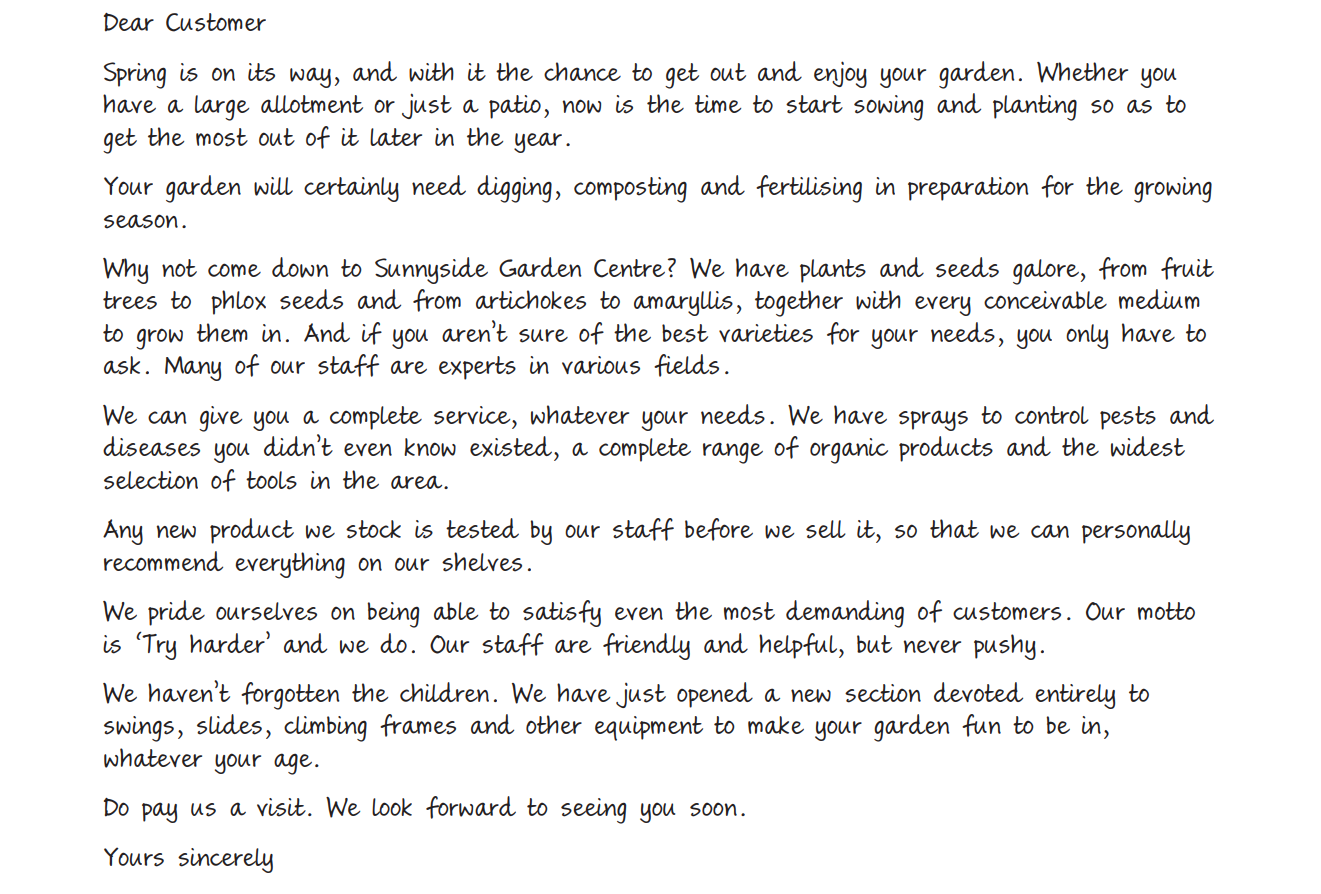
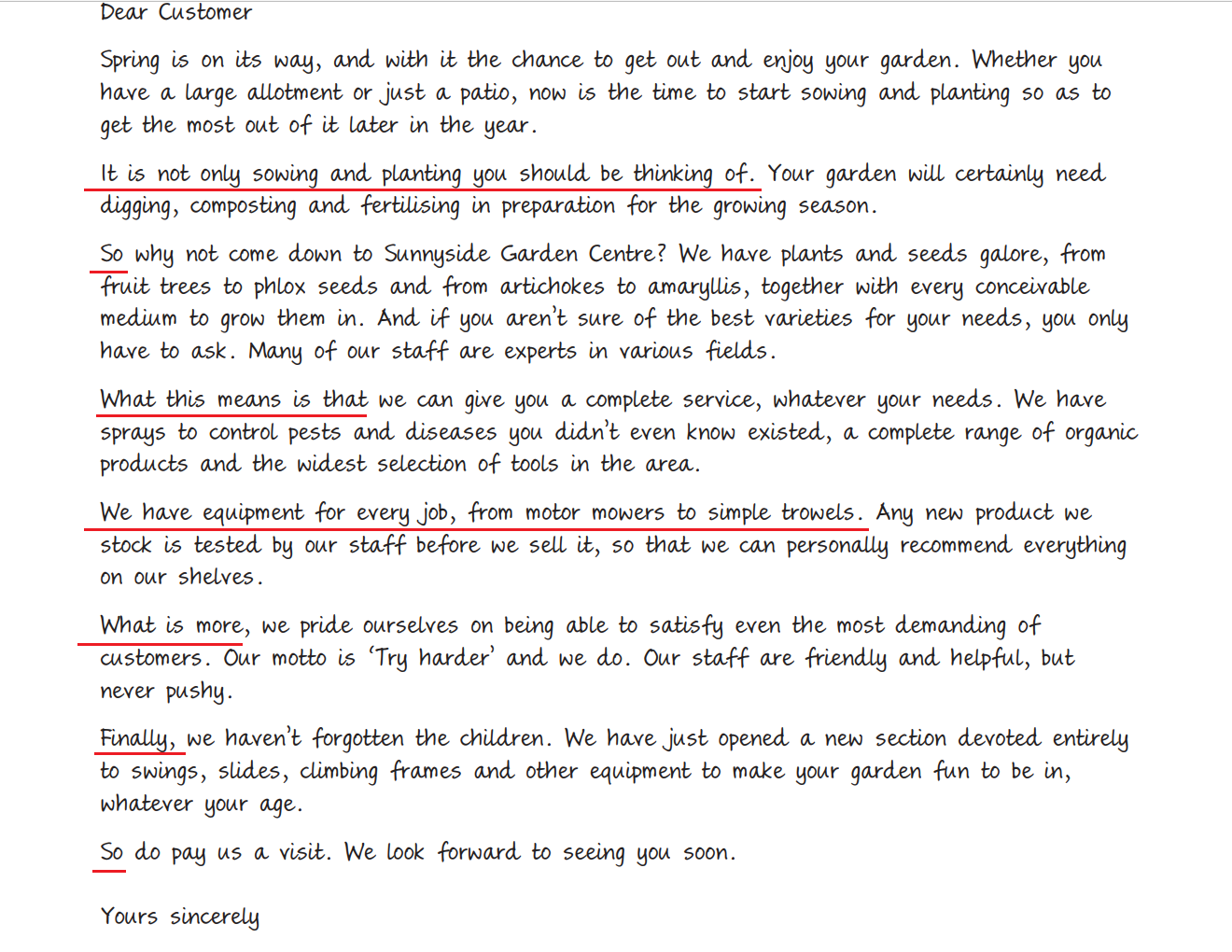
The devices used are:
● ‘It is not only sowing and planting …’ – repetition, combined with the expression ‘not
only’ to indicate that the writer is going to expand on this subject.
● ‘So why not come down …?’ – to indicate that he is going on to the next stage.
● ‘What this means is …’ – to indicate that he is going to explain further.
● ‘We have equipment …’ – repetition of the idea from the last sentence of the previous
paragraph.
● ‘Finally, we haven’t forgotten …’ – to indicate that he is reaching his conclusion.
bog down: get stuck while doing something
seamlessly: smoothly.
merge: combine or cause to combine to form a single entity.
paternalistic: relating to or characterized by the restriction of the freedom and responsibilities of subordinates or dependents in their supposed interest.
indicator: sign, signal
![[Work] Spoken English and Written English – SANTI Avatar](https://santi4u.files.wordpress.com/2023/04/cropped-wp_story1681739980193_15050431649920106744.jpg?w=48)



Leave a comment