If you think about using a script, every true professional follows a script or format. For example, take your favorite actor or actress (for me it’s Saul). They don’t get in front of the camera or on stage and begin ad-libbing their lines. Rather, each line they deliver has been carefully scripted and rehearsed, so that when they deliver those lines we are really moved by what they say. The key here is that rather than stumble around wondering what they are going to say next, they are able to concentrate on the timing, delivery, pacing, volume, enthusiasm, and inflection of their voice, and
that is why they are able to move us and infect us with their feeling.
I am sure you have felt this transfer of emotion after seeing a good movie. All of us have either felt happy or sad or charged with energy, etc., after seeing a well-acted movie. Did you stop to realize that you were just watching an actor deliver a set of scripted lines? You have to remember that well over 70% (some will even claim over 90%!) of any sale is simply a transfer of conviction and enthusiasm, and the best way to do this is to be able to concentrate on your delivery of information, rather than on what you are going to say about it next.
The Top 3 reflex responses you get when qualifying:
a. I’m not interested.
Response #2:
“I didn’t expect you to be interested, you don’t know enough about it yet. But I do know you’re interested in (provide a benefit here – saving $, increasing production, return, etc..)” and continue with your pitch.
Response #3:
“I know that , heck if you were interested you’d have called me! But seriously, I know you get
a lot of calls, and every now and then it makes sense to listen to the right call, and this is it.” (Now
(continue on with your presentation)
Response #4:
“_ you probably get a lot of these calls, don’t you? You know, I get them, too, and believe me, I
don’t like getting them any more than you do. But every now and then I listen because sometimes I there’s some information out there that will benefit me. And this is that kind of call for you. Let me ask you a quick question (make it a good one to uncover
their need!)
b. Just send your information.
(Note: This is a blow off and you’re not in the brochure business! Use trial closes here to assess
their level of interest):
Response #1:
“I be happy to, and if you like what you see, would you be ready to place an order?”
Response #2:
“Before I do, I want to make sure you’d be ready to act on it if you like it. Let me ask you…(qualifying questions on budget, decision-making process, etc.”
Response #3:
“Sure, and after you review it, how soon are you going to make a decision on it?”
Response #4:
“And what would you need to see to say yes to it?”
c. We’re already taken care of.
(Note: They may well be, but THINGS CHANGE! Your goal here is to get them to think of you when they do.)
Next in Line Script:
“I’m glad you’re taken care of right now. , let me ask you something. If you ever found it
necessary to get another (quote, point of view, find another vendor, information, etc.), could I be the first one in line to talk to you about some of your needs?
“Great. I’ll go ahead and send you some of my contact information; do me a favor and keep it with your (similar) records so you’ll have it handy if you need some help with (your product or service).”
Get all their contact information, then:
“Great. Just out of curiosity, _____________, what might have to happen to you for you to even consider looking at someone different?”
Another Great Way to handle the “We’re taken care of” is by using this script:
“That’s great _, that tells me you understand the value of (or appreciate the benefits of)
a solid solution for this. In fact you’re exactly the kind of company we work with. You see, I’m not
suggesting you stop using what’s working for you, but rather I’m here to help you get even better. You see the companies that use us as well have found that they can increase their (pitch your benefits here) by X%.
“And to see if this will work for you as well, let me just ask you a couple of quick questions…(now
qualify for interest, control, and budget).
How to Handle the Negative Prospect
“______, I know you get a lot of these calls and heck I don’t like making them any more than you like getting them. But the truth is, this is the one call this month that is worth you taking 5 minutes to participate in. Let me ask you…(ask a good, benefits filled qualifying question here).
“______, just imagine for a moment that what I was saying did work out, and you were already a client enjoying the steady monthly income, what would you be thinking now?”
Or,
“Just suppose for a moment that my product was able to reduce the time and money you now spend in this area just like it does for my other clients. Wouldn’t you be happy you took 5 minutes now to discuss this?”
Or,
“Let’s say for a minute you were to move ahead with this, and that it continues to work for you as well as it works for my other clients, what are some of the positive benefits you can see yourself enjoying over the next few years?”
Or,
“_______, why do you think that some of the (top business people, top financial advisors, your top business competitors), are recommending or participating in this very same program or product right now?”
And,
“In addition to the monthly income and great tax benefits of this investment, what are some other
features you would look forward to?”
And,
“Besides the tremendous dependability and service reputation our product has, what other reasons can you think of for moving ahead with this?”
Most sales reps hate cold calling because they have to deal with the gatekeeper and often get screened out.
Moreover, many inside reps make it worse on themselves because they try to manipulate or lie their way through to the decision-maker. This never works and only alerts the gatekeeper to screen you out.
80% of your competition is trying to dodge or trick the gatekeeper. This only encourages more screening! Always give both your name and your company name.
Here are the Top Three Techniques to eliminate screening:
A. Please use Please
“Hi, could you please connect me with_________, please?”
Remember, it’s a gatekeeper’s job to SCREEN YOU OUT! So when they ask:
“Can I tell him who’s calling?”
“Yes, please, please tell him with the ABC Company is holding please.” (Use please three times!)
“Can I tell him what this is about?”
“Yes, please tell him it’s about (the problem your prospect is having or your solution), please. I’ll hold while you put me through.”
B. Give your full name and company name.
C. Use instructional statements.
Scripts to Deal With Assistants.
“I’m glad I reached you,” Or, “Oh, you’re just the person I wanted to speak with!”
Assistant: “ isn’t here right now, could I take a message?”
You: “Yes, please. But maybe you can help me first. Do you work pretty closely with_______________?
If Yes:
“Oh, that’s great. I don’t want to waste any of his/her time, perhaps you know if…….”
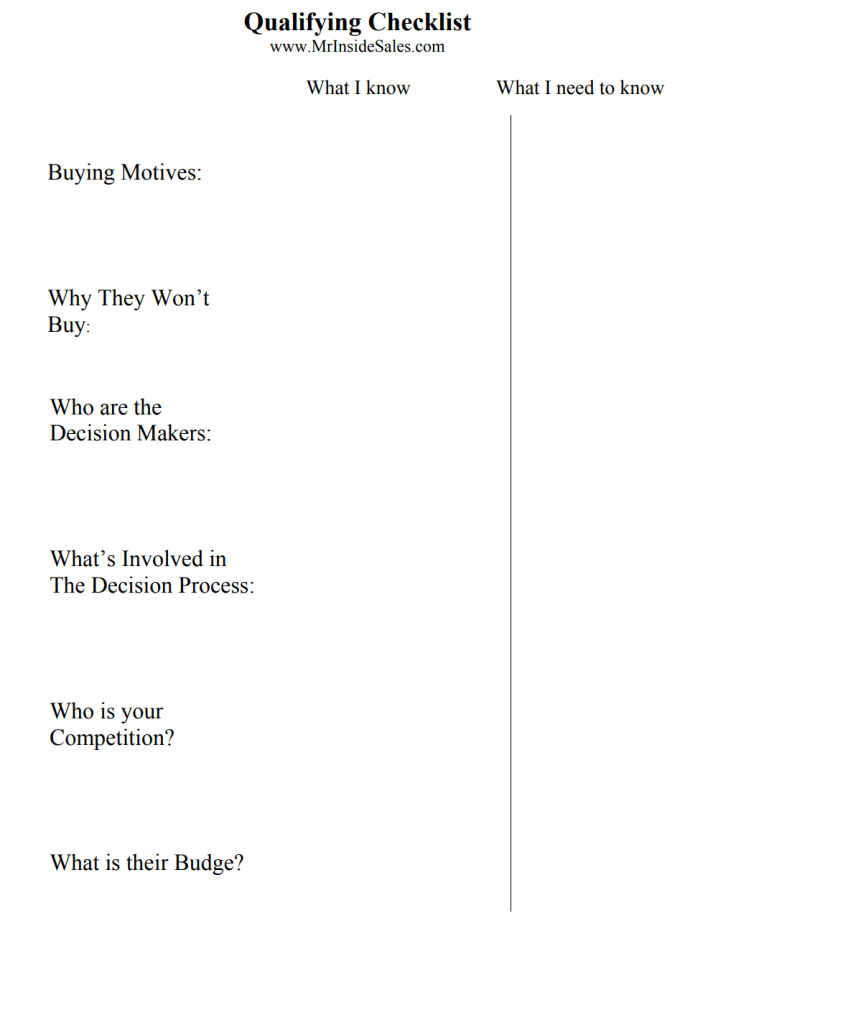
The Six Things that need to be on your Qualifying Checklist:
- Why they will buy it?
- Why they won’t buy?
- Who makes the decision?
- What is involved in the decision process?
- What is your competition?
- What is the budget?
Breaking It Down:
Here’s what each of these qualifiers mean, and here
are specific questions you can use to find them out:
1) Buying Motives (Needs and Wants)
What is this client looking for?
What are their buying motivations?
What do you need to say to get them to buy?
What is important to them?
Why did they buy last time?
What would they like to change this time?
If they could get what they want, what would that look like?
“________, what are you hoping to accomplish with
this?”
“What is most important to you when choosing a
vendor/company for this?”
“If you could get everything you want from this
(service/product/solution), what would that be?”
“Why did you get the (service/product/solution) you
got last time?”
“What would it take for you to choose our company
for this?”
2) Why won’t they buy? (Potential Objections)
Why are they getting another quote?
What are some of their sore spots? What are they trying to avoid?
Why didn’t they buy last time?
Why are they looking at different companies?
What are some of their potential objections?
Why won’t they buy?
Sample Questions to reveal potential objections:
“Who do you usually get this
(service/product/solution), from?
“Are you going to get a quote from them as well?”
“Why are you considering using a different
(vendor/company/provider) this time?
“What other solutions are you looking at?”
“I see you looked at our company before, what kept
you from going with us?”
3) Who’s the Decision Maker?
Who is decision maker?
How many of them?
Who do they consult with on this?
How much influence do they have?
Sample Questions to find the decision maker:
“_, who will you be making this decision
with?” (Assumptive)
“Besides yourself, who else will be weighing in on
this decision?”
“, who has the final say on this?”
4) What is involved in the decision process?
What the decision process is like?
What’s involved?
Who’s involved?
What happens next?
How long does it take?
How many other steps are involved?
Sample Questions to uncover the decision process:
“_, after we submit the (bid/proposal/send the
information), what happens next?”
“How long does this process take?”
“Who’s involved in that?”
“When would you like to see a decision made on
this?”
5) What is your competition?
How many other companies are they looking at?
Is the company they’re using now still involved?
What are they looking for in another one?
How many bids are they getting?
Who do they like best so far?
What would they like to improve upon?
Sample Questions to discover your competition:
“Who else are you looking at for this?”
“What do you think so far?”
“Might you use the same company (providing the
current service) again?”
“Who are you leaning towards so far?”
“Oh, why is that?”
6) What’s the budget?
It’s always about the money!
What is their budget for this?
What did they spend last time?
How big of a position do they usually take?
What is their limit?
What would they feel comfortable spending?
Is your product or solution within their budget??
Sample Questions to uncover budget:
“What is your budget for this?”
“What did you spend last time for this?”
“If we could provide a solution you were comfortable
on this, could you afford $_________ amount?”
“What is a ball park range you’re looking to stay
within on this?”
Examples of Red Flags and how to handle them:
1) If someone says that they usually buy from __, but will take a look at your information,
ask:
“Why would you switch vendors?” Or
“How many other companies have you looked at in
the last six months?”
And then: “And how many did you go with?”
2) If someone says that they will pass the (quote/information/brochure) on to someone else,
say:
“Thanks. So that I make sure I’m not wasting her time it’s best that I speak with her for just a few
minutes first. Can you please tell her that (your name) is holding please?”
If someone says that they’d be glad to look at over,
ask:
“Great. And after you do, if you think that it can help you (or your business, etc.), when would you
move on it?”
Write out your own questions to the Red Flags you often get and don’t be afraid of disqualifying nonbuyers early. Remember: You can never close an
unqualified lead!
How To Use Assumptive Questions
80% of sales reps will simply ask, “Who makes the
decision on this,” or “Are you the one making the
decision?” (Closed ended which allows the prospect
to hide or not reveal the truth)
The Top 20% assume the prospect involves others in
any buying decisions and wants that information up
front. They use Assumptive Questions to reveal it:
They will ask:
“Who will be making this decision with you?”
Or,
“Who do you think you’ll be speaking with about this
decision?”
For budget:
“__ most of my clients have a price range in
mind when considering this, what is yours?”
To sell bigger orders:
“ many of my clients want the discount
that comes from ordering this by the (case, unit,
multiple month contract, etc.), is that how you want
to do this is well?
Assume the close:
“ I’ve been looking forward to getting back
with you today. I’m sure you (reviewed the
information, brochure, material, etc.) and liked what
you saw. Did you want to start with (X size order)
today, or take the (larger) order?”
You can use Assumption Questions throughout your
sales process, and they will immediately make you a
better closer.
How To Use Layering Questions
First, for those of you who have seen me live, you
know that I am big on questioning your prospects
during the qualification stage. As I’ve said — they
have all the answers as to why they’ll buy or not buy,
and it is your job to get them to tell you.
While asking questions is certainly a good start,
you’ll get the most thorough and complete
information if you use layering questions.
Layering questions are simply questions that go a
little deeper into an area or concern so that you get to
the root of what really drives your prospect.
An example of a layering question goes like this:
“Who are you going to be talking with about this
decision?” (A nice assumptive question). And when
they say their spouse, you then layer the question
by asking –
“And what do they think you should do about this?”
Examples of other layering questions you can use:
“If you decide to move on this investment, how much
would you put into it?”
Layering question: “And is that money liquid now
or would you have to move something around?”
Another
“I’ll get this quote off to you today, and I’ll follow up
with you tomorrow at 10 o’clock – would that work?
Great”
Layering question: “Assuming you like it, what is
the next step?”
I’m sure you see how this goes, so take a few minutes
now and write some of your own. And then use
them!
How to Handle Incoming Leads
80% of your competition mistake the “implied
interest” of a call in to mean they are already
qualified, and all they need to do is explain their
product or service. Wrong!
The Top 20%, on the other hand, know that warm
leads can be some of the biggest time wasters of all,
so they do what they always do — disqualify people
who are “just looking” so that they can identify the
real buyers, and they do this by asking questions
rather than pitching.
“Thank you for contacting us today, what was it
about our ad/promotion/website that caused you to
call us today?” [Listen for the buying motive]
“Who else are you looking into?” [Listen for your
competition]
“What do you like best so far?”
“How long have you been thinking about (buying,
investing, changing) something like this?” Then,
“What has kept you from acting on this?” [Listen for
possible objections]
“When are you looking to make a decision on this?”
How to Handle Voice Mail
Golden Rule #1 — Be specific.
It is imperative to do some research and leave a
message that specifically addresses a problem or
event that your prospect is dealing with. For
example, if you find out on their website that they are
opening a new branch or division in another city,
mention this and tie it in with your value proposal.
And always use their first name. Something like:
Sample Voicemail Message:
“Hi Barbara, Mike Brooks here with HMS software.
I’m calling about your new office that’s opening in
Houston next month, and I wanted to provide you
with some ideas that may help with your networking
issues. We work with a lot of companies in the area,
and I think you’ll find it useful if we talk.
You can reach me by calling area code (800) 222-
- That number again is area code (800) 222-
0568, and ask for Mike Brooks. I look forward
speaking with you and thanks for returning my call.
Examples of how to handle common initial sales
resistance:
Objection #1:
“I looked it over and I’m/we’re not interested.”
Response #1:
“I understand, and that’s perfectly OK. At first many
of our clients don’t fully understand the benefits of
this and that’s why I’m here.
But let’s do this. I’ll take a few minutes to explain
how this might help you, and if, after you understand
it, you still think it’s not for you, we’ll part friends.
Do you have that information handy?”
“I didn’t expect you to be interested! Heck, if this
thing sold itself, they wouldn’t need me – they’d just
send out the information and clients would send in
checks!
Response #3:
“I understand, and some of my best clients said that
at the beginning as well. But I’m sure you’d agree
that any decision you make, whether it’s a yes or a no
– and I can take either one – is best made once you
understand all the facts, right?
Well, I’m here to help you learn those, so grab that
information, let’s go over it and if at the end it’s not
for you we’ll part friends. Do you have it handy?”
Objection #2:
“I don’t have the time right now.”
“I know that feeling, my schedule is pretty full as
well. Should I call you back in an hour, or would
later this afternoon be better?”
(Than make a definite appointment to call back.)
If your prospect says “I’m not interested,” you should
say,
“I understand how you feel, and I think you would
agree with me that any decision you make, whether it
is a yes or a no, is best made when all the facts are
known right? Well __ I’m calling to help you
learn all facts. You see, I can take a no as well as a
yes, but what is important here is that you understand
this program/product/service completely so that you
are in the best possible position to make the right
decision–but you get to make the decision! So go
grab that brochure and let me help you learn all the
facts. I’ll hold while you get it!”
“Of course you’re not interested , I didn’t
expect you to be! You don’t have enough
information on this investment/product/service yet,
nor do you understand it well enough to be interested.
In fact most people I call back feel the same way you
do–they think this investment/product/service is
(Quickly list one or two perceived negative points),
so I don’t blame you for not being interested! I
wouldn’t be either if that was true.
But __, that isn’t how this
investment/product/service works. To begin with
(list two or three benefits that contradict the first
couple of negatives you just gave). These are just
some of the things you need to be aware of before
you make any decision, so go get that brochure and
I’ll show you how this works. I’ll hold on while you
grab it!”
Again, assume that they will go get the brochure, and
make sure you end with an instructional statement. If
your prospect says that they looked at it, and they
introduce another popular objection like they, “Don’t
have the money right now,” again, remember not to
give this or any objection any credence now by
questioning it. Rather, answer with another positive
reflex response like:
“I understand what you are saying, and most people I
speak with don’t have money to throw away or put
into a bad (investment, product or service).
However, once I explain how this (your product or
service) can actually save you money, or make you
money, you will be glad you invested a few minutes
to find out how. Do yourself a favor, and grab that
brochure, I will hold while you get it.”
“Let’s put the money aside for a minute because
before you make any decision we first have to
determine if this (product, investment or service) can
benefit you. After I explain a few facts about this
and answer any questions you have, then you will be
in a much better position to decide if this is
something you want to pursue. I will hold on while
you grab the (brochure or paperwork).”
The whole point here is that by not buying into their
objections by saying things like, “When will you
have the money?” Or, “Last time we spoke you said
your company could afford this,” etc., you will avoid
giving all control and momentum to them.
If your prospect says, “We looked at your material
and this just isn’t for us right now,” rather than saying something like “Well when would be a good
time?” you should say,
“I understand, and you know you said something very
important. You said right now. I think you would
agree with me that timing is probably the most
important part of any decision you can make isn’t it?
Well right now the timing is perfect for (your
investment/product/service). Before you make any
decision, it is important for me to explain how, by
acting now, you will (describe a benefit that is
important to them). Grab that (brochure or
paperwork) and I will explain why. Do you have it
handy or do you have to get it?”
If you receive the objection of “We already have a
supplier or dealer or service person,” you should
respond,
“I understand and that’s great! You see I only work
with companies like yours that are used to using this
kind of (product or service). And that is because I
know you will really appreciate the (give a benefit
here that you know they want) that our (product or
service) can offer. Before you make any decision, it
is important to see if this can indeed make your job
easier. Grab that information and I will cover a few
of the highlights with you. Do you have that handy
or do I need to hold on while you get it?”
Opening Call:
You are calling back to take control of the close and to get the prospect to buy! The way the Top 20% do this is by being prepared with scripted openings that work. Use these:
Sample Opening #1:
“Hi, , this is calling with the
ABC Company. I’ve been looking forward to
speaking with you, and I’m sure you’ve looked at the
information I sent and probably even have a few
questions.
Do me a favor and grab that, and I’ll hold on while
you do.”
This works because:
A. It’s assumptive
B. You’re in control
C. It overrides any initial resistance
Sample Opening #2:
“Hi, , this is with the ABC company, how are you doing today? Great. __, it’s been an exciting morning here, and I’ve
got some updates I think you’ll be interested in
Sample Opening #1:
“Hi, , this is calling with the
ABC Company. I’ve been looking forward to
speaking with you, and I’m sure you’ve looked at the
information I sent and probably even have a few
questions.
Do me a favor and grab that, and I’ll hold on while
you do.”
This works because:
A. It’s assumptive
B. You’re in control
C. It overrides any initial resistance
Sample Opening #2:
“Hi, , this is with the ABC company, how are you doing today? Great. __, it’s been an exciting morning here, and I’ve
got some updates I think you’ll be interested in
Sample Opening #1:
“Hi, , this is calling with the
ABC Company. I’ve been looking forward to
speaking with you, and I’m sure you’ve looked at the
information I sent and probably even have a few
questions.
Do me a favor and grab that, and I’ll hold on while
you do.”
This works because:
A. It’s assumptive
B. You’re in control
C. It overrides any initial resistance
Sample Opening #2:
“Hi, , this is with the ABC company, how are you doing today? Great. __, it’s been an exciting morning here, and I’ve
got some updates I think you’ll be interested in regarding that (quote/brochure/information/demo) I
sent to you.
It’ll just take a minute to bring you up to speed, so do
me a favor, can you please grab that
(quote/brochure/information/demo), and I’ll be happy
to hold on while you do.”
Sample Opening #3:
“Hi is that ? Hi , this is
_ with the ABC company, how have you been?
Gee I know the feeling. , the good news is
that this won’t take long, and you’ll be glad you took
a few minutes to go over this briefly. Do you have
the (quote/brochure/information/demo) handy, or
should I hold while you grab it?”


Leave a comment