It’s not easy to write this book review—especially because both the author and the book are quite well-known. When Hessler left Fuling, he was 29—just like me now.
What amazed me most was how clearly the author laid everything out—you don’t need any prior knowledge of Chongqing to appreciate the story. I first read Other Rivers last summer. Although most of the details have faded from memory, I remember enjoying it—otherwise, I wouldn’t have picked up River Town. After finishing this book, I found myself wanting to recommend it to anyone curious about life in 1990s China.

Although I’ve never been to Fuling, the landscapes, people, and everyday moments described in River Town felt strangely familiar. My earliest impressions of Chongqing came from old computer games set in places like Shushan (蜀山)and Yuzhou (渝州), which are often depicted as mystical, ancient places associated with martial arts, immortals, and spiritual cultivation. Later on, after watching iShowSpeed’s livestream in Chongqing, I got the impression of a city bursting with youthful energy and genuine warmth. Besides, during a recent trip to Shenzhen, one of my travel companions happened to be from Chongqing. These experiences brought the book vividly to mind.

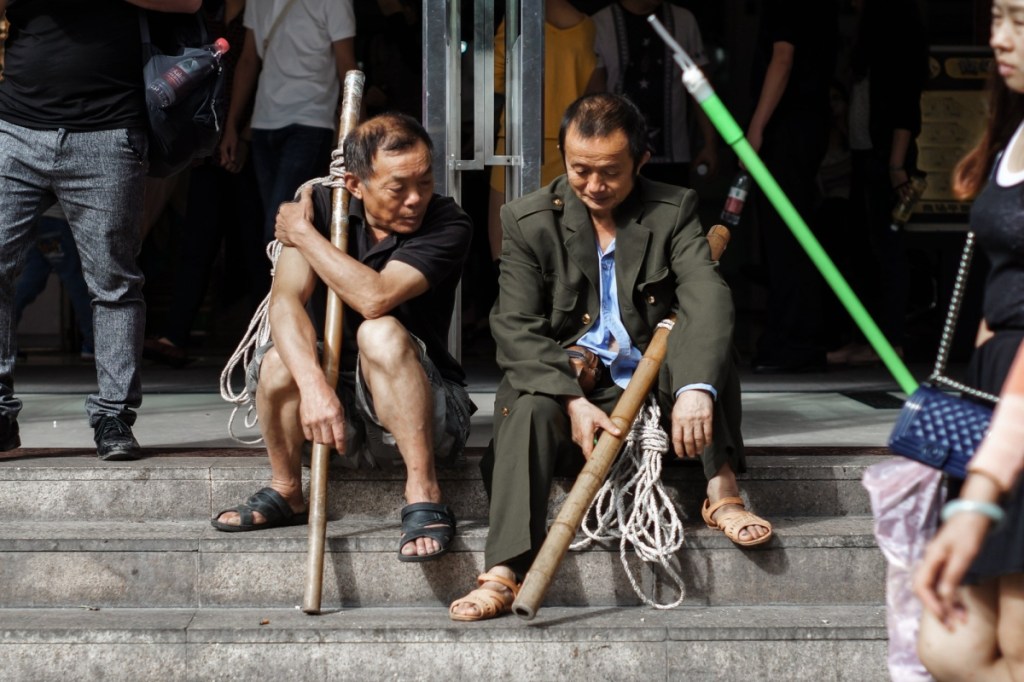
I especially love the parts about the streets, the “stick-stick soldiers” (porters with bamboo poles), and the mountains and rivers. The book mentions that after the Three Gorges Dam was built, many residents had to relocate. Midway through reading, I ended up buying two large photography books by He Zhiya, documenting Chongqing’s architecture and old neighborhoods.
As a younger reader, I inevitably drift into personal memories when reading these kinds of place-based memoirs. After I got my first phone, I tried to take as many photos as I could of old streets, buildings, and my school. Of course, most of them have been torn down now. The demolition of old neighborhoods and the redevelopment of urban villages are very common throughout East Asia. Do I miss the past? Not really. There was warmth in those smoky, lively scenes—but there were also tears, and as the book says, “Meibanfa (There was nothing we could do)”.
I remember starting River Town around the same time there were rumors that a journalist’s memoir Seeing had been pulled from shelves. I read a few chapters of it digitally but decided to stop—I didn’t want to dwell too much on the past.
Naturally, the book touches on ideology. The author has a strong grasp of these issues, and some parts are genuinely funny—absurd, even—thanks to the political constraints of the time. There are plenty of examples: the Don Quixote play, Christmas being turned into a Chinese revolutionary song… surreal moments that made me laugh.
However, If this book were published today, it might get slammed—or might be banned. First, because nonfiction travel writing always carries the author’s perspective, and someone will always take issue with it. Depending on how you edit a story or shape the language, you might end up with a bleak reality, absurd humor, or poetic longing. Second, the topics in these China observations often feel repetitive nowadays—even small everyday moments lack freshness. And when writers try to reflect deeply on society, they risk sounding ideologically arrogant or classist.
Back to the author. As a foreign teacher driven by almost a religious idealism, he came to a small western Chinese town. I believe he was genuinely committed to education. He encouraged his students to think independently and be open-minded, and he interacted with them outside the classroom, despite political risks. Despite facing discrimination and distrust, he made efforts to integrate—learning Mandarin and the local dialect, making friends, and never using his higher salary or “foreign face” to behave inappropriately. That’s rare. I noticed another reader, also appreciated this rare quality in his blog. And he’s stayed true to that for decades, which I truly admire.
Toward the end of the book, there’s a student play where someone rewrites the final Don Quixote monologue:
“Don went back to his noodle shop, and Sancho went back to his farm
to raise hogs in order to support his tuition, hoping that he could get
the degree in Oxford University. Meanwhile Don taught himself and
got the bachelor’s degree in Penn University. Later the two crazy men
travelled to China and became two English teachers, also the most
famous Yahoos in Fuling.”
I was honestly moved. To have had such a good foreign teacher—especially back in that era—must have been a once-in-a-lifetime stroke of luck.



Leave a comment