I wanted to write something about The Long Goodbye by Raymond Chandler… but honestly, nothing profound came to mind. So I guess this will just be a casual ramble.

I discovered this book through Will I met in a group chat. One night, we were all on a group call—singing, joking, talking nonsense. But as it got later, the mood shifted. People started opening up. I was building a long staircase in Minecraft’s wasteland biome at the time, but I paused my game to join the conversation. While talking and scrolling through my feed during a lull, Will recommended this book in a post. That was enough for me to decide to give it a try.
When I started reading it, I immediately got stuck on the first page. I even documented the moment:
It started when I read the first page of one such book and saw just three lines that immediately struck me. The style was something I had never seen before. I couldn’t describe it, only feel it—so this is also what writing can be like?
….
Most of the books I’ve read over the past few years are recent publications—novels, memoirs, that sort of thing. But to read from a literary classic … that feels like a whole new beginning.
And now, about a month later, I’ve finished the book. My biggest takeaway?
It didn’t shatter me the way I expected it to.
I kept thinking: What was missing?
Maybe it’s because if this story were told in a modern style, there would’ve been flashbacks—whole chapters of Eileen and Paul, Eileen and Wade, showing their best days. And then, only at the end, would that emotional connection be slowly, devastatingly dismantled.
But Chandler didn’t write it that way. He left things unsaid. Hinted, then stepped away.
Maybe the point wasn’t to break the reader with drama, but to quietly let the story seep in. Enough to make you think about people you haven’t seen in a while, about relationships that couldn’t be saved, about the inevitable partings and the lonely aftermath.
I don’t know how ordinary Americans during the old time experience that kind of grief. But in many developing countries, the sense of loss might be even sharper.
Our parents grew up in small towns where everyone knew each other—classmates since childhood, neighbors who’d visit unannounced, kids falling in love, and even fights were mediated by familiar faces. Their kids—us—played together, ran between each other’s homes, listening to grown-ups reminisce about their own youth.
Then one day, someone transfers to a school in the next town. Someone else moves to the city. The small town gets demolished gone are the corner stores, the old phone booths, the dirt patches where we played. Skyscrapers go up. My family buys a new computer, I start gaming, my best friend gets hooked on mobile novels, the boy next door chases after girls with pigtails. His friend mocks him, calls it “effeminate Japanese influence.” That classmate who always laughed too much suddenly starts falling behind. His dad won’t pay for him to retake the college entrance exam. He’s told to quit school and help with the family grocery store. He dyes his hair purple. The quiet, bespectacled guy from next door transfers schools overnight—turns out his family got lucky in business and moved to a big city. And all of us pretended nothing had changed. We studied harder. Stayed up late.
After we graduated, the school moved to a new campus. The old one was repainted and became an elementary school…
And I’ve only talked about school here.
In many towns in developing countries, just a few years can wipe away decades or centuries of history. The pace of change is dizzying. So fast that even grief becomes ritualized—something we perform quickly before moving on.
There’s no time to linger. Too much reality, too many stories. If we really dug into it, it would hurt more than any novel ever could.
So we pick up a few new terms: avoidant, passive, cautious…
Then we adopt pets, or fall in love with characters in anime or games.
I can’t say much more than that.
I’m truly grateful that you’ve read this far. It’s been a long time since I last read a classic novel—perhaps the last one was Hawthorne’s The House of the Seven Gables. I found myself really drawn to the character of Marlowe—not because of his role as a detective, but because of a certain detached clarity in him that’s hard to put into words. After browsing some forums, I learned that this novel is part of a series. Some readers love The Long Goodbye just as much, while others compare it with Farewell, My Lovely and The High Window. Maybe someday—years from now—I’ll try reading Chandler’s other books featuring Marlowe. Also, I came across a brief introduction of Raymond Chandler that I’d like to share here: THE GREAT WRONG PLACE: RAYMOND CHANDLER’S LOS ANGELES AT 70
“Down these mean streets a man must go who is not himself mean, who is neither tarnished nor afraid…. He must be a complete man and a common man and yet an unusual man…. He must be the best man in his world and a good enough man for any world.” by Raymond Chandler
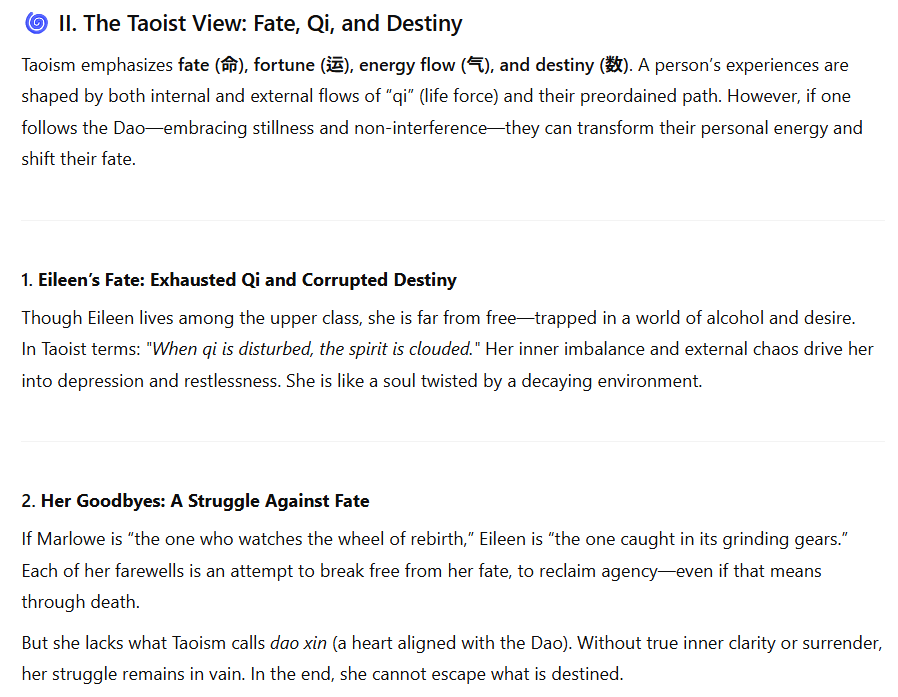
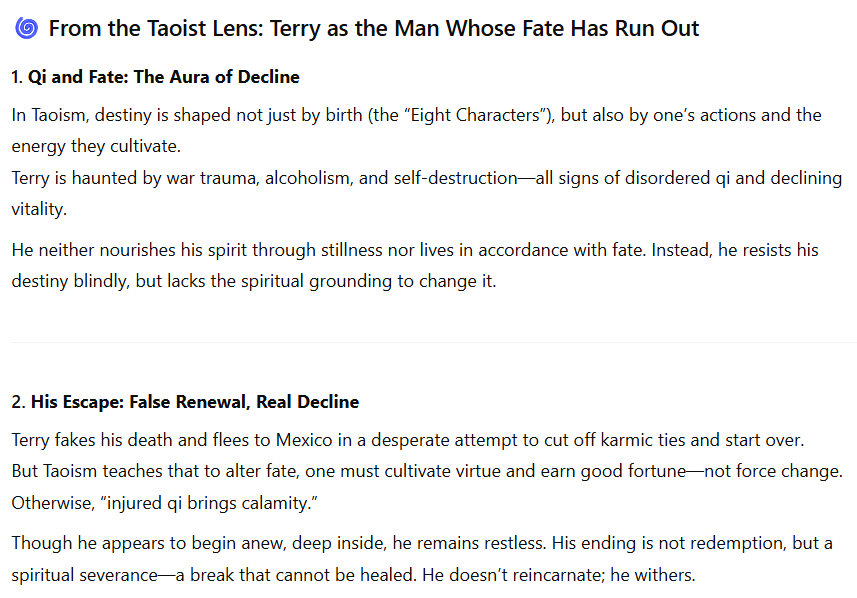
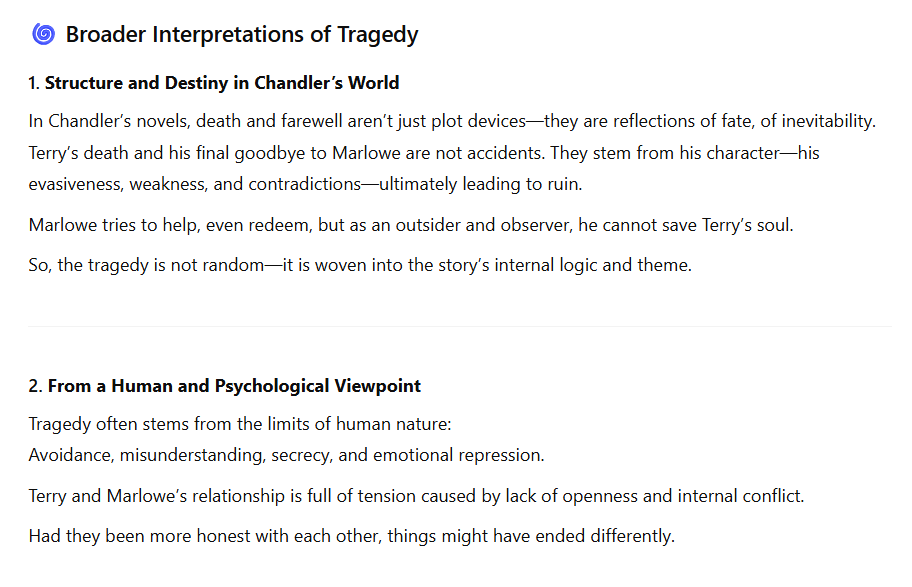
This morning, I asked GPT a random question—how would Taoism or Buddhism interpret the characters in the novel?
It gave me a perfectly composed nonsense answer: Life is impermanent. Be honest. Let go. Go with the flow.




Leave a comment