I have started to make my own notebook series since I was a middle school student. I read different materials and keep notes for myself. Like I am making a sensory word list… it’s not just like copying or printing others success to memories, but I was learning how others made those notes. Besides, I was making updates and personalization, then sharing my own notes and thinking. I’ve learnt so much but it is not easy to do that.
First, I have to find delicious fruits from others which means the materials should be reliable and complete. While searching “sensory words” you will find some titles below and one of them is ” 583 sensory words (https://smartblogger.com/sensory-words/)“. It’s a brilliant work and I believe it is much reliable and complete. However, if you had tried to search other materials you would always find there were just a few examples, sometimes wrong words or not accurate enough. That means, it’s time to build your own vocabulary list.
Second, I have to use some common sense which might be linguistics here. Usually I try to remember what I had learnt at language and literature class. For example, when I was making the sound sensory words, I must knew how many types of these words, or how many ways I could classify these words. In that post, I made sound sensory words in three types:
Characteristics of general noise: loud, faint, whisper, boom, silence, ear-piercing, rumble, etc.
Characteristics of animals and nature sounds: roar, bleating, crash, creek, purring, susurration, whine, etc.
Description words of human behaviors: cheer, whooping, scream, wail, hiccup, sneeze, yell, etc.
In fact, there should be more details. For example, some words are verb and noun while others are verb which noun are the verbs followed by -ing. In other words, gerunds and infinitives. Some words are positive while others are unpleasant. I didn’t show them clear enough. Moreover, some words show a loud and clear sound, but some show a loud but noisy sound… If you didn’t know the difference, how could you use them correctly?
As a editor and learner, I would have to correct and finish the list base on these examples. Perhaps I would have to look up different dictionaries to compare the lists of explanations for only one word. When I was making Touch Sensory Words List, I was thinking if the first word, abrasive, is a touch sensory word. Here are the definition from Oxford dictionary and Merriam-Webster dictionary:

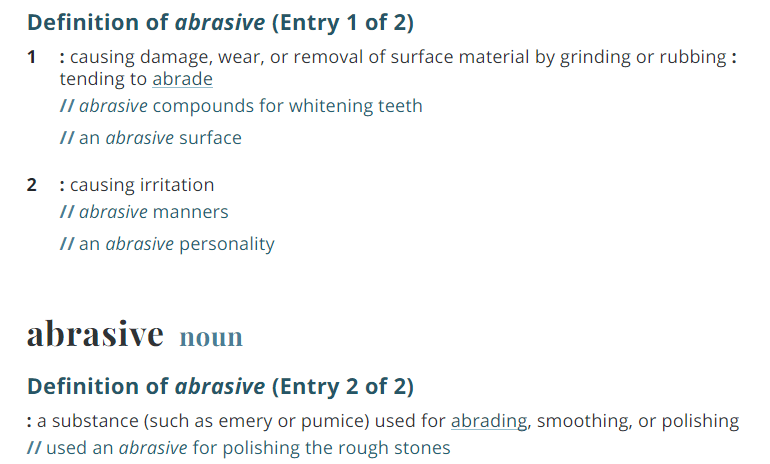
According to oxford dictionary, we use abrasive to describe a rubbing substance. But it could be used to describe something smooth and shiny. Here is the question, is it a sight sensory word or touch sensory word? Can I say “it feels abrasive” or “it looks abrasive”? What is touch sensory word?
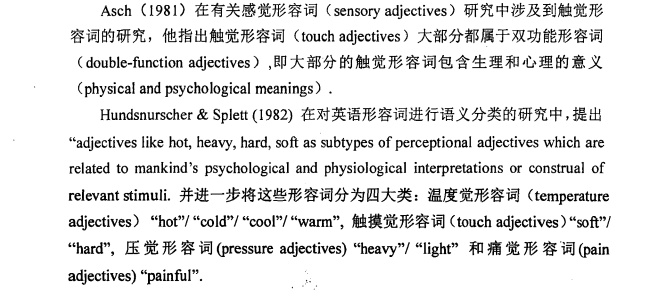
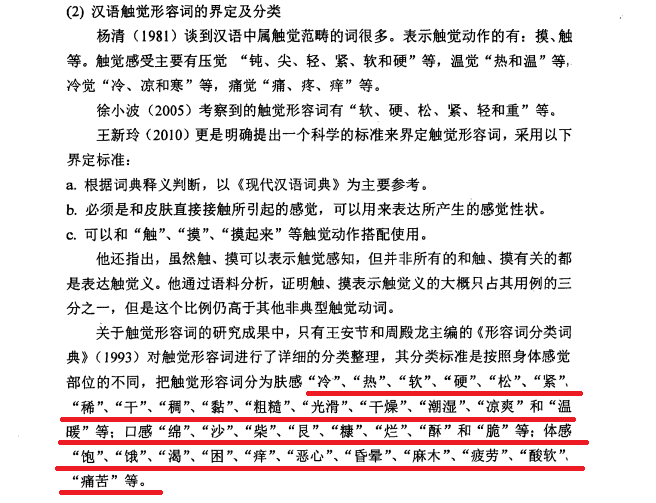
I looked up some linguistics articles, and one of them says: touch sensory adjectives are mostly including physical and psychological meanings; are including temperature adjectives, pressure adjectives, and pain adjectives. Besides, one researcher lists more catagories based on feeling of skin, taste and body. At this time I know the way to make sort of sensory words: feeling of skin and body.
At last, checking each words with explanations, examples and synonyms are a time-taking work. Usually I take around 3 afternoons to finish a list with around 150 words. It’s tired but also satisfied. I post them on the site but I don’t say it is only my work because I saw others been sweating blood. If I have seen further, it is by standing on the shoulders of giants. Hope there will be more reader like my notes.






Leave a comment