I followed the film on social media for several days and tried to document the online discussions at the time, as well as my own thoughts after watching it. But I still felt that the discussion was unfinished. This note came from an essay I read on Douban, China’s IMDb by @二脚猫摄影梅林, who wrote an in-depth interpretation of the ending sequence and the final song. I felt that he captured the part that moved me, as well as things I hadn’t been able to recognize because of my limited life experience. I enjoy the memes surrounding the film, but this time, I wanted to return to the story itself.
I therefore wanted to include this interpretation and share it here. I think this is a very good Chinese story. I don’t know whether maternal love is expressed in similar ways in other cultures, but I really love this one.
I originally considered using “In My Life” by The Beatles or “Mother” by Pink Floyd to help you get into the mood, but I still hope you’ll listen to the original ending song from the film: a song with a slightly Soviet feel that serves as the perfect finishing touch. AI-generated and cover versions of the song have appeared online, but they all lose the emotion and authenticity of the mother’s original voice.
Even in comments from people who disliked Niu Lai, what Chinese audiences and audiences outside China were discussing may not actually have been the same thing.
This becomes especially apparent when discussing Niu Lai: This becomes especially apparent once the meme becomes detached from the story. They may not fully understand the original context in which these elements appeared in the film, while certain characters, images, gestures, and even the label of being “shitty” can detach themselves from the film and become memes on their own.
This can lead to several things:
- From narrative to symbol: A meme originally exists as part of a story, but eventually only a character, image, line, or gesture remains. People can use it without knowing the original story at all.
- A shift in meaning: What the original creator intended to express is no longer important. New users give it meaning according to their own contexts and give it new meanings.
- From content to template: The meme no longer refers directly to the original work, but becomes a reusable structure for expressing something else. A character who originally served a particular role in the story may eventually come to represent only an abstract idea such as stupidity, absurdity, or a breakdown.
- Remix and recontextualization: The original meme is placed into completely different political, social, entertainment, or personal contexts. In the process, it acquires a new life of its own.
- The original work gradually becomes background knowledge, or is even forgotten: In the most extreme case, people can use a meme without knowing where it came from at all. At that point, it has evolved from a reference into a form of cultural shorthand.
It is like the head-touching dodge meme from that Indian game (no offense to my Indian friends). Nobody really cares what the story of the game is. Indian audiences might find the gesture awkward too, but they may interpret that awkwardness differently from Chinese audiences.

The following contains spoilers.
Yes. I actually wanted to interpret this part at the time, because this part may be related to the behind-the-scenes story of the director and his mother making this film. As for the behind-the-scenes story, because the creators did not come forward to give any response after the film became popular, I did not go into a deeper analysis of it in the video. I can write about it here, and we can discuss this part together.
Actually, this part returns to Niu Lai’s growth, which is also the director’s own growth experience. It may not have much to do with the broader, more elevated meaning I discussed in my video (WeChat Video Channel: 梅林的末班车), and I suspect that it has more to do with some of the director’s personal memories.
There is an ending song. When I was in the cinema, almost everyone was laughing from beginning to end. The audience was easily drawn in by its crude modeling, abrupt performances, and completely unpredictable plot, and even by the time the ending arrived, they were still immersed in that sense of bizarre amusement, to the point that they never really heard the final song. But when I put the ending of the film and the ending song together again, I suddenly felt a very complicated set of emotions.
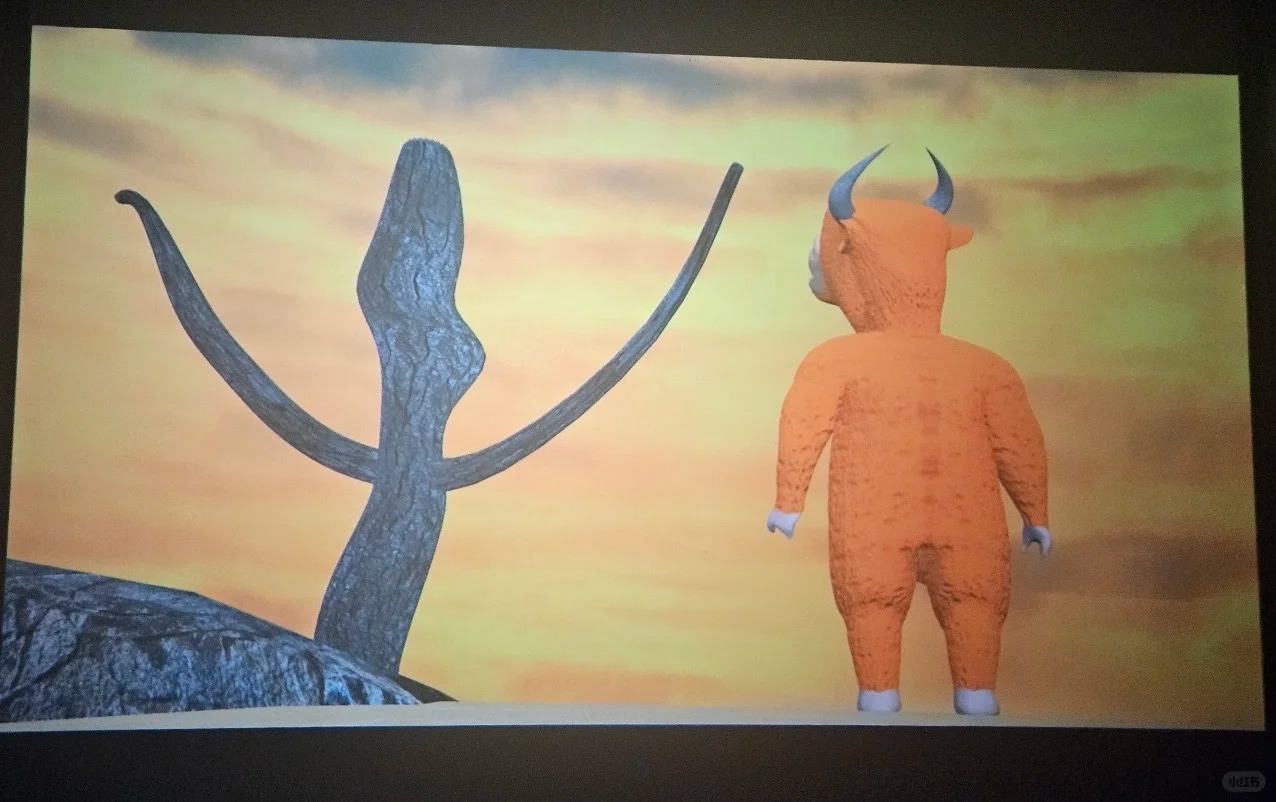
In its dream, Niu Lai experiences a long lifetime. It begins as a little calf that cannot stand, then meets friends, learns and grows, and experiences misunderstanding and separation. Its mother sacrifices herself to protect it, and it eventually becomes the leader of the herd, just like its father. The second half of the dream suddenly becomes extremely abstract. The wolves once again harass the herd, and Niu Lai and Baola prepare to fight them. A sudden loud noise scares the wolves away. Baola goes alone to investigate and tells Niu Lai to leave first. Niu Lai walks all the way to the edge of a cliff, with nowhere left to go, and even considers jumping off. At that moment, an inexplicable wooden cart suddenly appears, constantly changing shape and expanding in front of it, before charging toward it. Niu Lai does not jump off the cliff. Instead, it turns around and charges straight toward the wooden cart. Then the screen goes dark. But Niu Lai does not die. Or perhaps that entire lifetime never actually happened.
In the darkness, the little bird says to it, “There is still one thing missing from our cooperation.” Before the bird can say what that thing is, Niu Lai wakes up. It finds itself back in childhood, back at the moment when it has just learned to stand. Its mother has not died, and its father has not grown old. The injured little bird has also recovered. It exchanges a few simple pleasantries with Niu’s mother and then flies away.
Niu Lai desperately chases after the bird, but it can never catch up. Looking back on this scene now, I find it extremely cruel. In the long lifetime inside the dream, the bird had always accompanied Niu Lai. It had landed on Niu’s mother, witnessed migration, friendship, death, and growth, almost like a third-person perspective detached from the story itself—a kind of god’s-eye view, as you described it. It was like the audience, and also like memory itself, watching Niu Lai grow up all the way. But when Niu Lai wakes up, the bird no longer knows it. All those things they experienced together exist only in Niu Lai’s memory. On this real timeline, they were never friends. To the bird, Niu Lai is merely an unfamiliar little calf that has just learned to stand. It flies away, taking with it everything Niu Lai once possessed in that other possible life. This reminds me of the rose in The Little Prince. It is not that there is only one rose in the world, but that the time you have spent on that rose is what makes it irreplaceable to you. Yet life can only move along a single timeline. In the other life that was never chosen, those lives that might have become close friends, family members, and witnesses eventually become strangers who merely pass by you. Perhaps that is why Niu Lai desperately tries to chase after the bird. What it wants to recover is not merely a bird, but that life that only it remembers, yet that never truly happened.
Even stranger is that Niu Lai continues forward, only to discover that the seemingly bottomless cliff from the dream is actually just a very low mound of earth in reality. It walks down the slope and sees its father. Its mother happily introduces it to its father: “This is Niu Lai. It found its own way here.” Looking back now, this may be the single most important line in the entire film. Niu Lai was not ordered by its father to come here, nor was it supported or carried here by its mother, and it was certainly not dragged here by the herd. It stood up by itself, crossed the little mound that had seemed like a cliff in the dream, and walked to its parents by itself.
In the dream, all the cows walk upright like humans, talk to one another, and have families, friendships, wars, and heroism. But after waking from the dream, the herd becomes four-legged animals again. They no longer speak human language. They simply stand there quietly, occasionally letting out a few low bellows. This suggests that the lifetime in the dream may not be a prophecy of the future, but merely another possibility imagined by Niu Lai. In that possibility, it completes a conventional, socially defined process of growing up: making friends, gaining recognition, losing its mother, inheriting its father’s position, becoming a leader, and finally confronting its fate like a hero.
But after waking up, it is still just a little calf that has only recently learned to stand. At first, I thought this ending was simply absurd. Now, however, I suddenly feel that it is actually quite sad. The dream has allowed Niu Lai to complete a standardized life: moving from weakness to strength, from being protected to becoming a protector, and from being a child to becoming a father. But the film ultimately cancels out that entire process of growth with its own hand, sending Niu Lai back to its original position, a position where it has not yet been recognized by the world. This easily reminds me of a child who cannot grow according to the pace prescribed by society.

This is not to say that we should diagnose the director based on this, or claim that Niu Lai symbolizes some specific psychological state. More accurately, it resembles all those people who cannot smoothly enter a “standard life”: everyone else has already stood up, while they are still falling; everyone else can naturally integrate into a group, while they can only immerse themselves in their own inner world; everyone else moves forward along the paths prescribed by society, while they need to use a long dream to imagine the life they might otherwise have had. And the ending song makes this layer of emotion suddenly more concrete. The lyrics, music, and vocals for the song were all provided by the mother of the director, Xin Yumeng.were all done by the director Xin Yumeng’s mother. There are also two lines in the lyrics:
“When will the rain be gentle?
When will the sprout break through the soil?”
The characters for “rain” (yu) and “sprout” (meng) appear in the lyrics, coincidentally forming the director’s name, Xin Yumeng. It sounds as if the song is asking: When will you grow up? When will you finally become like a seed and truly grow out of the earth?
But this sentence contains neither pressure nor blame. It is not like the father’s line, “Why can all the other little calves stand up except you?” Instead, it resembles the different sense of time represented by Niu’s mother: It’s okay. You can take your time. There will be another tomorrow after tomorrow, and another tomorrow after that. You will grow a little more.
I do not know whether the mother-child relationship in the film can be directly mapped onto the director’s real relationship with his mother, and I should not draw conclusions about a real person based on a few interviews and descriptions from neighbors. But judging from what is shown in some of the videos visiting the creators, the place where they live and work seems to be an ordinary residential building rather than the well-funded animation studio that outsiders might imagine. The neighbors and nearby shopkeepers also mostly describe the director as quiet, solitary, and not very talkative. If we temporarily put aside our judgment of the real people and look only at the emotional structure presented by the film, we might imagine it this way: a child who has not achieved much according to society’s standards, and who has spent a long time immersed in his own inner world, suddenly decides to make an animated film. To professionals, the film may seem clumsy; to ordinary viewers, it may even look like a joke. Its technology is immature, its expression does not fit in, and almost every aspect of it fails to meet the standards of the modern film industry. But his mother never asks, “Why do you have to make this Niu Lai?” She simply stays with him and helps him finish the film. She accompanies him as he imagines friendship, migration, rejection, and the loss of loved ones; she accompanies him as he experiences, in a dream, a life that he may never truly have possessed in reality; and finally, she personally writes, composes, and sings a song for his film, gently hiding her child’s name inside the lyrics.
If we try to understand this from the mother’s perspective, perhaps her love would sound like this:
I know that you are not quite like other people. I also know that this film may not be understood. Other people may laugh at you, treat you as a curiosity, or even regard you as a failure. But it is not my job to judge you by the world’s standards. What I can do is simply stay behind you and accompany you. It is okay if you walk more slowly. If you fall, you can stand up again. I do not know where you will eventually go. But as long as you are willing to keep moving forward, I will walk this road with you. I will stay with you until you finish this film. Because whether what lies ahead is a bottomless cliff or an ordinary little mound of earth, a mother cannot decide in advance what lies ahead for her child.
In the child’s dream, the future may be terrifying: his mother will die, his friends will leave, the world will force him to become a hero, and finally an enormous, nameless object will come crashing toward him. But when he actually gets there, he discovers that what seemed to be a cliff is nothing more than a small mound of earth. A mother can tell her child what might lie beyond the hill; she can accompany him as he practices standing and encourage him when he falls. But she cannot walk those final steps for him. So in the end, all she can tell his father is: “This is Niu Lai. He found his own way here.” Growing up is not about a mother delivering her child to the finish line. It is about the mother finally being able to stand aside and watch her child walk there by himself.
When the ending song begins, its old-fashioned folk-song quality, with something reminiscent of Moscow Nights, intertwines childhood, family love, growth, and loss. The images remain crude, the characters remain clumsy, and Niu Lai is still futilely chasing after a bird that does not even know who it is. But precisely because of this roughness and clumsiness, the emotion becomes unusually real. It does not feel like a tearjerking sequence precisely calculated by an industrial film. Instead, it feels like an inarticulate person trying, with the only means available to him, to tell a story about a feeling that cannot be spoken directly. We can certainly still say that Niu Lai is a technically immature film, and there is no need to suddenly proclaim it a masterpiece simply because of this layer of interpretation. Because I suddenly realized: what we are laughing at is a crude film, but for some other people, this may be something they truly spent many years finally completing. Great maternal love does not necessarily mean turning a child into someone who conforms to the world’s expectations, nor does it necessarily mean pushing him toward success according to society’s standards. Sometimes, maternal love is simply this: when everyone is laughing at what the child has made, the mother is still willing to sit beside him and help him finish it; and then she sings a song to tell him:
“I know that you walk slowly. I know that your path is different from other people’s. But that is okay. When will the rain be gentle? When will the sprout break through the soil? You do not have to become someone else. You only need to reach a day when you can stand up by yourself, cross that little mound of earth by yourself, and find your way here by yourself. That will already be growth.”
From this perspective, Niu Lai is not a film that exists to express some grand meaning. It is even a kind of “anti-meaning” film. Its greatest meaning is simply that the son wanted to make a film like this, and his mother supported him in completing it. That is the most moving thing about this film.


Leave a Reply