A few days ago, I wrote a Chinese-language review after watching Niu Lai. I originally wasn’t planning to write an English version. But after seeing a few people now on Threads who had actually watched the movie saying that it wasn’t the “trash” people online made it out to be—and seeing more and more people saying the movie was actually pretty good—I decided to write one.
I spent several days scrolling through what people were saying online. Ever since the first wave of negative reviews hit, the movie has basically been labeled as “terrible.” People started comparing it to The Room and calling it a cult movie. That viral clip of “ma~ma~… Niu Lai!” kept spreading everywhere, along with AI-generated remixes all over social media, making the movie look absolutely cursed:

A widely shared image online shows the Chinese character “草” being used instead of an actual 3D model of grass.
- After Niu Lai gives Baola her mother’s milk, she also gives him “Dad’s exclusive.” Online, people called this vulgar and obscene.
- The opening has a bird flying around for ten minutes.
- Niu Lai’s mom steps on a snake. The snake turns into a ring, and she kicks it away.
- Niu Lai sees his dad, and then several cows start randomly going “moo moo” for seemingly no reason.
- Niu Lai trips over a rock, and her mom says, “That’s a semiconductor. Even dogs wouldn’t touch it.”
- Niu Lai’s mom feeds him grass, represented by a giant green Chinese character “草 (grass)” instead of an actual 3D model of grass.
- Near the end, the dump truck is made out of several geometric shapes instead of being properly modeled as an actual truck.
- After the movie came out, someone dug up government policy documents showing that the film had received subsidies, leading to claims that the whole movie was just made to scam subsidy money.


That was basically the early controversy surrounding the movie.
Some people said, “Niu Lai is lowering the bar.” Others turned the old saying “bad money drives out good money” into a joke: “Now even ghost money is driving out counterfeit money.” Others saw the movie as an outlet for audiences to vent their frustration with recent Chinese films by big-name directors.
One comment put it this way: “For people like us who are already deep into Tuntuntun Sakur, cursed images, weird Chinese Douyin content, and obscure internet memes, Niu Lai is honestly pretty tame. The fact that it somehow made it into the mainstream is itself kind of hilarious.”
The internet collectively agreed on one thing: AI couldn’t make this.
Another person said that The Skai Isyourgod’s “The Chinese Can Fly” and Niu Lai had basically monopolized the internet’s supply of bizarre content this month.

Then, suddenly, the movie’s box office started exploding. More memes appeared. Stock traders started talking about a “bull market.” People arranged theater seats to spell “牛B (fucking awesome)” or “牛来 (Niu Lai)”, and photoshopped cows onto basically every famous movie poster. There were even jokes about Niu Lai defeating Nolan.
But as countless social media accounts and news outlets started covering the phenomenon, they kept using the same theater-recorded clip of “ma~ma~ Niu Lai!”
International media picked up the story too. The New York Times and AP News more or less summarized the entire phenomenon by framing it as a bad movie. In one BBC report, the footage they used was actually a semiconductor meme remix.

People who hated the movie weren’t going to theaters. They said that anyone who did go was just following the trend or going there for the spectacle.

Then I came across another kind of take on Xiaohongshu. Some people were analyzing the movie from the perspective of cinematography and shot composition and somehow finding actual “film language” in it. Others said some of the movie’s images belonged in an art gallery. There were discussions about its “asymmetrical modeling,” mixed in with comments like “please show some basic respect for art.”
A small number of viewers went further, interpreting Niulai as an autistic child and the story as a relationship between a mother and her autistic child.

It was very much giving there’s always some great scholar willing to argue the most ridiculous case for me.
And honestly, I couldn’t tell whether people were trolling or whether they genuinely thought there was something there.
Then I saw one comment:
“Why can’t Niu Lai just be a picture book?”


That made me decide to actually go see it for myself.
I picked a screening with very few people in the theater, partly so I wouldn’t hear everyone laughing. I wanted to watch it while genuinely trying to understand what the creators were attempting to do.

When the scenes that had already become memes came up, I really didn’t hear any laughter. It almost felt like I had the entire theater to myself.
Or maybe everyone had already seen the memes and knew exactly what was coming.
First, there were several things that turned out to be different from what I had seen people arguing about online. And as far as I remember, I wasn’t zoning out:
- After Niu Lai gives Baola his mother’s milk, he also gives her “Dad’s exclusive.” Some people online interpreted this as a reference to the story of Du Kang and a wild boar, a historical/mythological Chinese figure associated with the origin of wine.
- The bird really does fly around for ten minutes at the beginning. Maybe because I had already been warned about it, I didn’t find it particularly weird.
- Niu Lai’s mom stepping on a snake, the snake turning into a ring, and her kicking it away — that scene isn’t actually in the movie.
- The scene where Niu Lai’s mom feeds him grass with the giant green “草”, and a semiconductor — also not in the movie.
- The truck at the end being made out of several geometric shapes instead of a proper truck model — that one is real.
- Niu Lai seeing his dad and several cows randomly going “moo moo” — that is part of the ending.
- After the movie was released, people dug up policy documents and claimed that the film was made to obtain government subsidies. There are also claims that the movie had already been in production before those policies were introduced. And the commonly repeated “five years in production” claim isn’t exactly accurate either. If production started in 2021 and the film received its Chinese film release approval number (the “Dragon Seal”) in 2024, that would be four years at most.
By the time I went to see the movie, someone had already uploaded the entire theater-recorded version to YouTube. A few days later, people were even making subtitles in different languages themselves.
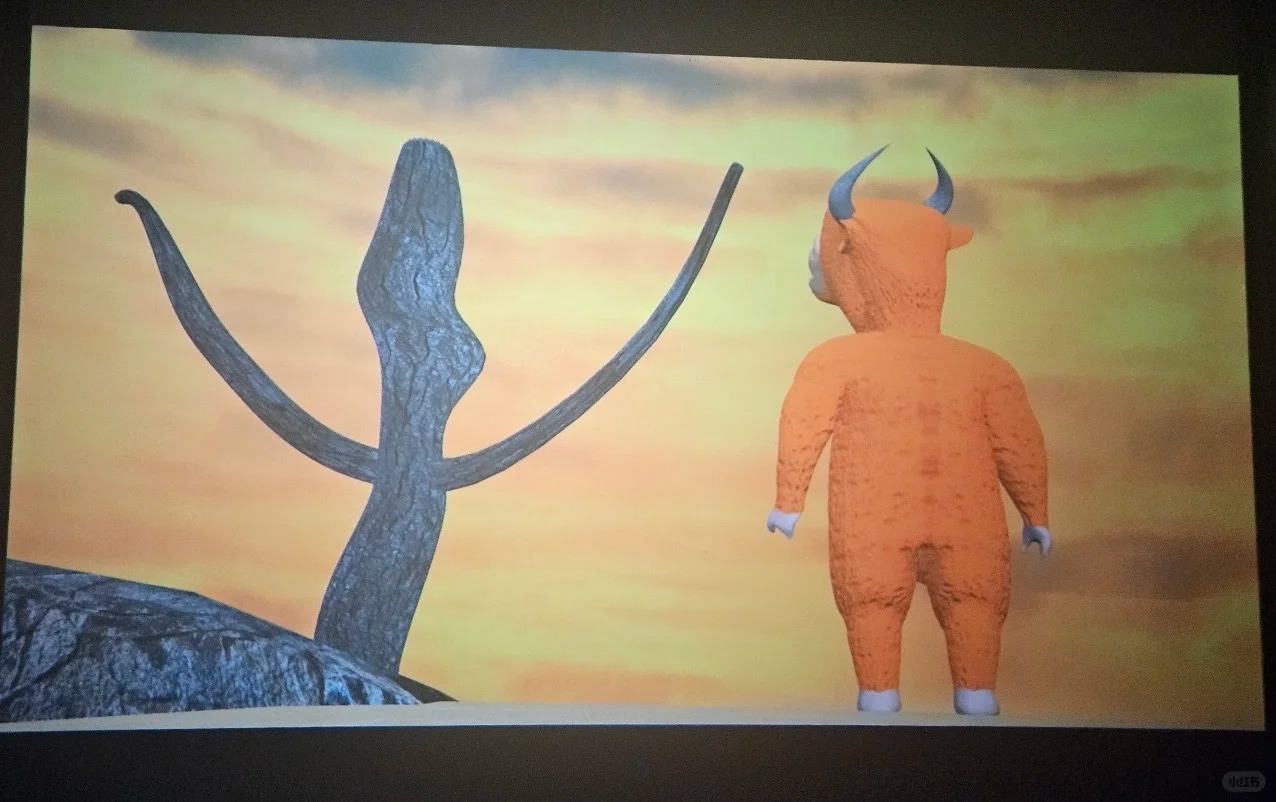
There are definitely parts of the movie that feel less like conventional animation. A lot of it comes from the background shots and the long close-ups of characters’ faces. For example, during some conversations, if you put yourself into the character’s position, you can imagine how long a person would actually need to process what was said, or how long it would take for their facial expression to change. And the movie actually gives them those few seconds. You can interpret the empty shots and some of the background music in a very conventional cinematic way. But the way the cows’ facial expressions change isn’t really how people are used to seeing animated characters express emotions.
The movie also doesn’t really have those moments that make your adrenaline spike. For example, when Baolai suddenly rushes out to stop the black wolf, I expected at least a relatively simple fight scene. Instead, the movie cuts to a large rock and the sound of biting. That’s basically it. There’s no violence.
If you ask me whether it’s a complete story, I’d say yes. The story is complete. It’s actually pretty wholesome, with a little bit of sadness underneath.
I also think it works as a picture-book story.
Maybe it’s the kind of illustrated story that would take dozens of pages, where a mother spends a little time reading it to her child before bed. And maybe that child is under five.
Sitting next to me in the theater was a mother and her daughter. The girl looked around six. As they were leaving, the mother asked her:
“How long did you watch it for…?”
And that’s basically where my thoughts about the movie itself end. What follows is more about the things the movie made me think about.
This isn’t really an argument about the artwork itself—I’m not an art major—and I’m not trying to decide whether this movie “deserves” to be in theaters. I also wouldn’t simply describe it as “terrible.”
Perhaps something can feel poorly made simply because we’re used to seeing things made differently. I kept thinking about it through comparisons with things I’ve seen before.
Take RPGs, for example. There are tons of them, including Genshin Impact—I’m using something everyone knows just to make the comparison easier. A lot of story progression in these games happens through huge amounts of text dialogue. The graphics can be incredibly detailed, but the main characters are often basically expressionless, and the range of their animations is extremely limited. It’s no surprise that many players have been asking for a skip button.
If you follow Chinese donghua, you’ll notice a different problem: everything moves way too fast. A lot of Chinese animation is adapted from novels or games. Compared with the original source material, the characters’ emotional arcs can feel extremely rushed. Side stories get cut, and it can feel like the production team just wants to speedrun the entire story. It’s almost like trying to cram the entire Naruto story into twenty or thirty episodes (You might have watched the whole thing at 2x speed). If you’re already a fan of the original novel or manga, you can probably follow what happened and fill in the emotional gaps yourself. But for a new viewer, the emotional moments can feel incredibly rushed. When you watch a donghua, have you ever actually cried when a character died or two characters were separated? By the end, the characters may have gone through love, loss, separation, and death, but the emotional weight doesn’t always have enough time to sink in. You can imagine how much that helps.
Then I thought about another game: Minecraft. By the time games like Call of Duty 4 and Assassin’s Creed were already showing what single-player games could look like in the West, Minecraft came along with extremely simple graphics and, at least at first glance, barely any conventional gameplay structure. And people loved it. It’s still one of the biggest games in the world.
Or look at some PS1-era games. I have absolutely nothing against synthesized music or old-school graphics. I actually like that aesthetic. But some of those games have story pacing and grinding mechanics that, if released today without modification, would probably have a much harder time attracting new players.
So when I saw all the negative reviews of Niu Lai, I actually came away thinking that it wasn’t nearly as bad as people were saying. If I judge it purely as a children’s picture-book story, I actually kind of like it. When you evaluate a movie, you inevitably need some kind of reference point. You can say this visual style is like Miyazaki, that character modeling looks like Pixar. But Niu Lai doesn’t really have an obvious comparison point, either in the Chinese market or internationally. Or maybe it does have one: it challenges people’s existing habits of what an animated movie is supposed to look like. And if you do that, getting roasted online is probably inevitable.
I deliberately didn’t use the word “aesthetics.” I used the word habits. There’s a common interpretation online that Niu Lai and The Room share this bizarre, almost “cult movie” energy—that if you watch either of them, you must be insane. Some people went to see it precisely because they had already heard about the memes. They went in expecting everything to be hilarious, so whenever one of those meme moments appeared, they laughed.
Once a label sticks, it’s really hard to remove. People who genuinely dislike the movie obviously aren’t going to see it.
But think about it this way: When you see a Hitler meme, do you instinctively think, wow, Downfall, this might actually be a great movie?
I didn’t watch Niulai because I wanted to see some weird internet spectacle. Nor did I go because of the later narratives about “Mom encouraging the creator” or “hand-making this thing for years.” I simply wanted to see what was actually on the screen.


Leave a Reply